








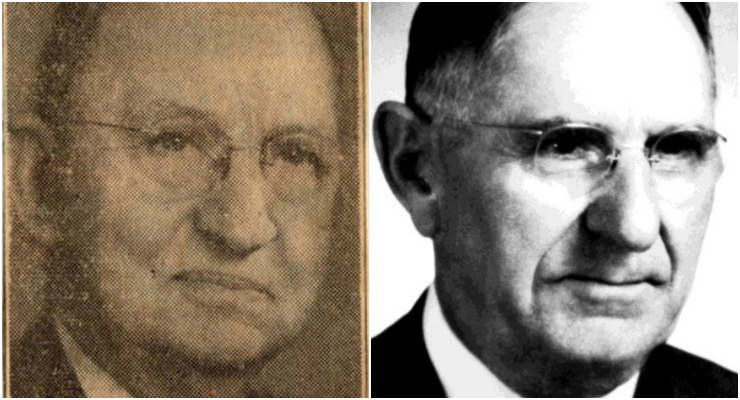
The 8-0 vote directs staff to reduce the size of Stewart’s portrait and add a written statement within the same frame on the City Hall wall of former mayors, rather than take it down.
On a friendly amendment from Councilmember Jason Lyon, the council also directed staff to return at a future meeting with a discussion of the Arthur Noble Award presented to Herbert Hahn — with members signaling clear support for rescinding it — and to confirm whether any of the other directors of the segregation-era Pasadena Improvement Association received city honors.
The item, requested by Councilmembers Tyron Hampton and Justin Jones and listed on the agenda as a discussion of “former Pasadena Chairman/Director A.I. Stewart,” went well beyond a single portrait.
Councilmembers and speakers described Stewart as a central architect of housing segregation in Pasadena — not merely a mayor with offensive views.
Stewart’s portrait hangs on the City Hall wall of former mayors, and city records surfaced during the meeting show he was also recognized as acting city manager in 1941, Mayor Victor M. Gordo said. Gordo said Stewart additionally served as a state assemblyman representing the area.
The 1941 minutes were not part of the staff package; the city clerk said they turned up while searching old records for Stewart’s correct titles.
According to Lyon, Stewart — then a city director — joined about a dozen civic leaders in 1939 to form the Pasadena Improvement Association, whose founders included a bank president, a past president of the law firm for which Lyon currently works, Hahn & Hahn, and the heads of the chamber of commerce, the realtors’ board, the Lions and the Pasadena Rotary.
The association existed to urge white homeowners to attach racially restrictive covenants to their properties, Lyon said, and was “incredibly successful” until 1944, when he said the California Supreme Court struck the covenants down.
Jasmine Schupper, who helped present the restorative justice elements the council adopted earlier in the meeting, told the council that at one point 60% of Pasadena homes carried such covenants.
Herbert Hahn, the son of the Hahn & Hahn founder, worked with Stewart to deny home purchases, Gordo said, and later received the Arthur Noble Award, presented sometime in the 1960s, according to Lyon. Lyon counted 25 directors listed on the association’s letterhead.
A record the staff package left out
Much of the underlying research documentation was missing from Monday’s materials. The Human Relations Commission studied the matter years earlier and returned two recommendations — remove Stewart’s photo and rescind Hahn’s award — but the council never acted, Lyon said.
The commission sent its letter a second time about a year later, and Lyon said that follow-up letter still is not in the council record. He asked that it be added.
“It’s a shame that their hard work and their work product wasn’t a part of this discussion,” Vice Mayor Jess Rivas said of the commission.
Keep it, shrink it, or take the whole wall down
Councilmembers split over what to do with the portrait itself. Rivas and Councilmember Gene Masuda favored keeping it as honest history. Rivas said she was “slightly inclined to keep it,” with education as the priority; Masuda said he arrived opposed to removing any portrait but supported the motion’s footnote-and-statement approach.
Councilmember Steve Madison floated removing the entire mayoral wall, saying that for a woman or a person of color “there’s not much for you to see there,” and likened the dilemma to monuments honoring George Washington despite his ownership of slaves.
Gordo offered a third path: leave Stewart’s portrait — which he noted is a caricature, not a photograph like every mayor before and after — and mount the image of a Pasadenan who fought segregation on top of it, doing the same with a plaque over Hahn’s name on the award. He speculated the caricature either marked a decision that Stewart should not share equal standing or replaced a vandalized portrait, and asked the clerk to research its history. Hampton rejected placing anything on top of the portrait; his motion instead shrinks it and adds a statement in the same frame.
The portrait drew the council’s caution; the award did not. Members across the dais called rescinding Hahn’s honor the easy call.
“The city gives the honor and we can take it away,” Lyon said, crediting the point to Hampton. Jones, who pressed for the rescission, said the gestures could not undo the economic damage: “Herbert Hahn has a law firm. A.I. Stewart has forever gone down as the mayor of Pasadena, and there’s families who are still suffering.”
New honorees, and a wider review
Hampton and Jones proposed reviving the Noble Award and redirecting it to Pasadenans excluded in their own time — among them Edna Griffin, who as NAACP president sued the city over its segregated Plunge pool, and Ruby McKnight Williams.
Councilmember Rick Cole, who said he revived the lapsed award during his own time as mayor, traced its history: endowed by philanthropist Arthur Noble, given yearly until it petered out around 1977, then handed four years later to Cornelius Pings — an architect, Cole said, of the city’s “equally racist” redevelopment — before lapsing again.
Jones said he would explore renaming Brenner Park, also long known as Manzanita Park, for Griffin and awarding her the honor posthumously. Madison noted the park’s namesake, a former board member named Brenner, had pushed to move interned Japanese Americans away from West Pasadena.
Gordo pointed to real estate agents William and John Carr, who founded Friends of the American Way to break covenants and, he said, paid the mortgages of interned Japanese American families to keep their homes.
Lyon noted a counter-history already on the same wall: Loretta Thompson Glickman, who he said reflects the city’s evolution. He also pointed to a detailed Pasadena Unified School District curriculum, housed at the Pasadena Foothill Association of Realtors, that traces the association and the redlining that followed.
Cole framed the local action against a national fight, saying the president “is actively seeking to rewrite the history of our country” and citing a federal judge’s order halting an executive effort to strip material from historic sites.
“This is about truth and justice and making a real difference in our society,” Cole said.
Gordo asked colleagues and residents to send the city clerk a list of other episodes warranting recognition or apology, to be brought back for council action or referred to a commission. Madison asked that the review also cover the city’s parks and monuments. Action on the Hahn award and the broader review returns to the council at a future meeting.
 Get our daily Pasadena newspaper in your email box. Free.
Get all the latest Pasadena news, more than 10 fresh stories daily, 7 days a week at 7 a.m.