






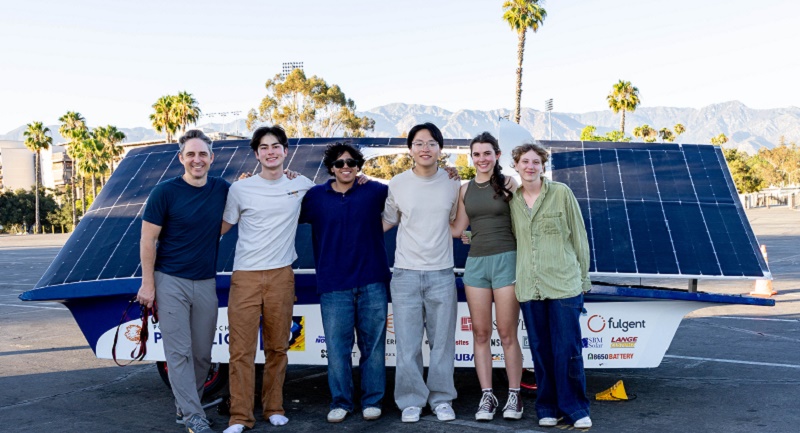
Left to right: Jeff Keltner, Ryan Keltner, Arjun Singh, Evan Chen, Caroline Perez-Fraga, and Georgie Collister.


A solar-powered car built by students at Pasadena’s Polytechnic School is in Texas this week for a 631.7-mile race across the state, the school’s third year in the competition and a year the contest runs on open highways rather than a closed track. A week earlier, closer to home, the students had run it up a hill above the Rose Bowl, where, their adviser said, it climbed the grade at 27 miles an hour — above the 20 the race requires.
The car, named Perihelion, is the work of Polytechnic’s student-led solar car team, part of the school’s Engineering Club. Because the 2026 Solar Car Challenge is a cross-country road race rather than a closed-track event, the students say they had to adapt the vehicle for hills and road obstacles it never encountered on a flat course.
The Solar Car Challenge, a nonprofit education program founded in 1993 by Dr. Lehman Marks, says it has engaged more than 85,000 students across 39 states since its start. According to the event, Polytechnic is one of 24 high school teams entered this year. The race begins July 19 in Fort Worth and ends July 23 in Fort Stockton, with public showcase stops in Palestine, Round Rock, Fredericksburg and San Angelo.
The team describes Perihelion as a roughly 750-pound car about 16 feet long, its body holding 468 solar cells that feed a 5.1-kilowatt-hour battery. To keep it light, Chen said, the students used bike suspension forks and go-kart brakes; the body is shaped like a catamaran, with an underbody wind tunnel meant to smooth airflow.
The road format drove this year’s hardest engineering work. “We needed to adapt a car suspension for the ride height so that it wouldn’t scrape as we traversed highway ramps,” said Jamie Hsieh, a co-captain, describing a custom part the team machined to fit mountain-bike forks to its wheels. Chen said the fixes came slowly. “We would get one part, have it start working, it’s like moving together. And then we realized, oh, something else is wrong and broken because of this new part,” he said.
The Rose Bowl gave them a place to try it on real pavement. The team ran the loop, which includes a hill of about 5% grade, and set up a slalom course in the parking lots to practice quick turns, Chen said. Jeff Keltner, the team’s lead adviser and a Poly parent, said the hill was the test everyone watched. “I think everybody was holding their breath to see if the car would make it up the hill,” he said, with students in a trailing car reading how many watts the motor pulled. Under race rules Keltner described, a car that cannot hold 20 mph must pull over and be trailered until the road allows it to keep pace.
Keltner said the project is the students’ own. “It is really their project more than mine and I’m there to kind of facilitate and ensure it’s safe more than to direct them,” he said. The school provides insurance, fundraising support and logistics, he said, but the building is volunteer- and student-driven. Before the race, teams face three days of scrutineering, July 16 to 18 — a review across six stations, Keltner said, covering mechanical and electrical systems and safety tests for braking, slalom handling and stability.
The team last year finished second in the Advanced Division and received the 2025 Jarrett Dunn Award, according to the fact sheet the school provided. Chen said the team also set a track record last year for the most laps completed in a day, a claim not independently verified. Ten students traveled to Texas this year out of a team of about 20, he said, with underclassmen expected to carry the project forward.
For Chen and Hsieh, both 18 and headed to Washington University in St. Louis and Columbia University this fall, the race is a last turn with a team they will hand off. “Nothing rarely works the first time you do it,” Hsieh said. “It’s always good to find your problems early.”
 Get our daily Pasadena newspaper in your email box. Free.
Get all the latest Pasadena news, more than 10 fresh stories daily, 7 days a week at 7 a.m.