














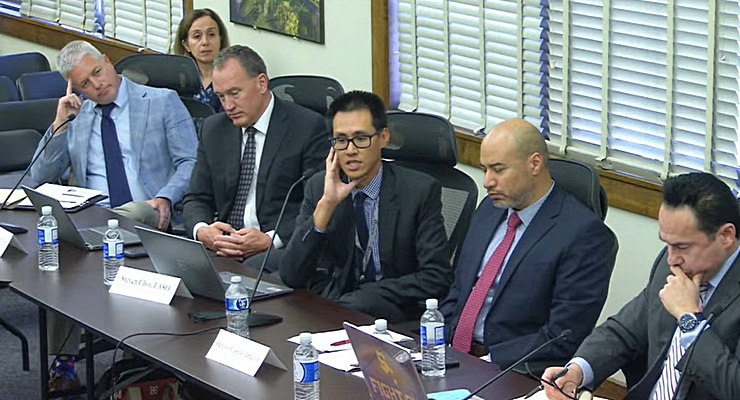
The stark pronouncements delivered by Los Angeles County Office of Education officials marked real-time clarifications of the current fiscal crisis. The district now faces the possibility of state intervention that could strip the superintendent and seven-member elected board of decision-making authority.
“The decisions made in the upcoming months will define Pasadena Unified School District’s future,” Octavio Castelo, director of business advisory services for LACOE, told board members during a presentation that laid out the district’s precarious financial position. Castelo is responsible for the fiscal oversight and monitoring of all 80 school districts in LA County.
LACOE earlier conditionally approved the district’s 2025-26 budget in June, citing “serious warning signals” including deficit spending that began in the 2023-24 school year and has widened sharply since. County officials said they are now reviewing a response submitted Oct. 6 to determine whether to lift that conditional status.
But the critical test comes Dec. 15, when the district must submit its first interim financial report. If county officials determine Pasadena cannot meet its obligations, they could label it a “lack of going concern” — triggering a series of escalating interventions that could ultimately result in a state-appointed trustee taking full control.
“If you draw a loan, if it’s an immediate cash insolvency issue and we monitor your cash daily … immediately the superintendent loses her job,” Castelo said. “Once that loan is drawn, the board has no authority.”
FOUR LEVELS OF INTERVENTION
County officials outlined four potential levels of intervention, each more restrictive than the last:
The least severe would place a “fiscal expert” in the district to work with staff. If problems persist, that expert could be elevated to a “fiscal advisor” with full authority to override board decisions. In cases of immediate cash insolvency requiring a state loan, a trustee would assume complete control.
Inglewood Unified School District, cited repeatedly during the meeting as a cautionary tale, has operated under county administration for more than 13 years — a fact that seemed to shake some board members.
“Those are good people,” board member Tina Fredericks said of Inglewood’s elected officials. “And even with good people that work really hard, it’s still very hard to get out of that status.”
Student board member Lucas Kittle asked whether districts in receivership could ever regain autonomy. Castelo confirmed they could, but called the process “very extensive” and “arduous,” requiring the state’s Fiscal Crisis Management Assistance Team to assess everything from governance to human resources to facility management.
WILDFIRE REVENUES MASKED CRISIS
The presentation revealed that temporary insurance proceeds from recent wildfires, along with earlier federal COVID relief funds, masked the district’s true structural deficit — ongoing imbalances between recurring revenues and expenditures.
“The biggest concern was that we were unable to determine how much of it was fully implemented and how much was masked by the wildfire revenues at that point of time,” said Steven Choi, a financial advisory services officer who has worked with Pasadena for several years.
David Hart, LACOE’s chief financial officer, emphasized the severity by attending the meeting personally — reportedly an unusual step that underscored county concerns.
“I am here in support,” Hart said. “I would not be here if we weren’t trying to convey that the clock is ticking. We appreciate the challenges, very unique challenges that Pasadena is facing, but it’s going to be tough for you if not impossible to revenue your way out of the problem.”
DECLINING ENROLLMENT, RISING COSTS
County officials identified several key fiscal pressures driving the crisis:
— Declining enrollment and average daily attendance, which directly reduces state funding
— The expiration of federal COVID-19 relief dollars
— Special education costs that have increased contributions to the general fund by more than $50 million
— Economic impacts from the wildfires affecting property taxes and attendance
The district’s fiscal stabilization plan identifies $83.1 million in combined reductions and revenue enhancements needed between fiscal years 2025-26 and 2027-28. County officials said these cuts must be implemented “with urgency and accountability.”
Officials said that by March 2026, the district must issue reduction-in-force notices to align staffing with budget realities. Castelo discussed retirement incentives as one potential strategy, noting from his experience as a fiscal advisor at another district: “We were able to stave that off because we issued a retirement incentive.”
LAWSUIT CLAIMS STRAIN BUDGETS
Board member Patrice Marshall McKenzie raised concerns about AB 218 claims — sexual assault and molestation cases with extended statutes of limitation — that are affecting school district budgets statewide.
“There are many school districts that are struggling financially right now, not necessarily because of the fire, but because of AB two 18 claims that are exacerbating district’s budgets,” McKenzie said, noting the difficulty of defending decades-old cases when alleged perpetrators are often deceased.
Castelo acknowledged the problem affects multiple districts and said county officials are advocating for legislative caps on such claims.
“Mr. Kittle and everybody else should not have to pay the price” for incidents from 30 years ago, Castelo said, referring to student board member Kittle. “We’re advocating strongly for that.”
However, Hart cautioned that legislative relief is unlikely to come quickly, saying any reform to judgment and settlement structures “is typically even slower to come about.”
UNION CRITICIZES OVERSIGHT
Jonathan Gardner, president of United Teachers of Pasadena, was passionate in public comments before the presentation.
“Can you not see that PUSD is overspending compared to its peers in contracted services and in central office expenses? Can you not see that?” Gardner said. “How dare you come in here and pretend to provide oversight and instead give further cover to the bloated central office admin and outside contractors that PUSD is wasting its funding and grants on as opposed to ensuring students receive a proper caring, supportive learning experience.”
Gardner argued the district should target cuts to administrative contracts rather than teaching positions.
BOARD SEEKS CLARITY
Board members pressed county officials for specifics about what would satisfy their concerns, with several noting that budget projections presented at the meeting were from June and did not reflect more recent developments, including additional state funding and higher-than-expected fire insurance proceeds.
Board member Kimberly Kinney requested updated multi-year projections before the December deadline to provide a clearer picture of the district’s actual financial position.
Kinney also raised concerns about the district’s approach to budget cuts, saying the district needs to fundamentally redesign operations rather than make incremental reductions across the board.
Fredericks asked county officials about optimal facility utilization rates for declining enrollment districts and whether school consolidations might be necessary. Castelo and Hart declined to provide specific percentage targets, saying the answer depends on multiple factors including grade levels, programs offered and whether enrollment is trending up or down.
Board member Michelle Richardson Bailey questioned why county intervention waited until the crisis reached critical levels rather than providing earlier, more proactive support, asking officials about the availability of training and technical assistance for board members trying to understand complex budget documents.
Castelo acknowledged that county communications about fiscal concerns have been sent to board presidents for several years, though he said the wildfire and COVID relief funds complicated the picture.
“It hasn’t been a zero to 60,” Castelo said.
LEADERSHIP VACANCY RAISES CONCERNS
The district is currently operating without a permanent chief business officer — a situation that county officials identified as a significant concern.
“To us is a concern,” Castelo said when asked about the vacancy. “Anytime of vacancy is and your chief financial officer or even the director of budgets or fiscal services, it’s a concern to us.”
Superintendent Dr. Elizabeth Blanco said the position’s responsibilities have been divided among three chiefs with relevant experience, and county officials confirmed they are in regular communication with district staff as the December deadline approaches.
 Get our daily Pasadena newspaper in your email box. Free.
Get all the latest Pasadena news, more than 10 fresh stories daily, 7 days a week at 7 a.m.


