





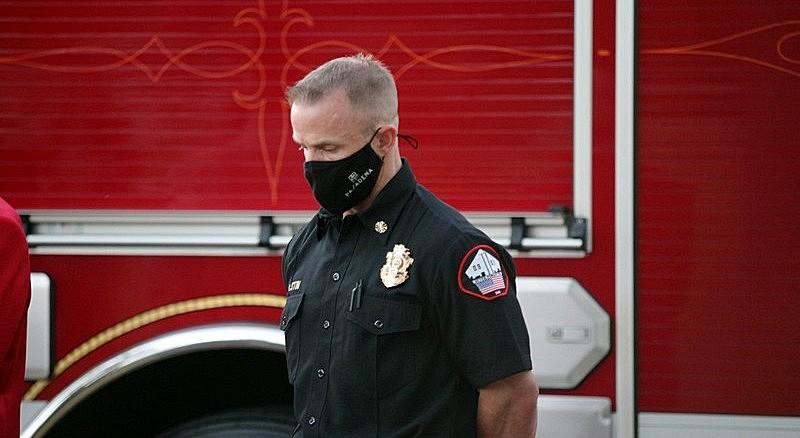
The ceremony will “honor and remember the lives lost on September 11, 2001, and recognize the courage, sacrifice, and service of those who responded that day,” the City of Pasadena said in its announcement of the event. The announcement invites the public to “come together as a community to remember, honor, and never forget.”
The city had not released a program or a list of speakers as of Thursday.
For Mayor Victor Gordo, who had been elected to represent District 5 on the Pasadena City Council six months before the attacks, the first decision that fateful morning was how to assess the danger to Pasadena itself.
Gordo said in an interview this week that he was at home preparing to go to work when “one of my neighbors came knocking on my door and said to me, ‘Turn on your television.'”
He turned it on to see that what appeared to be an airplane had hit the first of the World Trade Center’s twin towers, which at that moment “seemed like a horrible accident,” he said. He was still watching when the second plane hit.
“I remember standing there in shock and awe that something like that had occurred, and it became clear that this was an intentional act,” Gordo said.
“Immediately, I started to receive calls from city staff, colleagues, and the discussion was what shall we do to protect our city in the event this is more widespread?” he said.
His first decision as a councilmember, Gordo said, was to ask the city manager, police chief and fire chief at the time to brief him and his council colleagues on whether Pasadena and particular locations in the city were in danger and on what was being done to protect the city and its residents, and to make sure the city was in communication with regional, state and national authorities.
The concern, he said, was that Pasadena has a high profile and “iconic buildings that are recognized around the world, such as the Rose Bowl.”
“It really seemed surreal that the United States of America was under a concerted attack,” Gordo said. “I don’t think ever before had I ever, or even we as a society ever contemplated that the United States might be susceptible to a direct attack on American soil.”
What changed permanently was harder to see that week, Gordo said. The attacks, he said, set off a national debate over America’s role in the world that grew heated and emotional in the years that followed and caused “tremendous division that I think we still see in our society, well, in our country today.” He called 9/11 “one of those flashpoints for our generation,” comparing its effect to the one Vietnam had on other generations.
“But I think 9/11 was even on a grander scale,” he said.
“If I could fix anything, it would be the fallout of 9/11,” Gordo said, describing the public discourse that followed the attacks as heated and divisive. “It’s hurt us as a people.”
Nearly 3,000 people were killed on Sept. 11, 2001, when hijackers crashed airliners into the World Trade Center in New York and the Pentagon in Arlington, Va., and a fourth hijacked plane, Flight 93, crashed near Shanksville, Pa., after passengers fought back. Among the dead were 343 New York City firefighters.
“What we learned on 9/11, 2001, when we were attacked, is that we are stronger together,” Gordo said. “That feeling of pain, but also the feeling of hope and patriotism and understanding that we are in fact stronger together is what we need to get back to.”
On Saturday, first responders and their families are scheduled to gather at the Rose Bowl for an on-field flag ceremony honoring those who responded to the Sept. 11 attacks, held before UCLA’s 4:15 p.m. home football game against San Diego State.
Pasadena City Hall is at 100 N. Garfield Ave. The city is encouraging people to use public transit; transit information and a trip planner are available at: https://www.cityofpasadena.
 Get our daily Pasadena newspaper in your email box. Free.
Get all the latest Pasadena news, more than 10 fresh stories daily, 7 days a week at 7 a.m.