







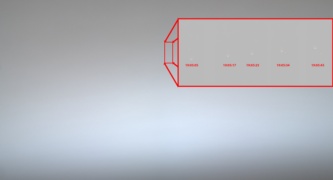

NASA’s Perseverance rover, built and operated by the Jet Propulsion Laboratory, which Pasadena-based Caltech manages for NASA, has recorded the first observation from the surface of another planet of Earth disappearing behind another celestial object, NASA said in an Aug. 5 release.
The images show Earth as a small point of light briefly vanishing behind Phobos, the larger of Mars’ two moons, in the evening sky above Jezero Crater.
Perseverance’s Mastcam-Z camera system captured the sequence at about 7:00 p.m. local solar time on July 2, the 1,907th Martian day, or sol, of the rover’s mission.
In the composite released by NASA, Earth moves from the upper left toward the lower right as Phobos travels in the opposite direction, from the lower left toward the upper right. The two objects cross paths in the third frame, when Earth disappears behind the moon’s darkened edge.
“This is the first time humanity has captured from the surface of another planet an observation of Earth disappearing behind an object,” NASA said in the release.
Justin Maki, Mastcam-Z deputy principal investigator and an imaging scientist for Perseverance at JPL, described the sequence as an unusual view of humanity’s home planet.
“The composite image makes for a unique Earth self-portrait, taken from the surface of another planet, with a Phobos photobomb,” Maki said.
The apparent encounter resulted from the alignment of two objects that were separated by a vast distance.
Phobos is an irregularly shaped moon measuring about 17 miles, or 27 kilometers, across at its widest point. It orbits about 4,850 miles, or 7,800 kilometers, from Mars.
Because it is so close to the Martian surface, Phobos appeared in the images to be approximately one-third the apparent width of Earth’s Moon as viewed from Earth.
Earth, meanwhile, was about 195 million miles, or 314 million kilometers, from Mars when the images were taken. At that distance, the planet appeared as a single, pixel-size point of light.
Mark Lemmon, a Mastcam-Z co-investigator at the Space Science Institute in Boulder, Colorado, planned the observation and assembled the composite.
Phobos crosses the Martian sky three times each day, while Earth can remain visible from Mars for months at a time, Lemmon said. Aligning the rover, Earth and the rapidly moving moon, however, required advance planning.
Catching Earth directly behind Phobos “takes planning and a little luck,” Lemmon said.
Astronomers classify the event as an occultation, which occurs when an object that appears larger from the observer’s viewpoint completely blocks an object behind it.
An occultation differs from an eclipse, which occurs when one object moves into another object’s shadow. A lunar eclipse, for example, occurs when the Moon moves through Earth’s shadow.
A transit occurs when an apparently smaller object moves across the face of a larger one. Perseverance has previously observed transits of both Phobos and Mars’ smaller moon, Deimos, across the face of the Sun. Such events are sometimes informally described as Martian solar eclipses.
The latest observation involved several institutions with separate responsibilities for the rover and its camera system.
JPL built Perseverance and manages the rover’s operations for NASA’s Science Mission Directorate in Washington as part of the agency’s Mars Exploration Program.
Arizona State University leads operations of Mastcam-Z. The university worked with Malin Space Science Systems in San Diego on the camera system’s design, fabrication, testing and operation.
The Space Science Institute contributed to the observation through Lemmon’s work planning the imaging sequence and assembling the resulting composite.
 Get our daily Pasadena newspaper in your email box. Free.
Get all the latest Pasadena news, more than 10 fresh stories daily, 7 days a week at 7 a.m.