








The PCC team built a custom LED dress that illuminates in real time based on the wearer’s brainwave activity, translating neural signals into visible, interactive light patterns, according to the American Association of Community Colleges. The project bridges neuroscience and design, with applications that range from STEM classrooms to museum installations and performance spaces, according to the AACC press release announcing the finalists on April 28.
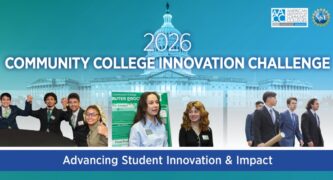
The team will travel to Washington, D.C., next month for a four-day Innovation Boot Camp from June 8 to 11, where they will receive coaching in entrepreneurial thinking and strategic communication before presenting their work at a poster session on Capitol Hill and competing in a pitch presentation for cash awards. The competition, now in its 10th year, is run by AACC in partnership with the National Science Foundation. The CCIC was created in 2015 to strengthen entrepreneurial thinking among community college students by challenging them to develop STEM-based solutions to real-world problems, according to AACC.
Their mentor is Jared Ashcroft, a chemistry professor at PCC and the principal investigator of the Micro Nano Technology Education Center, a national NSF-funded center based at the college. Ashcroft, who earned his doctorate in chemistry from Rice University and conducted research at Lawrence Berkeley National Laboratory, is no stranger to the competition: In 2021, a PCC team he mentored won first place at the CCIC for a project that used nanoparticle technology to target cancer cells.
“In solving real-world problems that impact our communities, these teams of students are advancing their talent, skills and creativity,” DeRionne Pollard, president and CEO of AACC, said in the announcement. Pollard, the first woman to lead the 105-year-old organization, took the helm in 2025. “AACC is proud to partner with the National Science Foundation to celebrate their achievements and to support the entrepreneurs, innovators, and STEM leaders emerging from our nation’s community colleges.”
The 12 finalist teams were selected from community colleges across the country after a submission window that closed April 3, according to the competition’s rules. Each team includes two to four students and a faculty or administrator mentor. Other finalists this year proposed solutions for food insecurity, search and rescue, road safety, energy efficiency, safe drinking water, senior protection, and power grid security, according to AACC.
At the Boot Camp, teams interact with entrepreneurs and experts in business planning, stakeholder engagement, and marketplace dynamics. The event concludes with a pitch presentation before a panel of judges to determine first, second, and third-place winners. Finalist teams receive full travel support, with airfare and hotel costs billed directly to AACC, according to the competition’s rules. In past years, cash awards have been distributed to the top three teams $3,000 per team member for first place, $2,000 for second, and $1,000 for third, with a $500 honorarium for each finalist, according to AACC. Finalist teams are also required to participate in two orientation webinars and conduct three to five customer discovery interviews before arriving in Washington, according to the competition’s rules.
Ashcroft’s 2021 team — four PCC students who developed “NanoBio mAB: A Nanoparticle-Antibody Cancer Therapeutic” — won the top prize at that year’s virtual boot camp, according to the NSF. For one of those students, Sophia Ibargüen, the experience proved career-shaping: She said the pitch skills she honed at the competition helped her land a research position at a four-year university.
“If I see an opportunity that looks like I can impact students, I want to do it and figure out a way to support it,” Ashcroft said in a separate interview about his approach to securing research opportunities for community college students.
MNT-EC, the national center Ashcroft leads from PCC in collaboration with Edmonds College, Portland Community College, and the University of North Texas, coordinates micro- and nanotechnology education programs at community colleges and is funded through the NSF’s Advanced Technological Education program. The center has placed PCC students in research internships at the California Institute of Technology and Keck Medicine at the University of Southern California, according to ATE Impacts.
The Innovation Boot Camp runs June 8 to 11 in Washington, D.C. Updates on the competition and winners can be found at www.aaccinnovationchallenge.com.
Five years after PCC’s first CCIC team brought home a trophy for fighting cancer with nanoparticles, a new group of Lancers is headed to the same stage this time with a dress that reads your mind.
 Get our daily Pasadena newspaper in your email box. Free.
Get all the latest Pasadena news, more than 10 fresh stories daily, 7 days a week at 7 a.m.


