








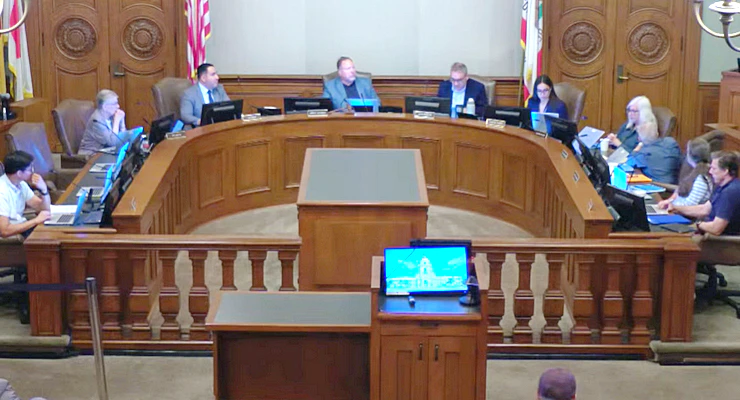
At a July 8 study session, commissioners and residents raised alarms over power and water demands and questioned an Amazon-linked property near Eaton Wash
A single 10-megawatt data center would consume as much electricity as 8,000 Pasadena households in a year and drink roughly 40 acre-feet of water, city planning staff told the Pasadena Planning Commission on Wednesday, July 8 — figures that, alongside a public commenter’s account of an Amazon-owned parcel near Eaton Wash, highlighted a study session on data centers that the city’s zoning code does not yet even define.
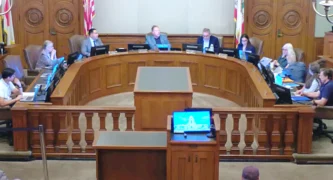
The commission took no vote. The data-center item was a study session — informational only, with no decision scheduled. Commissioners offered feedback, and Chair Lambert Giessinger asked staff to return with something concrete.
“Bring us a draft of something that we can respond to,” he said.
The direction, such as it was, is narrow: begin by writing a land-use definition. Data centers do not appear anywhere in Pasadena’s zoning code, and the use is therefore not currently permitted. Staff was already developing a draft definition, and the underlying instruction to do so traces to two City Council committees — the Municipal Services Committee on March 10, 2026, and the Housing, Homelessness and Planning Committee on April 1, 2026 — not to any Planning Commission action on July 8.
Principal Planner Martin Potter said the 10-megawatt example, drawn from the smaller end of the multi-tenant tier of data centers, would consume roughly 78,000 to 79,000 megawatt-hours of electricity a year — the equivalent of about 8,000 households in a city of some 57,000 homes, or about 14% of residential usage — and about 40 acre-feet of water, comparable to 120 households and used primarily for cooling. Larger “hyperscale” centers, staff said, can run 100 to 300 megawatts.
The draft definition staff is testing would classify a “general” data center as any facility of one megawatt or more, using more than 50 gallons of water per minute on an annualized basis, or sitting on one acre or more.
Commissioner Michael Albrecht pressed a Pasadena Water and Power engineer on that water threshold — whether any existing entity in the city currently uses that much on an annualized basis. The engineer could not confirm one; he suggested Brookside golf course as a possible comparable, while noting it may have shifted partly to reclaimed water, and Chair Giessinger raised Huntington Hospital as another candidate the engineer said he would need to check.
“That water usage just about blows my mind,” Albrecht said, calling on an old line about the American West: “Whiskey’s for drinking and water for fighting over.”
Staff will return to the Housing, Homelessness and Planning Committee for an update before bringing a formal recommendation back to the Planning Commission, which would then advise the City Council on any zoning code amendment.
 Get our daily Pasadena newspaper in your email box. Free.
Get all the latest Pasadena news, more than 10 fresh stories daily, 7 days a week at 7 a.m.