










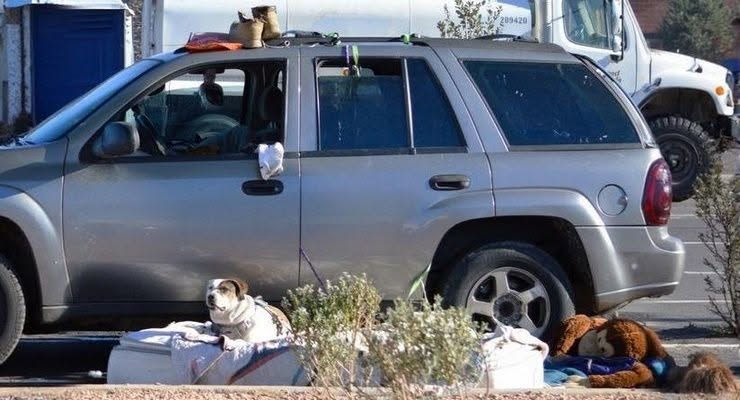
The Planning Commission began what is expected to be a lengthy discussion Wednesday over whether the city should expand where safe parking programs are allowed, examining potential changes that could make city-owned properties eligible while adding new operational standards addressing security and the concentration of homeless services.
The discussion came during a study session, with commissioners taking no action but providing feedback to staff, who will return with proposed amendments to the city’s zoning code.
Pasadena adopted its safe parking ordinance in 2023 as part of its Housing Element implementation, allowing overnight parking programs through a Minor Conditional Use Permit (MCUP) at qualifying religious institutions, certain college campuses and transit-related sites.
Since then, only two permits have been approved: one operating program at Trinity Lutheran Church and another approved at All Saints Church that has yet to begin operations.
Planning staff outlined several possible revisions, including expanding eligibility to selected city-owned properties such as parking garages, libraries, parks, Rose Palace, city yards and other public facilities. Staff also suggested the commission consider requiring secured entry and exit points, residential buffers and standards addressing the over-concentration of safe parking and similar homeless-service uses.
“The direction we were given was really almost kind of twofold,” Acting Assistant City Manager Jennifer Paige said. “One was let’s look to see if there’s additional sites that it can be located in so we can not have it just in one part of the city. But then at the same time, the conversation was… we need to make sure that the operational standards and conditions are in place to make sure that it’s not impacting other properties.”
City staff said Pasadena currently has about 81 eligible religious and institutional properties under the existing ordinance, but approximately 182 city-owned properties that could potentially be evaluated if zoning regulations were changed. Many of those sites, however, are occupied by infrastructure or public facilities that would not be suitable for safe parking.
Much of the commission’s discussion centered on determining the appropriate size of safe parking programs, defining what constitutes an over-concentration of homeless services and understanding why relatively few organizations have sought permits despite what operators describe as significant demand.
Commissioner Juliana Delgado questioned whether the city should first determine the ideal scale of a safe parking operation before expanding the list of eligible properties.
“I’m wondering… what the optimal size would be, the most efficient economically and just operationally,” Delgado said, asking staff to consult operators before rewriting the ordinance.
Commissioner Carol Hernandez said understanding the city’s actual need should guide future policy decisions.
“I think sometimes that might help in how you design a program,” Hernandez said. “If we know what the demand is, then you could design a program to meet that need.”
Supporters of expanding safe parking argued the Trinity Lutheran program demonstrates the model can operate successfully with little neighborhood disruption.
Bert Newton, who said he helped establish the Trinity Lutheran program and meets regularly with its operators, told commissioners the site has permanently housed more than 20 participants.
“Safe parkers are relatively high functioning when it comes to the total population of unhoused people,” Newton said. “They don’t need a fence or gates or buffers from the surrounding residential neighborhood.”
Others urged the city to authorize additional sites on publicly owned land, noting that hundreds of people remain unsheltered.
Longtime homeless advocate Sonja Berndt called on commissioners to move quickly.
“We continue to have over 300 unsheltered folks sleeping on the street,” Berndt said. “Please direct staff to return to the commission on an urgent basis with findings and a formal recommendation allowing safe parking on city-owned property.”
Not all speakers supported expanding the program without additional safeguards.
Madison Heights resident Erika Foy cautioned against clustering additional homeless services in the Raymond-Fillmore corridor, where the city is also considering a year-round shelter at Rose Palace and where Union Station Homeless Services already operates facilities nearby.
“If safe parking, shelters, interim housing, supportive housing and other homeless-serving uses are allowed to cluster in the same area, the impacts are no longer isolated,” Foy said. “They become cumulative.”
Foy urged commissioners to require buffers from sensitive uses and carefully evaluate public safety, sanitation and neighborhood impacts before expanding the ordinance.
The commission also heard from speakers who pointed to Santa Barbara’s long-running safe parking program as a successful model.
James Maddox urged Pasadena officials to review a safe parking operations manual developed there, arguing the city should learn from existing programs rather than reinventing them.
“It’s not rocket science,” Maddox told commissioners. “You’re going out and recreating the wheel and there are already programs in place.”
No vote was taken. Staff will incorporate the commission’s feedback into draft zoning code amendments that will return to the Planning Commission before being forwarded to the City Council for consideration.
 Get our daily Pasadena newspaper in your email box. Free.
Get all the latest Pasadena news, more than 10 fresh stories daily, 7 days a week at 7 a.m.


