







The gap is the point.
The Condor Squadron’s Missing Man Formation, flown in restored World War II–era North American AT-6 Texan trainers, has become one of the most recognizable elements of Pasadena’s annual Memorial Day commemoration — an aerial tribute to the 320 men and women from the city who died in combat from World War I through the War on Terror.
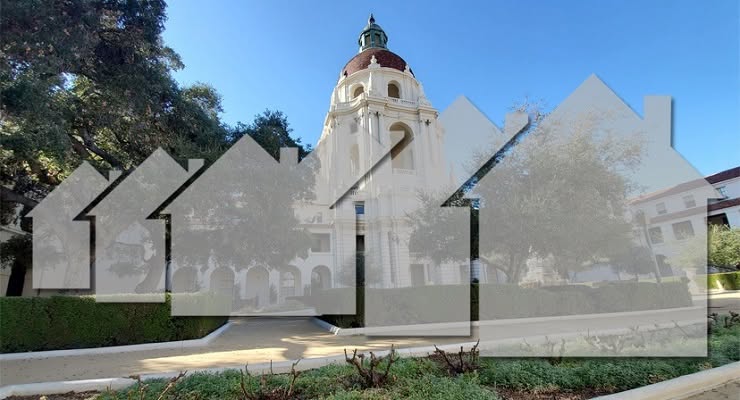
The squadron’s volunteer pilots have repeated the maneuver over Pasadena City Hall on Veterans Day, over the Rose Bowl on the Fourth of July, and at memorials and funerals across Southern California for more than six decades.
The squadron that makes that flyover possible is itself a study in endurance and loss.
The Condor Squadron Officer’s and Airmen’s Association is a nonprofit based at Van Nuys Airport, where its fleet of AT-6 Texans sits on the tarmac beside camouflage-painted buildings and walls hung with wartime memorabilia.
The group traces its origins to 1962, when several members of the 146th Fighter Group formed the squadron as a search-and-rescue unit of the Civil Air Patrol, according to the organization’s official history.
Its founders were World War II veterans: Richard T. “Dick” Sykes, an attorney who flew 50 combat missions over Europe in a Lockheed P-38 Lightning, and Walter Morrison, who flew Curtiss P-40 Warhawks in North Africa.
“We proudly fly WWII, North American AT-6 airplanes in formation over parades, memorial services and events commemorating veterans,” the squadron says on its website.
Its formal mission statement is succinct: “To Honor Military Aviation through Flight, Exhibition, and Remembrance.”
The AT-6 Texan was the plane that taught a generation how to fight a war. North American Aviation developed the trainer beginning in 1935, and it became the advanced training aircraft for the United States Army Air Forces, the U.S. Navy, the Royal Air Force, and the air forces of more than 30 other nations during World War II and the Korean War. A total of 15,495 were built, according to the Smithsonian National Air and Space Museum. The Navy designated its version the SNJ; the British called it the Harvard. The South African Air Force flew the last military Texans in 1995, giving the aircraft a service life of six decades.
The Condor Squadron and its members own a fleet of the planes — eight as of a 2013 account in the Los Angeles Times — bearing authentic U.S. and German military markings. The group currently lists 55 active members on its website.
“When I slide the canopy back and climb into the cockpit, it feels just like 1940,” Rob Sandberg, the squadron’s vice president and chief pilot, told the Times in 2013. “Sometimes I sit there and think of all the guys who have flown this plane.”
The squadron’s modern roster is led by Gelbard as president, with Sandberg as vice president and chief pilot, Will Tinsley as director of maintenance, Eric Zine as treasurer, and Scott Carleton as secretary, according to the organization’s website and its GuideStar nonprofit profile as of May 2025.
The leadership reflects a generational shift that was accelerated by tragedy.
On September 17, 2023, Chris Rushing, the squadron’s then-president and a former California Air National Guard aircraft mechanic, was killed at age 65 when his AT-6B, Baron’s Revenge, collided midair with another T-6 at the National Championship Air Races at Reno-Stead Airport, according to the National Transportation Safety Board. Rushing had just won the race.
That Squadron’s legacy now stretches back to Pasadena through years of civic ritual. The City of Pasadena’s Veterans Day celebration, held at Pasadena City Hall, has featured the Condor Squadron flying over Centennial Square at precisely 11:11 a.m.
Will Tinsley, the squadron’s director of maintenance, described the group’s purpose in a 2022 ABC7 interview.
“Honoring the veterans and recognizing the sacrifices that they made for our country,” Tinsley said.
 Get our daily Pasadena newspaper in your email box. Free.
Get all the latest Pasadena news, more than 10 fresh stories daily, 7 days a week at 7 a.m.