





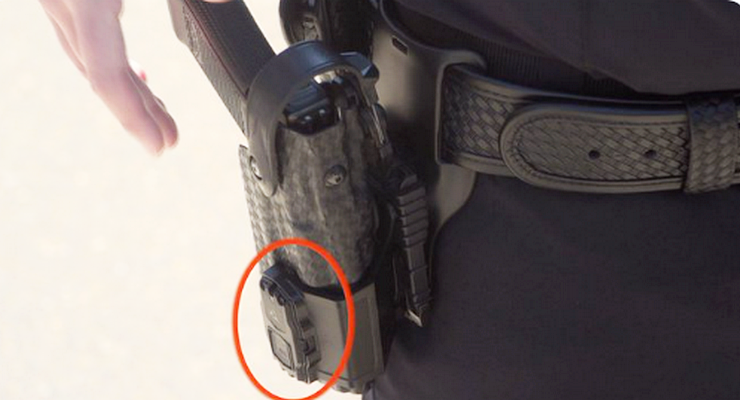
From April to July, the department considered the Signal Sidearm which automatically activates body worn cameras when officers remove their service revolvers from the holster. After the trial period staff decided to move forward with the cameras, according to department spokesperson Commander Marcia Taglioretti.
The department already has implemented technology that activate cameras which triggers bodycam recordings when an officer’s TASER is deployed and armed.
“The department will be looking at the Signal Sidearm with the Axon contract and will have to go through the city purchasing process,” Taglioretti told Pasadena Now.
Last December, the Pasadena City Council passed an amendment to its police body-worn camera contract, and directed staff to also consider the trial period of the new triggering technology.
The contract extension included upgrades to the latest Axon cameras and docking stations; an additional upgrade to the latest cameras in two-and-a-half-years; a complete five-year warranty for service and replacement; and 10GB of additional storage on Evidence.com per camera for digital media that is not produced by an Axon device. The additional storage allows for storage and upload of additional video provided by members of the community during investigations.
Body-worn cameras are now seen as a benchmark in police accountability, and according to some reports the technology has led to a reduction in use of force incidents.
The Pasadena Police Department initiated a body-worn camera program in 2016.
Since then, the department has uploaded over one million evidentiary items, including videos, voice recordings, documents to Axon Enterprise’s secure, cloud based digital evidence management system platform called Evidence.com, according to a city staff report.
Criminal case video and voice recording evidence have been submitted electronically to the City Prosecutor/District Attorney’s Office for prosecuting cases.
Axon will continue to provide unlimited data storage, new equipment, complete warranty on all hardware and integration with the Department’s Computer Aided Dispatch to automatically tag calls for service with the corresponding video.
The department responds to approximately 1,600 requests a year for body-worn camera footage for court and for public records requests.
In many cases, the footage is available to the public via a public records act. The city also releases footage in critical incidents usually well ahead of the mandated 45-day deadline.
According to research by the University of Chicago Crime Lab and the Council on Criminal Justice’s Task Force on Policing, in cities that use body-worn cameras, complaints against police dropped by 17% and the use of force by police, during fatal and non-fatal encounters, fell by nearly 10%.
Currently, the police department deploys 295 from its 313 body-worn camera fleet.
The cameras are assigned to both sworn and professional staff department members who routinely come into contact with the public while working in the field.
 Get our daily Pasadena newspaper in your email box. Free.
Get all the latest Pasadena news, more than 10 fresh stories daily, 7 days a week at 7 a.m.


