










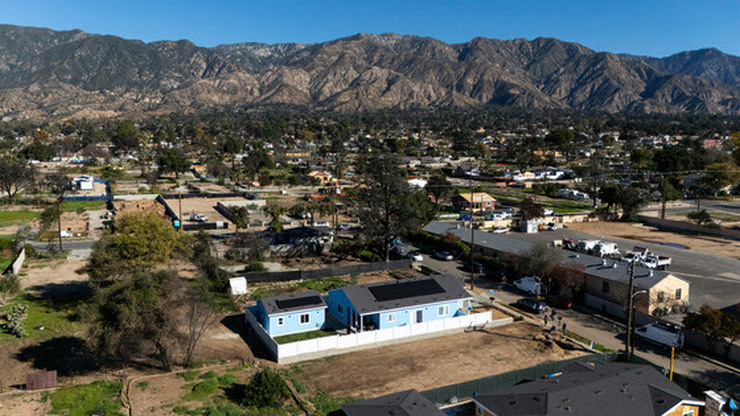
Edwin Castro, the Altadena native who won a record $2.04 billion Powerball jackpot in 2022, has spent roughly $10 million purchasing 15 fire-damaged lots in his hometown, with plans to build single-family homes for owner-occupants rather than rental investors, according to reporting by the Wall Street Journal and the Los Angeles Times.
Two of Castro’s houses were under construction as of May 2026, but he had not yet applied for permits on any of the remaining lots, the Los Angeles Times reported. Castro is the second-largest investor buying vacant lots in Altadena, behind Ocean Development Inc., according to the Times. Castro purchased his winning lottery ticket in November 2022 at an Altadena gas station that survived the January Eaton Fire largely untouched. The fire, part of a broader Southern California fire event that killed at least 31 people and destroyed more than 16,000 buildings, destroyed roughly 6,000 to 9,000 homes in Altadena alone, according to differing estimates cited by the Times and other outlets summarizing Journal reporting.
Castro and his brother, Jesse Castro, formed a real estate company called Black Lion Properties LLC in 2024, which by June was described as the largest land investor in the Los Angeles County fire zone, according to the Daily News. A separate Los Angeles Times report from May 2026 identified the operating company building Castro’s Altadena houses as “Grass Roots.” That report did not reference Black Lion Properties, and available source reporting does not clarify the relationship between the two company names.
Terry Fahn, a spokesman for Castro, said in a statement to the Los Angeles Times that the effort involves working with local groups on “how best to maintain the old Altadena they know and loved.” Castro has said he wants most of his lots developed with single-family homes that fit the character of the existing neighborhood, and that he expects buyers to plan to live in the homes rather than rent them out, according to the Journal’s reporting. Fahn also said Castro may build some houses for himself and his family.
Fahn said Castro is donating three of his properties to the Greenline Housing Foundation, a nonprofit organization that provides down payment assistance, maintenance grants and financial education, according to the Los Angeles Times.
Community reaction to outside investors purchasing burned lots in Altadena has been mixed. The Los Angeles Times reported that investors were initially viewed with suspicion by residents, a sentiment that has shifted somewhat as some projects have produced completed homes. Milessa Michelson, co-founder of the advocacy group Altadena Not for Sale, told the Times it remains too early to judge the impact of outside investors and called for greater engagement from developers, including town halls. Teresa Fuller, a real estate agent working in the area, was quoted by the Times dismissing concerns about investors driving up prices as “a myth.”
County-wide data cited by the Los Angeles Times showed investors purchased just under half of the 287 vacant lots sold in Altadena in 2025 — a figure the Times noted represents less than half a percent of the roughly 6,000 homes destroyed in the community. The Times also reported that investor-owned parcels overall — not specific to Castro’s holdings — have filed building permits on about two-thirds of their properties, a rate the paper said is 50% higher than the overall permitting rate for Altadena’s rebuilding effort.
 Get our daily Pasadena newspaper in your email box. Free.
Get all the latest Pasadena news, more than 10 fresh stories daily, 7 days a week at 7 a.m.