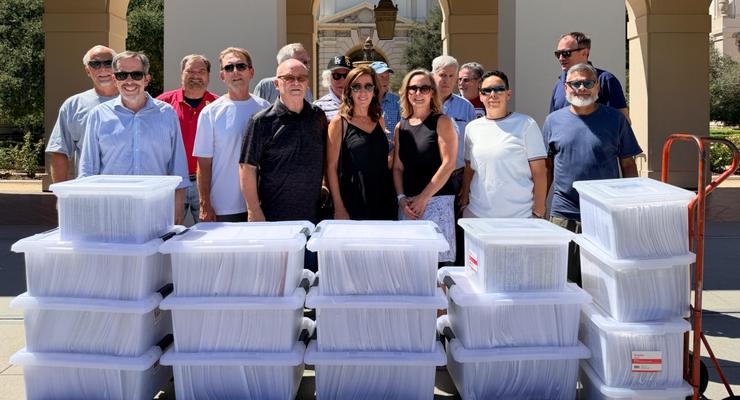







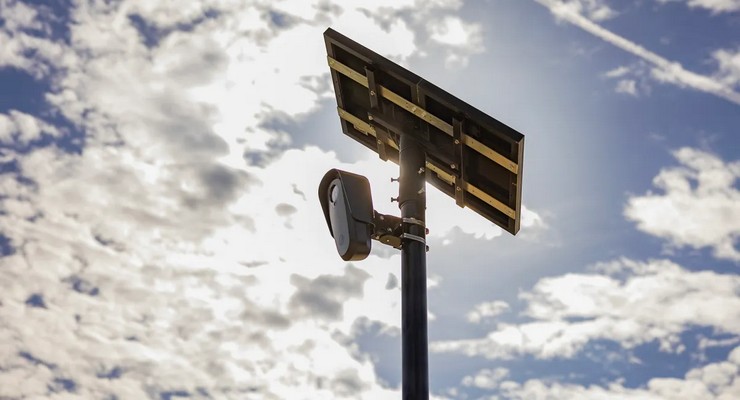
A privacy group plans to rally on the west steps of Pasadena City Hall on Wednesday to demand the city shut off and remove its Flock Safety license plate reader cameras, after the City Council committee that was scheduled to take up the cameras that evening canceled its meeting.
The Public Safety Committee agreed in May to schedule further discussion of automated license plate readers, and Pasadena Privacy says the Aug. 19 meeting was to be that discussion. The city instead posted a notice on Aug. 12 stating that the 5 p.m. meeting was canceled “due to a lack of quorum.” The group set its rally for the same hour, outside the building where the committee would have met.
Organizers plan a press conference at 4:45 p.m. followed by the rally at 5 p.m. They list four scheduled speakers: Mohammad Tajsar, a senior staff attorney at the ACLU of Southern California whose work focuses on government surveillance; Sabrina Jimenez, described as a full-spectrum birthworker; Brandon Lamar, president of the Pasadena NAACP; and Vice Mayor Jess Rivas. Rivas chairs the Public Safety Committee.
The campaign, organized by a group called Pasadena Privacy as the “DeFlock Pasadena,” is asking the City Council to disable and remove all Flock cameras, cancel the Flock contract in September, decline any replacement vendor and redirect the money to community-based safety programs. The group says the contract is up for renewal in September.
A letter campaign recorded 2,828 letters sent in support as of Tuesday, toward a stated goal of 3,200,according to Pasadena Privacy.
Pasadena’s Flock camera program began with a contract the City Council took up on July 17, 2023. The council accepted a base bid of $326,350 from Flock Group Inc. for cameras at seventeen intersections and authorized two one-year extensions, for an amount not to exceed $631,350. The Police Department’s staff report described the arrangement as “the original 2-year contract, plus two additional one-year lease options,” which it said would make a four-year contract at that total cost. Flock was the only company to bid. The purchase drew $231,350 from the city’s Asset Forfeiture Fund, with no impact to the General Fund, according to the report. An Edward Byrne Memorial Justice Assistance Grant of $34,390 funds the leasing of additional cameras. Pasadena Now research could not determine a date on which the current term ends.
“Pasadena deserves better,” the Pasadena Privacy said on its campaign page. “We know that safety is not brought about by surveillance and policing. True safety comes from community and life-giving infrastructure.”
The Public Safety committee last took up a Flock update on May 20, when the City Clerk’s Office reported 365 letters on the item, 276 of them from Pasadena residents. (Much of that volume traces to the campaign itself: in the first correspondence file the city published for the item, 93 of its 209 pages carried the identical opening sentence from the DeFlock Pasadena letter template, and 98 pages listed an Action Network sending address.)
Among the written comments, Daniela Navin, a District 3 resident, objected to what she described as “the high concentration of Flock cameras in Districts 3 and 5, neighborhoods that have historically been underserved, overpoliced, and heavily targeted by ICE.”
Police Chief Gene Harris presented the department’s update at that meeting, covering alerts generated by the software, searches conducted by staff, department clearance rates, stolen vehicle recoveries, audit findings and locations for new cameras, according to the approved minutes.
The department’s presentation said Flock disabled its National Lookup feature for all California agencies in March 2025 and, that June, blocked out-of-state agencies from forming data-sharing relationships with California agencies, leaving access limited to California law enforcement. It cited a Jan. 28 homicide investigation on Ashtabula Street in which detectives used the cameras to identify vehicles involved and the suspect confessed within 12 hours.
Independent Police Auditor Teresa Magula reviewed the program for the Community Police Oversight Commission in July. She found the system was used in a way that follows California law and department policy, with no evidence it was used for immigration enforcement. About 70% of searches were for a particular license plate, meaning officers were looking for a vehicle already connected to an investigation, and access is limited to fewer than 400 approved California law enforcement agencies. The department analyzed more than five million searches from 2025 and found two tied to a federal entity — Veteran’s Affairs Police, in a criminal case at a federal facility in Loma Linda — which it determined were not related to immigration enforcement.
The review also recorded developments the campaign has cited. The department disabled the Northern California Regional Intelligence Center’s access to its data effective June 18, after San Francisco police reported that month that their license plate data had been queried by analysts operating through the center on behalf of federal or out-of-state agencies. On placement, Magula found no evidence locations were selected based on race or ethnicity, while noting that cameras are not evenly distributed and that at least two districts on the city’s borders have none. She wrote that the uneven distribution “is real and visible” and that “the resulting distribution does have uneven geographic impacts.” The California State Auditor is auditing the state’s fusion centers, including that center. Her review produced two recommendations, which the department has not yet acted on.
The committee itself is divided. According to the approved minutes, Rivas voiced support for terminating the contract and not replacing the vendor. Councilmember Steve Madison spoke in support of continued use of the cameras and of adjusting the program within the boundaries of the law and sound policing. Councilmember Tyron Hampton backed contracting with a new vendor whose system would collect data for the city’s use only unless a warrant was issued. Councilmember Justin Jones raised concerns about data sharing with Immigration and Customs Enforcement and about camera concentration in Council District 3.
The department’s internal audit went to the City Council in March, according to Magula’s memo. The committee’s April 15 meeting was canceled as well.
Organizers say the Police Department operates 61 Flock cameras and is seeking 11 more, and that Districts 3 and 5 have more cameras than other districts while Districts 4 and 7 have none.
The rally is part of a National Week of Action Against ALPRs organized by DeFlock and running Aug. 16 to 22. DeFlock, founded in October 2024 by software engineer Will Freeman, says people in 460 cities are taking part. Other departments have stepped back from the company. The Los Angeles Police Department signed a three-year agreement with Flock in 2023 covering 138 cameras and let it expire on July 11, with Chief Information Officer Dean Gialamas saying it was not renewed because of concerns around civil liberties and privacy. The South Pasadena City Council voted in March not to renew a contract covering 14 of its cameras.
The press conference begins at 4:45 p.m. Wednesday and the rally at 5 p.m. on the west steps of Pasadena City Hall, 100 N. Garfield Ave. The event is outdoors, and organizers list no registration requirement. Information is posted at pasadenaprivacy.org and deflockpasadena.org, and the group lists a media contact at pasadenaprivacy@proton.me.
The Public Safety Committee meets on the third Wednesday of each month, which would place its next regular meeting on Sept. 16. Organizers say they will press the council to act before the contract comes up in September.
 Get our daily Pasadena newspaper in your email box. Free.
Get all the latest Pasadena news, more than 10 fresh stories daily, 7 days a week at 7 a.m.