










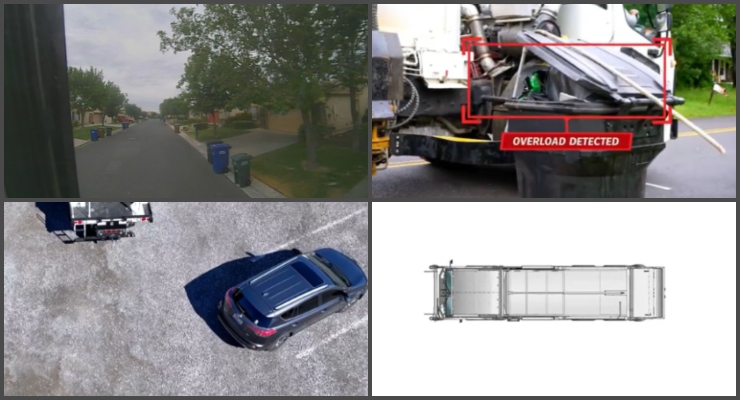
Thanos Gauthier, Deputy Director of Public Works, said the department was “not looking for” a system of “constant video monitoring,” though a slide noted that continuous feeds would be stored onboard for up to 14 days.
Raw footage would stay on the truck about 10 days before being overwritten, he said, with trigger events — an arm lifting a container, a load being dumped, a collision or unsafe driving — uploaded automatically to a vendor’s cloud and other footage uploaded if the department chooses.
Councilmember Rick Cole said he understood “that all of the seven cameras are operating all of the time” and that the footage uploaded from the truck “is the result of a triggering event.”
“Correct,” Gauthier said, though he added that the department could also upload other footage it wanted.
The Department of Transportation also presented a draft policy for parking enforcement body cameras, reviewed with union representatives, that bars using footage for routine performance evaluations absent a specific complaint or incident.
Public Works brought an information-only slide presentation, no written draft policy, and a feature list that includes monitoring “driving performance” and letting managers watch video to “coach drivers.”
Its presentation did not address whether refuse workers have been consulted. Neither item got a vote.
Public Works said the cameras — up to eight per truck — would log pickups, flag contaminated containers under state organic-waste rules and document collisions.
The cameras “are not automatic license plate readers and they are not facial recognition,” Gauthier said, adding that only authorized personnel could access footage, the cameras would capture only what is visible from public areas, and faces and license plates would be blurred in footage released as a public record. He did not say whether footage still on the onboard loop would be subject to records requests.
Councilmember Jason Lyon said the city’s data should be limited to the city and that vendor access could be addressed in the contract.
“I would want to see that language,” he said.
The official said he wants accident footage kept at least six months — the state deadline for presenting injury and personal-property damage claims against a public agency — and would prefer to keep only trigger-event data. But, he said,”The city attorney’s asking us to retain the data for a year.”
The city clerk’s office received 14 letters on the item, the committee was told; the seven posted on the city’s website all raised privacy or surveillance objections.
Both public speakers objected to the plan, one saying the plan would be “turning refuse trucks into roving surveillance that is totally unnecessary.” The other said the city needs “an actual policy that explicitly addresses privacy and data security concerns” before going further.
The parking policy grew out of concerns raised during the June budget process about funding for the cameras. Under the draft, recordings would be kept for one year. Transportation and Human Resources staff reviewed it with the Laborers International Union of North America, whose representatives and parking enforcement staff support it, according to the staff report.
Cole questioned the one-year retention: “If they’re going to complain, they’re not going to wait nine months to complain.”
Transportation Director Joaquin Siques said the department hopes for a shorter period, but that as he reads the state code section the policy cites, captured video “has to be maintained for a minimum of one year.”
The policy itself says recordings will be kept “for a maximum of 1 year.” The cited statute lets a city department destroy “recordings of routine video monitoring” after one year, with approval of the governing body and the agency attorney.
The two speakers also said a year of retention was too long.
The Department of Transportation’s next steps, according to its slides, are finalizing the policy, procuring a vendor and developing training.
 Get our daily Pasadena newspaper in your email box. Free.
Get all the latest Pasadena news, more than 10 fresh stories daily, 7 days a week at 7 a.m.