


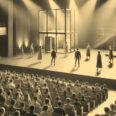


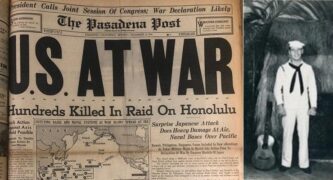


In the winter of 1939, Gilbert Livingston Kinney rode atop a Tournament of Roses Parade float as it made its way down Colorado Boulevard. Shirley Temple was the Grand Marshal that year. Kinney, a graduate of Pasadena Junior College and a dedicated member of Sea Scout Ship 10 (Aurora), waved to the cheering crowds — neighbors, schoolmates, families who had watched him grow up in the Crown City.
Two years later, Kinney was dead, killed in the magazine explosion of the USS Arizona at Pearl Harbor on December 7, 1941.
His body was never recovered. His name is inscribed on the Courts of the Missing in Honolulu, 2,500 miles from the boulevard where he once celebrated the new year in the California sun.
Today marks the 84th anniversary of the attack that killed 2,403 Americans and propelled the United States into the Second World War, more than two years after the war began with Germany’s invasion of Poland.
While the assault occurred an ocean away, in the waters off Oahu, Pasadena’s losses were immediate and specific: five young Navy servicemen, all residents of this city, died that Sunday morning.
Three were aboard the Arizona when it exploded. Two went down with the USS Oklahoma as it capsized after sustaining multiple torpedo hits.
They were sons, brothers, classmates. One was born on the grounds of the Henry E. Huntington estate. Another was the only child of his parents. A third had walked the halls of John Muir High School just a year before his death.
Their stories illuminate what was lost that day — not only for the nation, but for one California community that sent its young men to serve and watched for their return.
‘They Have Closure Now’
John Albert Karli was 19 years old when he died aboard the USS Oklahoma. His father had worked as a gardener on the Henry E. Huntington estate in San Marino, where Karli was born. The family later moved to Pasadena, where the young man attended John Muir High School, graduating with the Class of 1940, and then enrolled at Pasadena Junior College.
When the Oklahoma capsized after sustaining nine torpedo hits that December morning, Karli was among the sailors who went down with the ship. His remains, like those of so many others, could not be immediately identified. For 77 years, he lay unidentified, interred in the National Memorial Cemetery of the Pacific in Honolulu — the “Punchbowl,” as it is known.
Then, in 2018, scientists at the Defense POW/MIA Accounting Agency identified Karli’s remains using DNA analysis. On May 2, 2019, nearly eight decades after his death, he was brought home to Pasadena and buried with full military honors at Mountain View Cemetery in Altadena — laid to rest beside his parents at last.
“Every day is remembrance day with all of the veterans who rest here… It was probably very tough for the family. But they have closure now.”
— Nick Dormody, Mountain View Cemetery
Karli was the first of Pasadena’s “missing sons” to come home. His return, decades in the making, offered a measure of resolution that the other four families have never received.
The Boy on the Float
Gilbert Kinney had been a fixture of Pasadena civic life before he ever put on a Navy uniform. A 1939 graduate of Pasadena Junior College, he was deeply involved in the community as a member of Sea Scout Ship 10 (Aurora). His participation in the Rose Parade that year, riding on a float celebrating the parade’s 50th anniversary, marked him as a young man of promise — active, engaged, emblematic of the community’s future.
He enlisted in the Navy and was assigned to the USS Arizona as a Fireman First Class. On the morning of the attack, Japanese bombers struck the Arizona’s forward magazines, triggering a catastrophic explosion that killed 1,177 men — the highest casualty count of any vessel in the harbor. Most of the military vessels that went down in the surprise attack were resurrected and deployed to fight again. But for those aboard the Arizona, there would be no second chance.
For the Kinney family, there would be no burial, no headstone to visit, no grave to tend. Gilbert’s name is inscribed on the Courts of the Missing, alongside hundreds of others whose bodies were never recovered. The float he once rode is gone. The parade went on. But for one Pasadena family, January 1, 1939, was the last time they saw their son celebrated in public.
An Only Son
Harold Thomas Robinson Jr. was the only son of Harold T. Robinson Sr. and Hazell Nott. He served as a Seaman Second Class aboard the USS Arizona. When the ship exploded that Sunday morning, he was killed in action. Like Kinney, his body was never recovered.
The Robinson family’s loss was total. In an era when families often had multiple children, Harold Jr. was their one. The telegram that arrived in Pasadena in January 1942, confirming him as “Missing in Action” or “Killed in Action,” ended not only a young man’s life but a family’s lineage.
Remarkably, a second Robinson from Pasadena also died aboard the Arizona that day: Seaman First Class James William Robinson, the only son of Olin Robinson and Beemie Rita Nee. Despite the shared surname and city, he had no relationship to Pasadena’s famous Robinson sporting family.
The presence of two Robinsons from Pasadena on the same ship is accurate and not a clerical error — a coincidence that underscores the concentrated nature of the city’s losses. Two families, two only sons, one ship.
A Nation Transformed
Just before 8 a.m. on that Sunday morning, more than 350 Japanese torpedo bombers, dive bombers and fighters arrived in two waves, targeting the U.S. Pacific Fleet anchored in the harbor. When the assault ended, 2,403 American service members and civilians were dead. Two battleships — the USS Arizona and Utah — were permanently sunk. Bellows, Hickam and Wheeler airfields were also bombed, as were the installations at Ewa, Ford Island and Kaneohe Bay, sustaining major damage.
Japan had carried out the attack in an attempt to cripple the U.S. Pacific Fleet as it sought domination over much of Asia. The day after, the United States declared war. Most of the military vessels that went down in the surprise attack were eventually resurrected and deployed to fight again. But for the 1,177 men entombed in the Arizona, and for the families of the five Pasadena sailors who never came home, there would be no resurrection.
Remembrance
In 1994, President Bill Clinton signed legislation establishing December 7 as National Pearl Harbor Remembrance Day. This year, marking the 84th anniversary, President Donald Trump issued a proclamation honoring those who fell.
“The lessons learned 84 years ago on that fateful day still resound with America’s exceptional fighting force. We must remain ever vigilant and prepared to annihilate any foe who dares to threaten our liberty. This annual day of remembrance must be held in the highest esteem and reverence as we honor the Americans who laid down their lives to defend our homeland on the island of Oahu and in the battles of World War II.”
— President Donald Trump, 2025 Proclamation
In Pasadena, the memory endures in quieter ways: in the rows of Mountain View Cemetery, where John Karli finally rests beside his parents; in the archives of John Muir High School and Pasadena City College, where the names of young men who never returned are preserved; in the annual commemorations that invoke “Pasadena’s Five Sons” — Karli, Kinney, Harold Robinson, James Robinson, and Wallace Gregory Mitchell, a Fireman Third Class who died when the Oklahoma capsized.
Mitchell, the son of George and Isabell Mitchell of Pasadena, joined Karli among the Oklahoma’s dead. His name, too, is recorded on the Courts of the Missing.
For decades, one man kept the memory alive in person. Bob Fernandez, a mess cook aboard the USS Curtiss during the attack, became a longtime Pasadena resident after the war. He recalled the visceral memory of a Japanese plane crashing into his ship’s crane. Fernandez lived to be 100 years old, frequently sharing his story with the Pasadena community before his passing in 2024.
The attack also stirred the community’s conscience in unexpected ways. In 1944, “Friends of the American Way” in Pasadena, led by William C. Carr, began supporting Japanese-Americans — a direct community response to the racial tensions inflamed by the attack.
Eighty-four years on, the Rose Parade still marches down Colorado Boulevard each New Year’s Day, as it did in 1939 when Gilbert Kinney rode a float celebrating the parade’s 50th anniversary into the California sunshine. The crowds still cheer. The floats still pass. But five chairs at five family tables have been empty for 84 years now — a silence that echoes from a harbor in Hawaii to the quiet streets of the Crown City.
 Get our daily Pasadena newspaper in your email box. Free.
Get all the latest Pasadena news, more than 10 fresh stories daily, 7 days a week at 7 a.m.


