





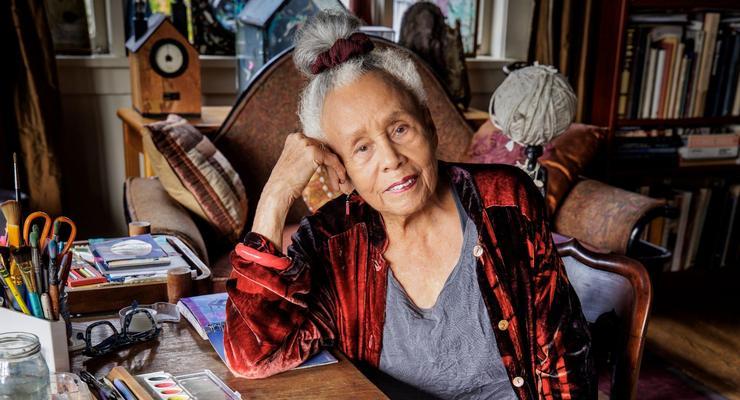
Roberts Projects, the Los Angeles gallery that represented Saar, announced her death in a statement, saying she died in her sleep in the early morning of Sunday, July 26. She was born in 1926.
Saar’s roots in the area ran deeper than her childhood. After growing up in Pasadena during the Great Depression and studying at Pasadena City College, she joined a community of Black artists in Altadena in the late 1960s and early 1970s — the years in which she produced “Black Girl’s Window” and began the work that would become “The Liberation of Aunt Jemima.”
After PCC, Saar earned her bachelor’s degree at UCLA in 1949. She also taught at the Pasadena Film School, which has since closed. The California African American Museum has published detailed biographical material on her Pasadena upbringing, including the death of her father in the city when she was 5.
Saar’s connection to the Altadena/Pasadena area remains on public view. Her large-scale commissioned installation “Drifting Toward Twilight,” a 17-foot vintage canoe piece built with found materials harvested from the Huntington’s own grounds, has been on view at the Huntington Library in San Marino since 2023 and runs through Nov. 30, 2027.
Saar had spoken publicly about childhood visits to the Huntington, which directly inspired the work.
In its statement, Roberts Projects described Saar as a pioneering artist and a leading figure in the assemblage movement whose work interrogated African American identity, spirituality and the intersections between diverse cultures. She emerged as a vital voice during the Black Arts Movement and second-wave feminism of the late 1960s and 1970s, the gallery said, using found objects, family heirlooms and vintage ephemera to explore race, gender and historical memory.
Among her best-known works is the 1972 assemblage “The Liberation of Aunt Jemima,” which places a stereotypical figure holding a broom and a rifle. The gallery said the piece transforms a symbol of servitude into a warrior of Black liberation. Another work the gallery called foundational, “Black Girl’s Window” (1969), uses an old window frame as a structural device to merge autobiographical elements with mysticism and racial identity.
Saar’s seven-decade career was the subject of exhibitions at museums around the world, and her work is held in the collections of more than 90 institutions globally, according to the gallery.
Saar’s legacy has been entrusted to the Betye Saar Legacy Group, which she and her studio established in 2025 in collaboration with Roberts Projects. The gallery said the group is a coalition of scholars and curators from global institutions, each selected by Saar for expertise in a different area of her multidisciplinary practice.
Exhibitions on view during her centennial year include “Betye Saar’s Black Dolls” at the New York Historical Society, through Oct. 4, 2026; “Betye Saar: Drifting Toward Twilight” at the Huntington Library, through Nov. 30, 2027; and “Let’s Get It On: The Wearable Art of Betye Saar” at Roberts Projects in Los Angeles, through Aug. 22, 2026.
Saar is survived by her three daughters, Lezley Saar (Agust Agustsson), Alison Saar (Tom Leeser) and Tracye Saar-Cavanaugh (Francis Cavanaugh); her grandchildren, Kyle Leeser, Maddy Inez, Sola Saar, Gen Saar-Agustsson, Spencer Saar Cavanaugh and Megan Cavanaugh; and her red-footed tortoise, Rojo.
 Get our daily Pasadena newspaper in your email box. Free.
Get all the latest Pasadena news, more than 10 fresh stories daily, 7 days a week at 7 a.m.