









The 5 p.m. rally precedes the city council workshop at 6 p.m. at which officials are scheduled to publicly unveil and review the draft Reconnecting Pasadena SR-710 Vision Plan.
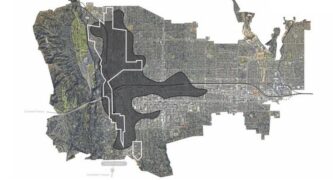
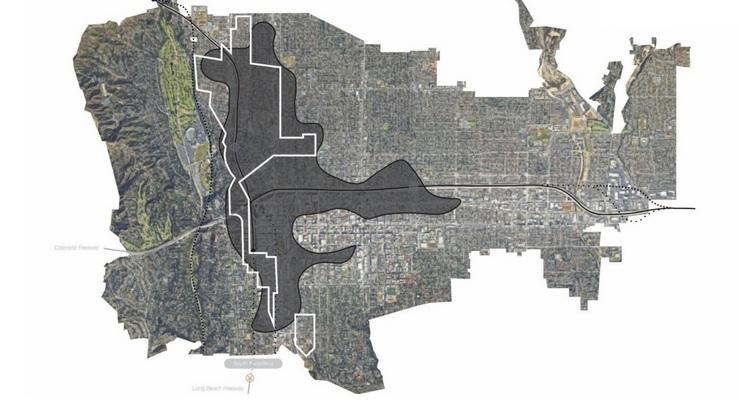
The proposal lays out a framework for redeveloping roughly 50 acres of land relinquished to the city in 2022 after the state abandoned plans to complete an ill-fated 710 freeway extension.
City staff is recommending that the City Council move forward with environmental review, land-use planning and financing strategies while also directing that the area become the City’s first carbon-neutral district.
At the heart of the proposal is a restorative justice framework intended to acknowledge and address the displacement of primarily African American, Japanese American, and Mexican American communities during freeway construction in the mid-20th century.
The workshop will take place in the City Hall Council Chambers at 100 Garfield Ave.
The rally beforehand is being planned and co-hosted by 710 Restorative Justice Pasadena, the Center for Restorative Justice and Greenline Housing Foundation.
Speakers will include displaced residents and their descendants, members of the 710 Advisory Group and Restorative Justice Subcommittee, representatives from the three hosting organizations and local pastors, according to a coalition fact sheet.
Beginning in the 1960s, hundreds of families were forced from their homes and businesses along a 10-block corridor south of the 210/134 freeways to make way for the planned extension of the 710 Freeway. The SR-710 northern interchange was constructed in the early 1970s, and by 1974 the community had been destroyed. The coalition’s fact sheet states that at least 4,000 residents were displaced and 1,500 homes destroyed. The displaced population lived in a mixed-income, racially diverse community of African Americans, Mexican Americans and Japanese Americans alongside working-class white residents. More than 50% were African American.
The State of California relinquished approximately 50 acres of condemned freeway land to the city in 2022. The draft Vision Plan represents three years of collaborative work by consultants, the city council-appointed Reconnecting Communities 710 Advisory Group and city staff.
‘Indivisible’ demands
Gilbert Walton, chairman of 710 Restorative Justice Pasadena, said in an interview Sunday that the coalition’s 10 restorative justice elements “are indivisible.”
“These are the constitutive parts of a whole,” Walton said. “If they are not passed in total as a unit, what it will do is it will undermine the apology and the pledge.”
The elements include a public apology from the mayor on behalf of the city, support for a Restorative Justice Community Oversight Committee, $150,000 in reparations for those displaced by the 710 Freeway, a 15% set-aside for affordable homeownership and a 20% set-aside for affordable rental housing for displaced residents and descendants of both 710 and 210 freeway construction, according to the fact sheet. The framework also contemplates down-payment assistance, wealth-building programs and a proposed community trust to support ownership pathways.
“I hope also that they will understand that we’re on the precipice of something really historic,” Walton said. “If they have the courage to move this forward, then we can have the kind of Pasadena that we have all hoped for, one that is just and equitable.”
Apology and accountability
Walton said a public apology “needs to be made by the highest officer in the city,” meaning the current mayor of Pasadena, Victor Gordo.
“It needs to acknowledge the harm,” Walton said. “It needs to have people understand that they are not responsible for the harm that was done to them.”
John Williams, executive director of the Center for Restorative Justice, said in a separate interview Sunday that a public apology “is only at the beginning of restorative justice.”
“An apology matters because not apologizing continues to silence,” Williams said. “It says basically this was not accidental, this was not neutral. Those decisions weren’t neutral and it caused harm and it’s important for us to name the harm.”
Lost wealth and displaced renters
Jasmin Shupper, founder and CEO of Greenline Housing Foundation, said Sunday that even homeowners who were paid through eminent domain could not replace what they lost.
“For those who sold through eminent domain, it was claimed to be at market rate, but market rate in that area doesn’t necessarily mean that you can then go and buy a house because of Pasadena’s legacy of redlining,” Shupper said. “Basically, what happened for a lot of people was that they had to move out of the city or move to a lower cost area.”
Shupper noted that not all displaced residents were homeowners.
“A portion of the people displaced by the proposed construction of the 710 were in fact renters and therefore didn’t get any compensation as the homeowners might have gotten something, but the renters got nothing, right?” she said.
The coalition’s fact sheet said that individuals displaced by the earlier construction of the 210 Freeway were offered $75,000 for their homes at a time when no homes in Pasadena cost less than $85,000.
Shupper said that in the 1940s, over 60% of homes in Pasadena had racially restrictive covenants attached to them, limiting where residents of color could purchase property. She described the displacement, redlining and urban renewal as interconnected, noting that many displaced residents moved to Altadena.
A route chosen through vulnerable communities
Shupper said an alternate freeway route had been proposed that could have displaced eight times fewer people but was not chosen. Freeway construction at the time “often took the path of least resistance, which was often communities who were more vulnerable, who had less power … and who were often minority communities,” she said.
The California Highway Commission determined the SR-710 routing on Nov. 18, 1964..
Oversight and enforcement
Shupper said one of the coalition’s recommendations is the creation of a restorative justice community oversight committee and a registry of displaced residents and their descendants. A proposed registry would give eligible displaced residents first-right-of-refusal on for-sale homes, affordable rentals and business leases tied to the 710 Stub redevelopment.
The organizations differ on who should control the oversight body.
The 710 Stub Working Group mandates that at least two members be descendants of displaced residents. The draft governance framework proposes that at least 51% of committee members be displaced residents or their descendants. The coalition wants at least 70%.
Williams said affected families must have decision-making power, not just a consultative role.
“We need to create spaces where impacted families are not just consulted, but that they are some of the decision makers and shaping what repair looks like,” he said.
Shupper warned that restorative justice commitments in development plans are often proposed but not enforced.
“Oftentimes those things aren’t enforced and there’s not proper mechanisms to make sure that they actually happen,” she said.
The coalition’s governance materials contemplate a Community Benefits Agreement or similar mechanism to ensure enforcement.
Legacy of displacement
Williams said the effects of displacement are visible in Pasadena today.
“Although Pasadena is a very, very wealthy city, there’s still areas that people look down on and those areas tend to be where black and brown folks were,” he said. “We’re kind of living this afterlife of those decisions.”
Williams described the stakes in broader terms. “Displacement’s not just where people live,” he said. “It’s about what they could have become if they had been allowed to stay there.”
Shupper placed Pasadena’s experience in national context, noting that after the National Interstate and Defense Highways Act was passed in 1956, “city planning departments across the country used that as license to erect physical barriers to segregate neighborhoods. Almost every community in the country, the freeway construction dissected a minority community.”
What’s next
Walton said today’s rally will begin at 5 p.m. on the steps of City Hall, last approximately 30 minutes and include time for questions.
At 5:30 p.m., attendees are expected to file into the city council chambers for the 6 p.m. workshop, which will feature an excerpt from the two-time award-winning documentary “Amplify | Voices of People and Families Displaced by Freeway Construction in Pasadena, California.”
Walton said representatives of the National Association for the Advancement of Colored People (NAACP), Making Community and Housing Happen, and Pasadenans for Gaza are expected at the rally. Shupper said representatives from Greenline Housing Foundation will attend. Williams confirmed he will be there.
A second city council workshop is scheduled for April 13 at 6 p.m. to hear staff recommendations and continue public discussion. The Pasadena City Council is the final decision-maker on the Vision Plan and any reparations framework.
“We’ve come further in these last three years than we have ever come in Pasadena before to doing justice,” Walton said. “To reject that, to take an exit ramp at this 11th hour would be tragic.”
 Get our daily Pasadena newspaper in your email box. Free.
Get all the latest Pasadena news, more than 10 fresh stories daily, 7 days a week at 7 a.m.