




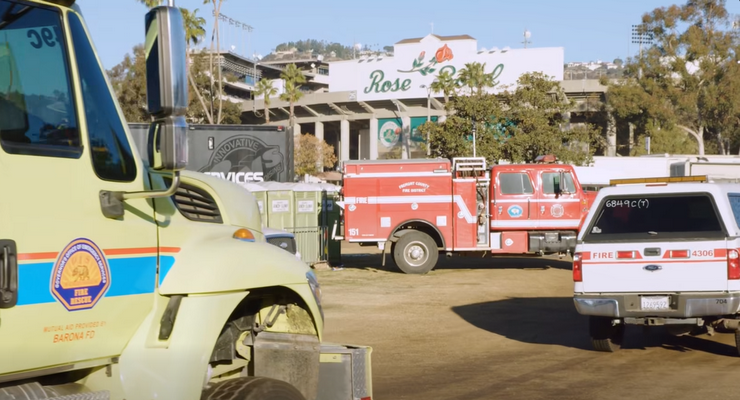
Officials said the Rose Bowl Operating Company has a $10 million request in Sacramento as part of the June 15 budget through state Sen. Sasha Perez and Assemblymember John Harabedian. They said the lawmakers “saw the value in the building” during the Eaton Fires, when officials said the stadium was part of the response.
A separate $23 million request in Washington, D.C., is focused on the 2028 Olympics, safety and security, lighting and cameras, officials said. The stadium is expected to host five Olympic soccer matches in 2028, including finals and semifinals for men’s and women’s soccer and a quarterfinal match.
The disclosure came as Rose Bowl leaders presented a broader case for government support, saying municipally owned venues serve a community role beyond events and economic activity. Officials said such buildings also can be “a resource in times of need,” language that placed the stadium’s disaster-response role alongside its Olympic and entertainment functions.
Budget materials prepared for the meeting listed preparation for the 2028 Olympics, event security and “outside the fence line management,” and long-term capital funding among the Rose Bowl Operating Company’s key issues for fiscal 2027. The listed strategies included working with public safety officials, event promoters and stakeholders, and continuing “Legacy 2.0” collaboration with donors and city, state and federal governments.
Officials said parts of the Sacramento and Washington requests also include solar lights for the golf course, which doubles as event parking. Additional lighting and movable temporary lights would improve customer service, address liability concerns and help staff document incidents, officials said.
The funding push comes as the Rose Bowl Operating Company says it faces capital needs well beyond what annual operations can cover. Officials said the organization can generally find only “a couple million dollars” for capital needs in a tight budget, while the Rose Bowl Operating Company has “a few hundred million” dollars in needs over the next 20 years.
The draft fiscal 2027 budget calls for a $9.9 million capital budget funded through net operating income, the Legacy Capital Campaign and partners, along with $2.2 million in planned preventative maintenance from operations. Budget materials said the recommended fiscal 2027 budget is expected to break even while transferring $3.3 million in net income to capital reserves.
The Rose Bowl Operating Company’s mission statement in the budget materials describes its purpose as improving the quality of life in Pasadena by providing entertainment and generating revenue through a world-class stadium and golf course complex. Tuesday’s presentation added another emphasis: the stadium’s value as a community resource in emergencies and in event security planning.
Officials did not provide, during the presentation, a detailed line-item breakdown of how the full state and federal requests would be spent beyond references to Olympic safety and security, lighting, cameras and solar lights. They also did not say what would happen if the requests are unsuccessful, including whether future costs could fall to the Rose Bowl Operating Company, the city or Pasadena taxpayers.
The Rose Bowl Operating Company said fiscal 2026 had been a “bounce back year” because of the Eaton Fires. Its president, Steve Haderlein, told the committee the organization was able to pay bond debt, protecting the city’s general fund; fund preventative maintenance on two 100-year-old assets; and transfer about $700,000 to capital.
Haderlein described the fiscal 2027 budget as “optimistic” but achievable, saying the operating company expects to keep paying bond debt, increase preventative maintenance and transfer about $3 million to capital if the budget is successful.
The organization also pointed to the stadium’s community use as part of its public-value argument. Budget materials said the Rose Bowl campus hosted more than 1 million patrons in programming in fiscal 2026 and that local community groups generated more than $3.2 million over the past 12 months through events, walks, runs, community programming and fundraising initiatives.
Councilmember Rick Cole also questioned the broader budget assumptions behind the stadium’s plan. Cole asked how officials squared projected operating revenue growth with a shortfall from the adopted budget, and officials replied that the event business carries risk, with no guarantees, while bookings are based on a hold calendar and market conditions.
 Get our daily Pasadena newspaper in your email box. Free.
Get all the latest Pasadena news, more than 10 fresh stories daily, 7 days a week at 7 a.m.