








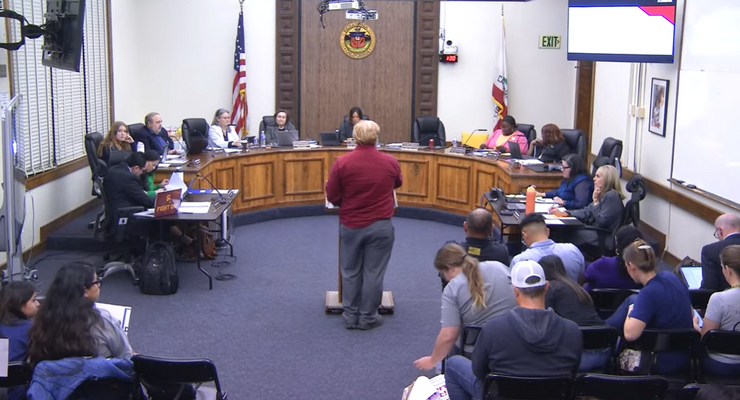
More than 50 speakers lined up at the Pasadena Unified School District board meeting Thursday to plead against school closures, filling a lengthy public-comment period with accounts of children displaced by the Eaton Fire, disrupted by the pandemic, and now facing the prospect of losing yet another anchor in their lives.
The March 26 session drew 56 public-comment cards — so many that President Tina Frederick proposed reducing each speaker to one minute, which the board accepted without objection, to accommodate the crowd. The central message, repeated by students, parents, teachers and classified staff alike, was that a cost-cutting consolidation plan could worsen the enrollment decline it is designed to address.
“If Marshall closes, I don’t know where I would go or if I would even stay,” said Violet, a student who said she commutes an hour each way to Thurgood Marshall Secondary School after being displaced by the fire. “You’re not just closing the school. You’re losing students.”
Marshall, a sixth-through-12th-grade campus, drew the most impassioned defense. Speakers cited its enrollment of more than 1,600 students — the largest of any PUSD school — its Advanced Placement offerings, its arts and athletics programs, and the unique continuity of its six-year model. Several families described returning to Marshall the day after losing their homes in the Eaton Fire because the school represented the one stable thing remaining.
“Despite living outside of the area, it is our school that keeps us connected to all that we have lost,” said Angelica Romero, an Altadena resident with two seventh-graders at Marshall. “Closing Marshall would create barriers for our most vulnerable.”
Blair High School and Middle School — with its International Baccalaureate wall-to-wall program, Armenian Academy, Spanish dual-immersion track and Health Careers Academy — also generated waves of testimony. Supporters noted that Blair is the only PUSD-managed high school south of the 210 Freeway, that the campus sits adjacent to the Metro A Line, and that the surrounding area is slated for significant new affordable housing development.
“In a world where AI is displacing jobs and commoditizing knowledge, the IB’s mission has never been more relevant,” said Kinga Doros, a Highland Park parent with children at Blair. “IB teaches them how to think, how to reason, evaluate and adapt — and those are exactly the skills AI cannot replace.”
A Blair teacher and former parent told the board that roughly 14 percent of Blair’s entire most recent graduating class — not merely those enrolled in the IB program — earned a full IB Diploma or Career-related Programme certificate, a figure that does not count students who took individual IB courses without pursuing the full diploma. He said that worldwide, approximately 10 percent of IB diploma candidates earn the diploma, a rate that applies only to enrolled program participants rather than an entire graduating class. He also said Blair is one of 38 schools in the United States offering all three secondary IB programs, and the only one in North America with an IB Armenian program.
Don Benito Elementary also drew defenders, particularly from families of children with disabilities, who said the school’s small size and consistency were not optional comforts but clinical necessities.
Connie Carcamo, a Don Benito parent of a special-needs student, told the board that consistency and structure are critical to her daughter’s ability to regulate, learn and thrive — and that another disruption would have a serious negative impact.
United Teachers of Pasadena members used coordinated speaking slots to press four bargaining priorities: a cost-of-living salary adjustment, class-size caps, health and welfare benefits, and a protected compliance period for special education teachers. A United Teachers of Pasadena (UTP) representative told the board that while the second interim budget submitted March 12 indicated a need to cut at most 50 teaching positions — down from 811 to 760 — the district had issued 135 layoff notices, despite 20 resignations and retirements that the representative said should have reduced the number needed even further.
“Why is PUSD laying off a hundred more teachers than they need to, and how does this help students?” the UTP representative asked.
The representative also alleged that the district employs four central-office administrators paid more than the governor of California, and that 95 central-office administrator positions total roughly $18 million annually at an average of $180,000 each.
The student board member reported that more than 150 pink slips sent to teachers in recent weeks were “weighing heavily on students,” and reiterated that school closures at this time were not in students’ best interest because fewer campuses would mean fewer spots in sports, student government, and performing arts.
Beyond the closure debate, the board took several actions.
It voted 7-0 to approve a contract with Verdantas for indoor environmental testing at the Altadena Arts Magnet campus on Calaveras Street, which has been operating at a temporary site since the Eaton Fire. Parents urged the board to ensure the testing scope prioritizes surfaces within six feet of exterior openings and HVAC ducting, and to make all results public. Verdantas representatives said a walkthrough would be conducted early next week, and that a detailed sampling protocol could be shared with the community within a couple of days of completing it.
The board also unanimously approved new secondary science curriculum — Amplify for grades six through eight and SAVIS for high school — ending a multi-year run with the fully digital STEM Scopes program, which has been in place since 2018. Administrators noted that having no print component became a liability when students lost their Chromebooks in the fire.
A financial consultant briefed the board on a potential refinancing of two outstanding bond series that could generate savings in excess of $10 million for taxpayers. A formal resolution authorizing the refinancing is expected to come before the board in April.
The board also approved a contract with RSSC, a firm specializing in equity-centered facilities planning, to update the district’s facilities master plan. The firm’s principals described an engagement process built around 90-minute listening sessions with students, parents and classified staff — particularly those from marginalized communities — before any design or consolidation decisions are proposed.
Earlier in the evening, the board unanimously approved three resolutions: designating March as Arts Education Month and affirming students’ rights to equitable arts instruction; honoring the farm worker movement and the legacy of labor organizing; and designating April as the district’s month of commemoration for the 111th anniversary of the Armenian Genocide of 1915.
The Pasadena High School orchestra, under the direction of Dr. Anne Rariden, was recognized for receiving a Superior ranking at the Southern California Band and Orchestra Association Festival — described by district officials as a rare achievement the ensemble had not previously attained.
The facilities committee is scheduled to meet Tuesday, April 14, at 6 p.m. in the boardroom.
 Get our daily Pasadena newspaper in your email box. Free.
Get all the latest Pasadena news, more than 10 fresh stories daily, 7 days a week at 7 a.m.