



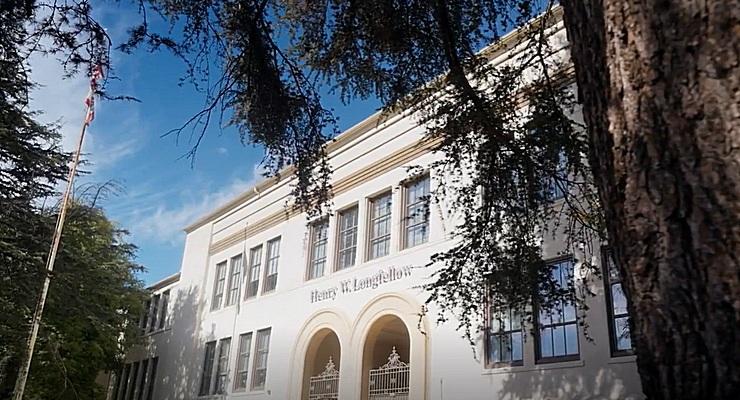
The Pasadena Unified School District reexamined its arborist’s findings in greater detail and reached the same conclusion it had before: several mature, protected trees on the front lawn of Longfellow Magnet School must come down to finish removing contaminated soil found after the Eaton Fire, the district told the school community in a 2 p.m. email Friday.
The more detailed review “did not change the central finding,” the district said: excavation to remove the contaminated soil, whether through air-knifing or other methods, would impact the trees’ critical root systems and compromise their stability.
The announcement concludes the fresh look the district committed to earlier this month before making a final decision on the remaining mature trees, and returns it to its original course.
Removal will begin early next week, followed by excavation and soil disposal, the officials said.
The district said that after what it described as an exhaustive review of the environmental requirements, the arborist’s findings, the available preservation alternatives and the long-term consequences of leaving contamination in place, it concluded that removal “is the most responsible path forward.”
“Student safety has to come first, and it has guided every part of this decision,” the district wrote. It said the aftermath of the Eaton Fire left it “facing conditions we did not create and choices we never wanted to make.”
“If a safe and workable way existed to preserve the Longfellow trees, fully address the contaminated soil, and return the property to unrestricted educational use, we would take it without hesitation,” the district wrote. “However, after an extensive assessment, we have concluded that, unfortunately, no such option exists within a reasonable timeframe to return students to campus safely.”
The district said the arborist’s original preliminary report “was not as complete or explanatory as it should have been.” In response to extensive questions from community members, it said, it asked the arborist to go back through the field work, measurements, photographs and observations from the August air-knifing assessment and more fully document the work and the basis for his conclusions.
The final report gives substantially more detail on the tree-by-tree evaluation, the district said. It covers where and how deep the air excavation went, the depth at which structural roots were found, how those roots relate to the contaminated soil, which the district’s environmental consultant evaluated at the same time, and the basis for the arborist’s conclusions.
The district said it used air-knifing because the Board of Education directed it to explore reasonable ways to preserve mature trees. The technique uses compressed air and vacuum excavation to expose roots while minimizing damage, and it allowed the arborist and environmental team to determine where major structural roots were and how they intersected with the contaminated soil, the district said.
The work showed that “the critical roots and the contaminated soil are comingled,” the district said, and continuing to remove soil around the trees would no longer be a preservation strategy. Removing that soil would take away the support that keeps the trees stable and would ultimately cause them to fail, according to the district.
The arborist also noted that several trees lean toward East Washington Boulevard and recommends removal rather than more air-knifing or excavation, according to the district.
The district said the California Department of Toxic Substances Control reviewed its latest front-lawn excavation analysis earlier this summer and confirmed that a significant quantity of contaminated soil remains within the trees’ critical root zones.
In an August 31 letter, according to the district, the department stated that this soil and “infrastructure, trees, and vegetation that impede removal of contaminated soil should be removed and replaced” for the site to receive a No Further Action determination and to support state matching funds for Longfellow’s modernization.
The district said it also ruled out two other approaches. Bioremediation is neither reliable nor feasible at Longfellow because of the lead concentrations, the contamination’s location and the requirements of the state-overseen cleanup, the district said. When it works, the district said, it can take years to show meaningful results, and the treated area must stay closed to students and teachers until contaminants fall to safe levels, a timeline it called unworkable for a campus undergoing comprehensive modernization. Contamination levels there are also not low enough to guarantee success, the district said.
Covering the soil with an impermeable barrier, likely a hard surface such as concrete or asphalt, would leave contamination on school property at levels not safe for use by children, the district said. It would also require a recorded land use covenant or similar institutional controls and bring substantial initial and ongoing annual costs, according to the district. Depending on the final restrictions approved, the district said, ongoing oversight by the state toxics department would be required, with limitations and controls any time soil is disturbed to repair utilities, install landscaping or perform modernization work.
The district said the better long-term choice is to remove the contaminated soil now rather than leave it beneath a newly modernized Longfellow campus for future generations to address.
Friends of PUSD Trees, a group that opposes the district’s tree removals, has said there is no evidence that tree removal supports soil remediation. The group has said the state department requires contamination to be lowered to allowable levels but “does not dictate how this is done.”
At Blair High School, the district is moving forward with bioremediation. The district said the approach can work there because contaminant levels are low enough and site conditions allow gradual treatment in certain areas, and that the Blair work reflects its commitment to protecting trees wherever conditions allow.
At its meeting Thursday night, the Board of Education approved a bioremediation agreement with the Center for Applied Ecological Remediation to treat a contaminated soil area at Blair containing two City-claimed protected trees, the district said. The work will take about eight months at no cost to the district. The board also approved exploring funding for bioremediation of one additional contaminated area at Blair containing a City-claimed protected mature tree.
 Get our daily Pasadena newspaper in your email box. Free.
Get all the latest Pasadena news, more than 10 fresh stories daily, 7 days a week at 7 a.m.