








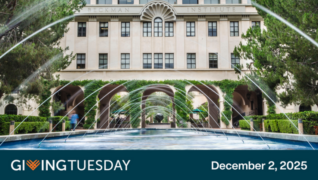

A $10 donation to Caltech on Giving Tuesday may not buy lab equipment, but it can help researchers prove their ideas work — unlocking the potential for major grants.
As the global charitable movement arrives Dec. 2, Caltech is positioning its participation as “startup funding,” according to Mark Casey, executive director of annual giving programs. These modest gifts provide proof-of-concept money that Casey says “unlocks” larger funding once feasibility is demonstrated.
“People sometimes feel like their gift doesn’t matter [if] it’s not very large. They may think, well, $10, what might that help?” Casey said. “But the reality is there are a lot of projects that need startup funding or what’s called ‘seed funding’ to create proofs of concept research to find the answer to a question that might be a small question at the start.”
Casey explained that unrestricted donations often support new labs and early-stage research, which then in turn, attract larger grants.
“Like anything else, if you are doing something that takes a lot of money and resources to do, people want to know that it’s going to work before they invest that money,” he said.
Examples of Caltech research supported by such funding include the RoAM Initiative — Robotic Assisted Mobility — which explores how robots, engineering and machine learning can help people unable to walk do so again.
During the most recent Olympics, an individual at the Paralympic ceremony carried the torch using a robotic exoskeleton produced by a company collaborating with Caltech on the technology. At the intersection of genetics and healthcare, a Caltech lab investigates the “gut brain axis” — microorganisms in the digestive system and their impact on brain function, specifically concerning Parkinson’s disease.
Casey noted that proof-of-concept research can take less than a year and relatively little money.
“It may only take a small amount of money over the course of one year or even less to do the research to say, is this feasible? Is my theory about this, whether it’s a cell or a plant or an engineering trait, is this going to be true? Is it feasible? Is it workable? And it doesn’t take that much money to prove that out,” he said.
The cumulative effect, Casey added, builds across the institution.
“Those startup funding, the new lab creation and the operational expenses that those types of gifts can help support, it really does build and create a ripple effect across the whole university at Caltech.”
Caltech’s Giving Tuesday and Giving Day campaigns emphasize unrestricted funds that can be directed where needed most. Casey said broad messaging resonates with diverse audiences, extending beyond students, alumni, faculty and staff to the general public. For alumni, he described the campaigns as creating a “nostalgic effect” that reconnects them digitally to campus life.
Giving Tuesday remains an international fundraising day, with Caltech joining organizations worldwide in inviting support for its research and community.
You can donate to Caltech on Giving Tuesday, including small amounts, through the official Caltech Giving Tuesday donation platform at https://giving.caltech.edu
or directly on their Giving Tuesday page at GiveCampus: https://www.givecampus.com/
These sites accept a range of donation sizes, so small contributions are welcomed and can be made securely online with a credit card or other digital payment methods.
 Get our daily Pasadena newspaper in your email box. Free.
Get all the latest Pasadena news, more than 10 fresh stories daily, 7 days a week at 7 a.m.