









For hundreds of students from Caltech and universities around the country, a summer internship at Jet Propulsion Laboratory offers more than a glimpse of science and engineering. It’s a chance to play an active role in discovery and exploration. This program has created a talent ecosystem whose influence reaches from the frontiers of quantum physics to the halls of NASA.
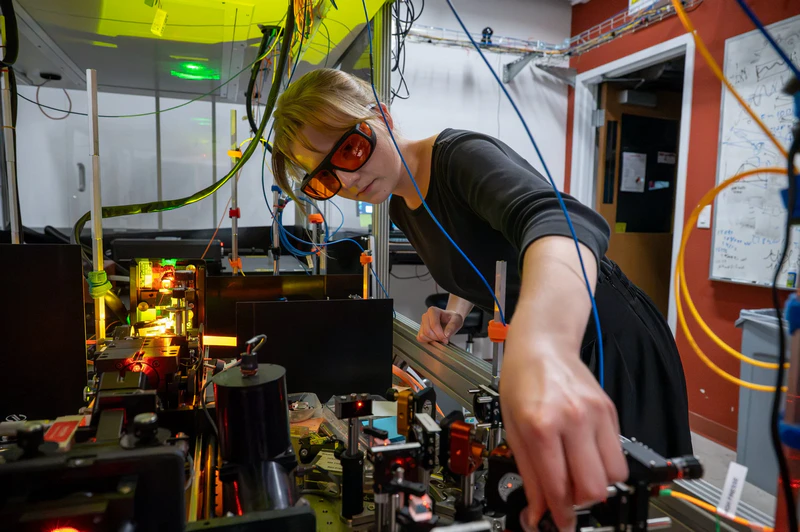
During the academic year, Tatyana McVay, a Caltech undergraduate student in physics, studies polyatomic molecules with potential applications in quantum computers.
But this summer at JPL, which Caltech manages for NASA, McVay has turned her attention to a very different problem: extreme weather. For her, the leap from quantum physics to atmospheric science is not so dramatic as it may seem—at least not at a place like Caltech.
“At most places, you can’t really exercise your skills in new fields,” she says. “You can only really do that at places that allow you to explore.”
McVay is one of approximately 500 students completing 10-week internships at JPL this summer and one of the 38 students in this year’s intern class who are enrolled at Caltech.
Across the full 2025–26 academic year, Caltech was the Laboratory’s top feeder school. But Caltech’s reach extends beyond its own campus: Another 179 students from universities around the country participated in Summer Undergraduate Research Fellowships (SURF) at JPL or the JPL Summer Internship Program, both administered with support from Caltech’s Student-Faculty Programs office.
Together, these pathways contribute to something larger than a conventional internship: They create a national training ground for emerging scientists and engineers in which students are entrusted with real research questions, encouraged to cross disciplinary boundaries, and surrounded by experts dedicated to cultivating the talent that will carry science and exploration into the future.
“At most places, you can’t really exercise your skills in new fields,” she says. “You can only really do that at places that allow you to explore.”
At the Center of Discovery
The Caltech JPL model has deep roots. More than two decades before NASA was created, Caltech students and researchers worked side-by-side on daring rocketry experiments in the Arroyo Seco, pursuing ideas that led to Caltech’s founding of JPL in 1936.
Caltech later formalized a culture of undergraduate research in 1979 with the SURF program, which began with 18 students, 17 faculty mentors, and a founding premise that remains central to its identity: Undergraduates would not simply assist established researchers. Instead, under expert guidance, they would propose and pursue meaningful projects of their own. The program soon expanded to JPL.
“Nationally, undergraduate research is recognized as a high-impact practice—teaching and learning practices that have been widely shown to increase student retention, improve engagement, and support students’ persistence to graduate school,” says Candace Rypisi, Caltech’s Assistant Vice Provost and Director of Student-Faculty Programs. “For students in STEM, it is a chance to apply what they are learning in the classroom to help solve real-world research questions. Beyond the research, students in these programs have many opportunities to participate in workshops, seminars, and networking events geared to supporting their academic and professional journeys. There is a natural research and educational synergy between Caltech and JPL—both are passionately committed to preparing the next generation of leaders.”
Nick Hutzler, Caltech professor of physics, credits a summer internship at JPL with changing his scientific trajectory. Today, Hutzler spends his days trying to answer one of the oldest questions in science: why the universe is made of matter at all rather than the antimatter that should have canceled it out at the big bang. He’s chasing the answer not with a particle collider, but with a tabletop laser experiment—the kind of audacious, do-it-yourself physics Caltech is known for.
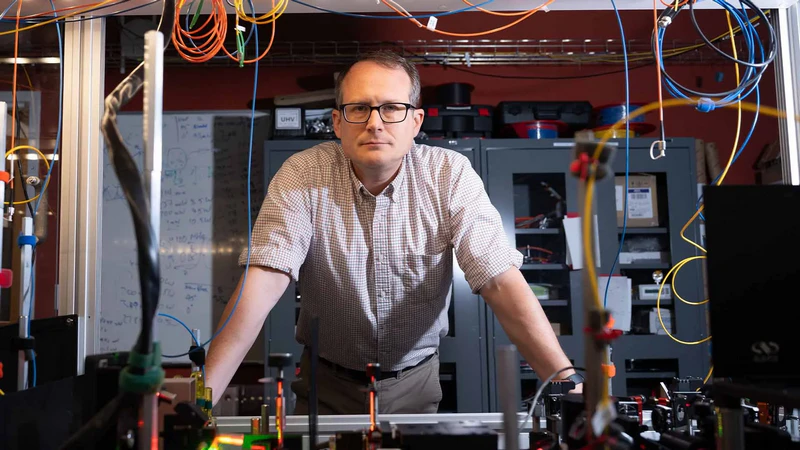
“We approach problems like: Here’s what we want to do, and we don’t know how to do it, so let’s figure out how to do it,” Hutzler says. “It’s about problem-solving and free thinking. It’s not about just following steps.”
By his own account, the onetime Caltech math student might have never become a physicist but for signing up for a SURF internship at JPL. “It is an actual NASA research lab, and I was in there learning how to do research,” he says. “The summer before that, I was working as a busboy. Caltech students participate in real research. It’s not about being a lab technician or a bottle washer. You are actually a part of the team. I learned how to be a scientist during that internship, and we all succeeded in our goals—we contributed something useful to NASA, and NASA contributed something useful to me and to all the other students.”
The long-term impact of experiences like Hutzler’s is evident across JPL and NASA. Before Amit Kshatriya (BS ’00) became NASA’s associate administrator, chief engineer, and highest-ranking civil servant, he was a 1998 SURF intern at JPL. Charles Elachi (MS ’69, PhD ’71) joined JPL as a student intern in 1970 and went on to direct the Laboratory from 2001 to 2016, overseeing an era that introduced NASA Mars rovers as well as new ways of exploring the solar system and beyond. NASA astronaut Jessica Watkins, who later held a postdoctoral fellowship at Caltech, completed several JPL internships as a UCLA graduate student, contributing to work on asteroid research, the Curiosity and Perseverance Mars rovers, and Mars Sample Return.
Hutzler, meanwhile, is now helping to provide similar opportunities to a new generation of students.
Breaking Boundaries, Building Scientists and Engineers
McVay is one of the students mentored by Hutzler. Her cross-disciplinary perspective has origins outside the lab. As a child, McVay experienced the destructive force of extreme weather when her family lost their Georgia home to a tornado, fueling an interest in storm chasing.
With the ability to explore beyond the conventional boundaries of her field, she was able to spend her JPL internship researching extreme weather.
That kind of intellectual freedom is emblematic of the Caltech JPL culture, in which disciplines are intentionally porous. Researchers move easily across fields, sharing tools, expertise, and resources—and building collaborations that extend from laboratories on campus to those at JPL. “We all are learning from each other and sharing the tools,” Hutzler says. “Caltech works really hard to keep those walls nonexistent, because they’re needless administrative hurdles that too often stifle innovation.”
“Caltech works really hard to keep those walls nonexistent, because they’re needless administrative hurdles that too often stifle innovation.”
From Fundamental Questions to Public Impact
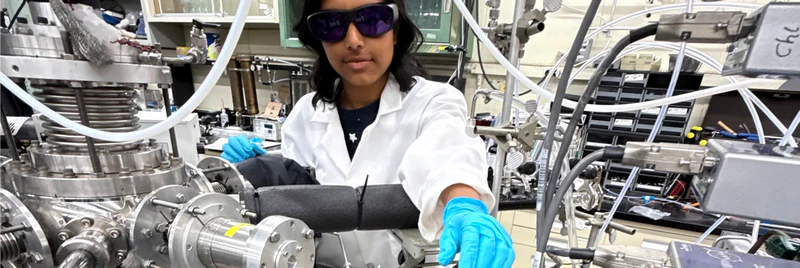
Riddhi Sadhanala, a Caltech undergraduate student, spent her JPL internship studying how carcinogens can be removed from the atmosphere through reactions with hydroxyl radicals under different temperature conditions. The research is closely connected to the heavily industrialized region of Louisiana sometimes referred to as “Cancer Alley.”
The work starts at the molecular scale, but its implications extend to modeling air pollution and supporting public health efforts in communities near industrial sites.
“I’m very passionate about investigating fundamental science that has such a very direct and relevant impact on society,” Sadhanala says. “Our culture at Caltech is basically a fearless love of learning. And that extends to JPL in the same way, whether applied to missions or research.”
Hutzler describes fundamental research as the seed from which later applications grow. The building blocks that become new products, technologies, and scientific advances, he says, begin with foundational inquiry. Whether on campus or at JPL, interns can watch that progression up close—and sometimes take part in more than one stage of it.
A Culture Built for Exploration
For student Alana Nisperos, a chemist drawn to planetary science, the connection between fundamental questions and space exploration is especially vivid. She studies how clouds and aerosols form in planetary atmospheres. The work bears on questions both practical and profound: how to improve atmospheric models, how to interpret observations of other worlds, and why Earth developed conditions capable of supporting life while a neighboring planet such as Venus did not.
For Nisperos, the Caltech JPL relationship is inseparable from the history of both institutions. “It’s just scientists at Caltech who wanted to explore this kind of new field, and then they created JPL,” she says. “We are linked by history, but also by current collaboration.”
While exploring the archives at JPL, Nisperos was struck by the original sketches for the Voyager mission, and especially by the Golden Record carried by the two probes into space, containing sounds and music meant to represent life and culture on Earth. “How can we boil humanity down to very simple things,” she asks, “and explain humanity to someone who’s never experienced humanity before?”

That kind of question, expansive and even audacious, defines the Caltech JPL spirit.
“Caltech and JPL have a tremendous audacity and fearlessness in the kinds of things they do,” Hutzler says. “Institutions which take this approach are becoming increasingly rare, and having two of them in the same city and with such deep ties is an extraordinary resource.”
“Caltech and JPL have a tremendous audacity and fearlessness in the kinds of things they do.”
Interns have a chance to find their place within that shared culture before their paths are fixed. A math student can discover physics. A physicist can investigate extreme weather. A chemist can connect molecular research to planetary science or public health. For NASA and the nation, the true return on a summer’s worth of research may be a new generation of scientists and engineers who have learned to ask difficult questions, cross boundaries, build what does not yet exist, and carry exploration forward.
 Get our daily Pasadena newspaper in your email box. Free.
Get all the latest Pasadena news, more than 10 fresh stories daily, 7 days a week at 7 a.m.