


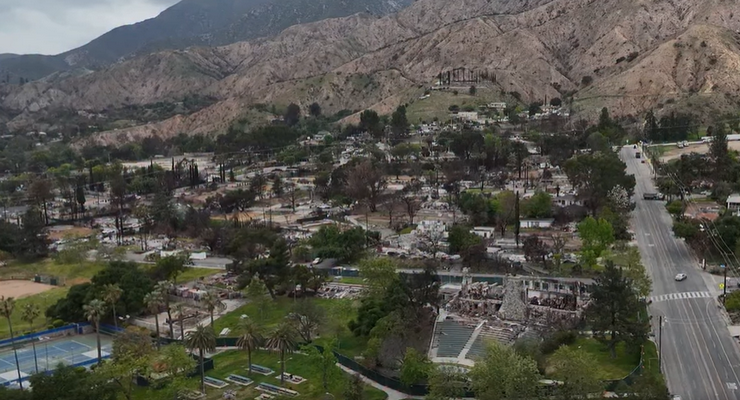
Los Angeles County supervisors on Tuesday, Sept. 15, ordered regular progress reports on a second independent review of the January 2025 fires, a study that found residents returned to Altadena without the access-pass system used in the Palisades burn area.
The review concluded the county lacks an updated recovery plan and a formal repopulation decision framework, and that many of the structures the county built in real time depended on improvisation and individual relationships rather than standing plans and rehearsed systems. The motion by Supervisors Kathryn Barger and Lindsey P. Horvath was approved unanimously, according to a news release issued by Horvath’s office. The release said the motion requires regular reporting on implementation, including who is responsible, what resources are needed and what barriers must be addressed to complete near-, mid- and long-term recommendations, and that it calls for a dedicated third-party administrator to track progress and strengthen coordination with local, state and federal partners.
The motion sets a reporting clock of written updates every 30 days, a verbal report in 90 days and reports every six months after that, and directs departments to immediately carry out recommendations left over from the 2018 Woolsey Fire review and report on those every 90 days.
“This motion ensures these recommendations don’t sit on a shelf,” said Barger, whose district includes Altadena. “A recommendation on paper does not change someone’s experience in a disaster. Implementation does,” Horvath said. Both supervisors were quoted in the news release.
The Eaton Fire burned the unincorporated communities of Altadena and Kinneloa Mesa along with Arcadia, Pasadena and Sierra Madre, and most of the residents who answered the review’s survey came from that burn area.
On repopulation, the report found that multiple entities in the Palisades burn area issued separate access passes with different formats, colors and eligibility criteria before converging on a unified design, and that the Eaton Fire footprint did not operate the same pass system. Checkpoint credentialing and information were inconsistent across the two burn areas, leaving residents confused about whether they were eligible to return and which credentials would be honored, the report said. It also found that repopulation decision authority was not clearly understood across agencies, and it recommended a formal Repopulation Plan, including a single access credential standard, led by the Los Angeles County Sheriff’s Department.
The review drew 1,500 public survey responses, 985 of them from the Eaton Fire footprint, 417 from the Palisades footprint and 98 from the rest of the county. Respondents were predominantly homeowners, and 41% were 65 or older.
The review covers Jan. 7 through March 31, 2025, and lists 26 findings and 25 recommendations across communications, volunteer and donations management, recovery, repopulation, sheltering and public health. It states that it is not an investigation and does not assign blame. It credited county workers and their partners with one of the fastest debris removal operations on record, carried out without pre-positioned contracts, pre-built tools or a formal debris management plan; county statistics cited in the report show more than 2.6 million tons of fire debris removed. It also found no evidence that county agencies intentionally withheld services from any population.
Of the 85 Woolsey Fire recommendations the review examined, 30 had been carried out before the January 2025 fires, six were in progress and 15 had no confirmed update. One gap the review tied back to Woolsey involved donations. The county’s cash donation system was not ready when public giving interest peaked, and the live donation link was not added until Feb. 11, 2025, more than a month after the fires started.
Erin Sutton, a McChrystal Group partner, told supervisors “the short answer is that your people delivered, but the systems behind them didn’t always help them do it,” Los Angeles magazine reported. “This is not a criticism of the workforce. It is a description of risk,” she said. Kevin McGowan, director of the Office of Emergency Management, told the board that about 70% of the 90 recommendations from the county’s first review are completed or underway.
Altadena survivors told the Los Angeles Times the findings matched their experience. “L.A. County doesn’t have a plan for disasters — that’s a ticking time bomb,” said Sylvie Andrews, who advocates for Altadena’s recovery. Shawna Dawson Beer said, “It’s clearly a pattern, with no accountability structure.” Barger told the Times she wants every recommendation to have “a responsible department, a clear timeline, and a way for the Board and public to measure whether it is actually operational.”
The first McChrystal review, released Sept. 25, 2025, examined alert notification systems and evacuation policies. The county’s contract for that report was about $1.9 million, according to the County Counsel. The new report lists other reviews of the fires being conducted by the Governor’s Office through the Fire Safety Research Institute, the California Attorney General and the California State Auditor, among others.
The county’s recovery bulletin lists a Disaster Preparedness Fair in Altadena later this month.
Saturday, Sept. 26, from 10 a.m. to 2 p.m. Altadena Community Center, 730 E. Altadena Drive, Altadena.
 Get our daily Pasadena newspaper in your email box. Free.
Get all the latest Pasadena news, more than 10 fresh stories daily, 7 days a week at 7 a.m.