


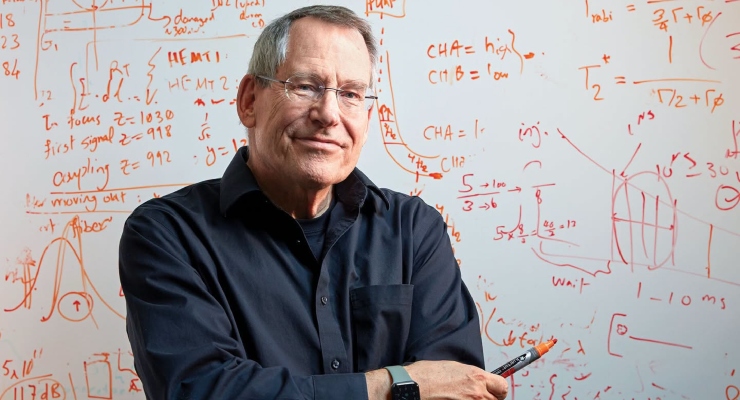
Quantum Zeitgeist, an international publication covering the quantum computing industry, published a feature profile on July 1 crediting Caltech theoretical physicist John Preskill with providing the field its defining vocabulary: “quantum supremacy,” the term for the moment a quantum computer outperforms any classical machine, and “NISQ,” short for noisy intermediate-scale quantum, the label scientists and companies use for today’s generation of still-imperfect quantum devices.
The profile, published under the outlet’s “Quantum People” section, describes Preskill as having “done more than almost anyone to give quantum computing its language,” according to the publication.
Preskill, 73, has worked at Caltech’s Pasadena campus since 1983. He holds the Richard P. Feynman Professorship of Theoretical Physics and the Allen V. C. Davis and Lenabelle Davis Leadership Chair of the Institute for Quantum Science and Technology.
He first used the term “quantum supremacy” in an October 2011 talk at the 25th Solvay Conference on Physics in Brussels, later publishing the concept in a 2012 paper. He introduced NISQ in a 2018 paper in the journal Quantum.
Both terms stuck. When Google claimed in 2019 that its 54-qubit processor had achieved quantum supremacy, the debate that followed used Preskill’s framing. Researchers worldwide now describe their hardware as “NISQ-era” devices, a phrase lifted directly from his work.
“I proposed the term ‘quantum supremacy’ to describe the point where quantum computers can do things that classical computers can’t, regardless of whether those tasks are useful,” Preskill wrote in Quanta Magazine in 2019.
Preskill did not start in quantum computing. He earned his Ph.D. at Harvard in 1980 under Nobel laureate Steven Weinberg, studying particle physics and cosmology. His early work on magnetic monopoles helped motivate the theory of cosmic inflation.
He shifted in the mid-1990s, drawn by Peter Shor’s 1994 discovery of a quantum algorithm for factoring large numbers.
“I realized with the discovery of Shor’s algorithm that it really meant there was a big difference between what problems we’d be able to solve and which ones we’d never be able to solve with computing technology because it’s a quantum world instead of a classical one,” Preskill said in an oral history conducted for the American Institute of Physics, as quoted by Caltech Magazine.
In 2000, he founded the Institute for Quantum Information at Caltech, the precursor to today’s Institute for Quantum Information and Matter, an NSF Physics Frontiers Center. The institute celebrated its 25th anniversary in 2025.
Preskill remains active. In 2025, he published a paper in ACM Transactions on Quantum Computing proposing the “megaquop machine” — a quantum computer capable of roughly one million reliable logical operations — as a milestone for the post-NISQ era. In July 2026, he co-authored a paper with researchers from MIT and Google Quantum AI establishing criteria for verifiable quantum advantage.
His credentials extend beyond publications. He is a Fellow of the American Physical Society, a member of the National Academy of Sciences, and the recipient of the 2024 John Stewart Bell Prize. In 2022, he was appointed to the National Quantum Initiative Advisory Committee, the federal body advising the White House on the direction of American quantum research.
Quantum Zeitgeist, which publishes daily news and analysis for researchers, engineers, investors, policymakers, and technology leaders, was founded in 2018 and operates as an independent outlet. The publication’s profile of Preskill traced his career from Highland Park, Illinois, through Princeton and Harvard to his four-decade tenure at Caltech.
“Companies are now pursuing ambitious plans to build the world’s most powerful quantum computers,” Preskill said in remarks at the 2025 Quantum World Congress, where he received the Academic Pioneer in Quantum Award. “Let’s not forget how we got to this point. It was by allowing some of the world’s most brilliant people to follow their curiosity and dream about what the future could bring.”
Preskill’s office sits in the Annenberg Center at Caltech — the same campus where Richard Feynman, the physicist for whom Preskill’s chair is named, first envisioned quantum computers more than four decades ago. The vocabulary the field uses to measure how far it has come since was built there, too.
 Get our daily Pasadena newspaper in your email box. Free.
Get all the latest Pasadena news, more than 10 fresh stories daily, 7 days a week at 7 a.m.