




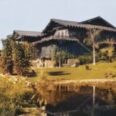


The federal document that put the bungalow at 462 S. Marengo Ave. on the National Register of Historic Places runs to nine continuation sheets. It records the original owner, W. D. Russell; the architect, C. W. Buchanan; the contractor, Leonard Bukowski; a construction date of 1904; and the exaggerated bellcast of the roof dormer. It does not even mention the house’s most historical claim to American history: Mary See perfected her delicious chocolate recipes in the house’s kitchen.
See’s Candies celebrates Mary See’s birthday, her 172nd, on Wednesday, Sept. 16.
The company’s own account of its origins places the black-and-white identity it has carried for a century in the kitchen of that Pasadena house. The 1982 nomination that gave the house federal standing places its significance somewhere else entirely: in the street it sits on and the quality of its carpentry.
There is no candy in any of it. The description, the statement of significance and the bibliography carry no reference to Mary See, to her son Charles, or to See’s Candies.
What the company says happened in that house is the reason the address is known at all. See’s Candies says Mary See was born Mary Wiseman in Ontario, Canada, in 1854, married Alexander See at 20, and developed her candy recipes while helping run her husband’s hotel in the Thousand Islands. It says the family settled in Pasadena in a post-Victorian bungalow, that Mary made candy in its black-and-white kitchen, and that Charles chose the checkerboard theme for his first Los Angeles shop because that kitchen inspired it.
Pat Egan, president and chief executive of See’s Candies, was asked in written responses how the company came to document that detail. “See’s has always been intentional about preserving the history of the company and the people who built it,” he said. “We’ve been fortunate to have photographs, family stories, recipes and traditions that have been with us since the beginning.” Of the kitchen itself, Egan said: “The Pasadena kitchen is a tangible piece of that history, and the checkerboard design that came from it became part of the See’s identity.”
Asked whether anyone from the company had ever visited the house, Egan said no one had been recently. “The house is still standing in Pasadena, more or less as it was, and has since been converted into an office for a professional business, so it has certainly had a storied life of its own!” he said. “We haven’t visited in person recently, but have treasured photos of when Mary, Charles and the family lived there while getting this startup off the ground.” The connection, he said, has run through the company’s own files: “the photographs, records and personal accounts that document Mary’s time in Pasadena and her influence on the company.”
The recipes are the part of the claim that is checkable against the product case. “We still make Peanut Brittle, Victoria Toffee, Chocolate Walnut Fudge and hand-dipped Bon Bons using her original recipes,” Egan said. “She developed these before See’s was officially founded and the recipes she developed became the foundation for what Charles brought to customers when he opened the first See’s shop in Los Angeles in 1921.”
That last point is the one most often lost. There was no See’s shop in Pasadena while Mary See lived here. The first store opened in 1921 at 135 N. Western Ave., in the Los Angeles neighborhood now called Koreatown, in a two-story Italian Renaissance revival building painted the white that came to be called See’s white. Its candy kitchen was at the back. The free sample handed to every customer started there. The Pasadena house supplied the recipes and the color scheme; Los Angeles supplied the business.
The arrival date is itself unsettled. Egan said Mary and Charles moved to Pasadena from Ontario in 1919. The Los Angeles Public Library’s account of the company puts the move in the spring of 1920, when Charles came with his wife, two sons and his recently widowed mother. Charles A. See had been selling for the Merckens chocolate manufacturer in Toronto. His father had died on July 15, 1919.
Mary See did not stay. She moved back to Gananoque, Ontario, and died there on July 31, 1939, at 84, buried at Willowbank Cemetery beside her husband. Her headstone gives her dates as Sept. 16, 1854 to July 31, 1939 — the date the company observes.
The house outlasted her by a long way. County-sourced property records list 462 S. Marengo Ave. today as a one-story office building of 2,698 square feet on a quarter-acre lot, built in 1903 and last altered in 1987, in what is now called the Playhouse District. The 1981 nomination measured it at roughly 3,000 square feet as a residence; the two figures bracket a conversion the federal listing never contemplated. The Los Angeles Public Library account describes the same building, no longer a residence, converted to professional office space.
The nomination’s photo log records one more thing worth chasing. In June 1981, Sicha photographed 462 looking east, and logged the negative as held at Pasadena Heritage, then at 54 W. Colorado Blvd. Pasadena Heritage, now in its 50th anniversary year and led by executive director Dr. Bridget Lawlor, prepared the nomination that left the See story out.
The company that grew out of the kitchen is now one of Berkshire Hathaway’s better-known holdings. Blue Chip Stamps, controlled by Warren Buffett and Charlie Munger, bought See’s for $25 million in January 1972. Buffett later wrote that sales were $30 million and pre-tax earnings less than $5 million at the time, on $8 million of required capital. Munger’s own Pasadena chapter came afterward: Blue Chip took a position in Wesco Financial the following year, and Munger chaired the Pasadena company, at 301 E. Colorado Blvd., from 1984 until 2011. He died in November 2023 at 99.
See’s Candies is headquartered in South San Francisco and operates more than 200 shops, with about 1,500 year-round employees. Greg Abel, who became Berkshire Hathaway’s chief executive at the start of 2026, appeared alongside Egan at the company’s booth at the May 1 shareholder meeting in Omaha. The candy company reaches its 105th year in November.
“Pasadena is an important part of our story because it’s where Mary and Charles lived in California as See’s was officially founded,” Egan said. “That connection to Mary is still very much a part of See’s today.”
The observance itself is a sales calendar. See’s is running eight Deals of the Day from Sept. 12 through Sept. 19 and a sweepstakes that opened Aug. 24 and closes Sept. 19, with a grand prize of a one-pound box every month for a year. Locally, See’s operates shops at 3641 E. Foothill Blvd. in Pasadena and 464 Fair Oaks Ave. in South Pasadena, open 10 a.m. to 7 p.m. Monday through Saturday and 11 a.m. to 6 p.m. Sunday.
The bungalow at Marengo and Bellevue is private office space and is not open to visitors. From the sidewalk, what is federally protected about it remains what Sicha wrote down in 1981: the bellcast dormer, the notched rafters, the leaded transom. The kitchen is not in the file.
 Get our daily Pasadena newspaper in your email box. Free.
Get all the latest Pasadena news, more than 10 fresh stories daily, 7 days a week at 7 a.m.


