









Nearly 22 months after the Eaton Fire devastated the community, residents are still confronting a fundamental question: Is the ground beneath their homes safe?
The Dena Soil Project brought scientists, environmental advocates and neighborhood organizations together for a community celebration that combined free soil testing with native plant giveaways, family activities and practical advice about restoring fire-affected properties.
Under a row of white canopies, residents delivered soil samples for testing while children played games and collected Halloween treats. Nearby, volunteers distributed California native plants, and representatives of the Fire Poppy Project and other community organizations shared information about recovery.
Jessica Handy, co-founder of Community Compound, which oversees the Dena Soil Project, said the gathering was intended to make environmental recovery accessible to families already facing enormous rebuilding expenses.
“There’s a barrier though, there’s a cost,” Handy said, explaining that contamination concerns extend beyond destroyed properties to homes that survived the flames.
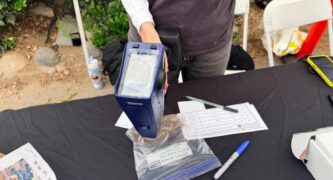
With support from university partners, scientists offered free preliminary testing using an X-ray fluorescence instrument, known as an XRF, capable of identifying heavy metals in about a minute.
Dr. Daisy Rosas Vargas, a chemist working with Soil Wise, demonstrated the handheld device, which analyzes soil for metals including lead, arsenic, cobalt and cadmium.
The results varied considerably.
“Some have had really high levels above RPA thresholds and other folks have had really nice, low, healthy levels,” said Adrian Jones, a biology and environmental science professor at Mount St. Mary’s University.
The scientists emphasized that the screenings provide preliminary information, not certified laboratory results suitable for insurance claims or legal proceedings. Jones estimated that laboratory testing costs about $100 per sample.
Rosas Vargas said contamination levels can change as construction, rainfall and shifting dust alter conditions around recovering neighborhoods.
The project, supported by the California Fire Foundation and California Community Foundation, plans to continue providing soil testing and remediation assistance into 2027.
Handy also hopes to establish a community resource hub offering mulch, compost and information about restoring damaged landscapes.
For families rebuilding their homes, she said, restoring the soil is equally important.
“We want to make sure that families can return back to land that is non-toxic.”
 Get our daily Pasadena newspaper in your email box. Free.
Get all the latest Pasadena news, more than 10 fresh stories daily, 7 days a week at 7 a.m.