


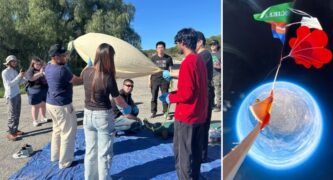
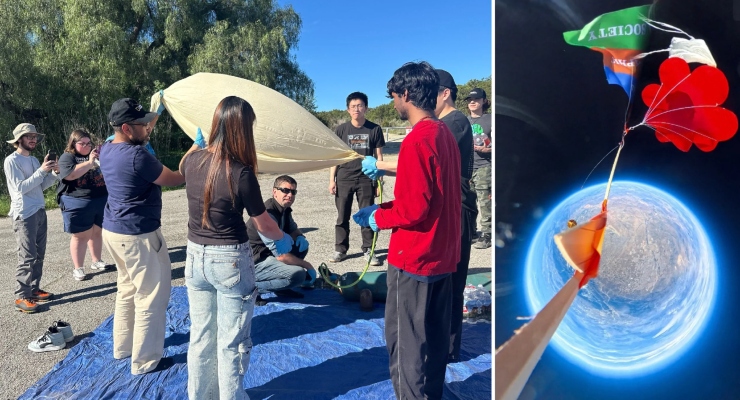
For years, Andy Klesh’s students have gone through a dress rehearsal for what it takes to design and then send a project to space. His course, Practical Electronics for Space Applications, is taught every two years and has typically used balloons to loft student payloads up to nearly 100,000 feet to see how they perform in a near-space environment. This year, though, the balloon test was just the beginning, and the sky is not the limit.
For the 2025-26 EE 154ab course, Caltech and the Jet Propulsion Lab, which the Institute manages for NASA, are collaborating with the National Geographic Society’s Explorers program through Caltech’s Brinson Exploration Hub. As the two-term course approaches completion, students are working toward its culminating objective: designing and building spaceflight payloads that address biological research questions proposed by National Geographic Explorers. Once built and tested, those instruments will travel to the International Space Station on a launch scheduled for early 2027.
During the first term, which happened in winter 2026, the course followed its familiar pattern: The students built instruments to test aboard a high-altitude balloon launch, an event they organized themselves, says Klesh, a visiting associate in planetary science, associate director and chief systems engineer for the Brinson Exploration Hub, and a lecturer in electrical engineering. “They planned a project for a flight environment, and then they went and executed it. They’ve then taken that knowledge into the second term where they have requirements for the payloads from the National Geographic Society.”
In previous years, during the course’s second term, Klesh would give students what he affectionately calls the “antagonistic payload” — one that he had programmed to actively work against the students as way to present them with the types of problems that crop up in real spacecraft such as data errors, interference, and overheating. This time around, there was no need to invent difficulty: From the start of the second term, which took place this spring, the students had just nine weeks to design, build, and test a space-ready system of cameras, sensors, and other payloads.
Third-year undergraduate Jeylin Lee says she decided to take the course after settling on electrical engineering as a major and astrophysics as a minor, seeing Klesh’s course as a fascinating unification of the two. She is a member of the thermal team, one of five subgroups each working on a particular payload problem. One of thermal team’s chief challenges is to devise an instrument that maintains a constant temperature in space because the mission will include samples of microscopic organisms collected in the local ecosystems of Thailand, Zambia, and the United States by ecologists and biologists from those countries serving as National Geographic Explorers. The Explorers will analyze those samples to study biological resilience under extreme conditions of microgravity and radiation.
“It’s definitely very new for a lot of us to learn about how electronics work in space,” Lee says. “A bunch of the things Professor Klesh taught us, and that we practiced doing last term, were about how to design systems and electronics specifically for the space environment. One example is that in space, there’s no convection. So, heat transfer is very different in a vacuum environment.”
Second-year Daniel Wareham worked on the payload team, which involved building and programming equipment, connecting various pieces together, and writing the code to record data. He focused on integrating a 360-degree camera for the balloon flight, including performing tests to see whether the camera could survive the cold, vacuum environment of space.
“It’s not like a problem set where there’s an answer key,” Wareham says. “I feel the main benefit of this class is learning how to be an engineer who has to do your own research and figure things out by yourself. Dr. Klesh nudgesus in the right direction. He’s not telling us what to do. I think out of all of my professors, he’s certainly someone who very often says, ‘I’m not going to tell you the answer, but I’ll give you some suggestions.’”
A huge part of the challenge, Wareham says, is that so many things must happen in parallel. Indeed, as the course approached its conclusion, the students faced a pressure-packed final stretch in May. “Now everyone’s done their own part, and we have to bring everything together,” Wareham notes. “And, almost always, things break when you try to bring the work of multiple people together.”
The first-term balloon mission helped prepare the team for the challenges ahead, says Vishal Yalla, a Caltech first year majoring in mechanical engineering and aerospace. He served as flight director for the high-altitude balloon mission, which he defines as “pretty much the guy who is steering the boat.” The students had to navigate every part of the mission themselves, right down to when the launch would happen, which turned out to be bright and early the morning of February 28, 2026. “We weren’t given a launch time. That is something that we had to figure out. We had to evaluate weather conditions, predict the balloon’s trajectory, coordinate recovery logistics, secure permissions, and make sure we complied with all FAA [Federal Aviation Administration] regulations among many other details. This is the real world.” Following a successful launch, the balloon ascended into the stratosphere before descending roughly 200 kilometers inland along its predicted flight path. The students then spent the remainder of the day tracking down and recovering the payload, chasing it across the California desert to complete the mission.
Some of that work will happen in the campus Resnick Sustainability Center’s clean room facilities, an opportunity Lee says she is looking forward to. “We’re going to learn how to suit up in cleanroom garb and go into the clean room to actually put that stuff together,” she says.
The term will end with a design review in which the students will showcase their builds to NASA and the National Geographic Society to ensure that everything is ready to go forward. Launch of the payload on board a SpaceX rocket is currently slated for spring 2027.
For the students who wanted a taste of real spaceflight, the course has already been the experience of a lifetime. “It’s all easy on paper,” Yalla says, “but once you get hardware on the ground and hardware in the lab, it’s always a challenge. If there’s one takeaway from this course, it would be how to have that system engineering mindset and how to orchestrate many different teams, many different individuals, components, hardware pieces, and expertise to align them in a single mission and ultimately do something extraordinary.”
 Get our daily Pasadena newspaper in your email box. Free.
Get all the latest Pasadena news, more than 10 fresh stories daily, 7 days a week at 7 a.m.