





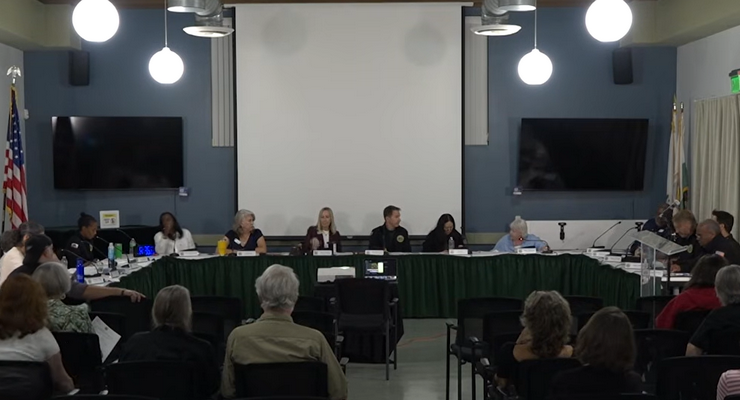
An Altadena Town Council member said Tuesday he and a colleague found no record of public input on license plate reader cameras gifted to the community by camera vendor Flock, as a new contract is being negotiated.
Council member Anton Anderson presented findings from work he and Council member Isis Moulden, who both represent Census Tract 4610, did in response to concerns from residents of their tract. He described the presentation at the council’s Sept. 15 meeting as a “work in progress” report, not one from a standing committee. Anderson said the data retention policy for the cameras is still being worked out. He also said the cameras have no current Altadena-specific oversight.
Town Council Chair Nic Arnzen announced that a community meeting on the cameras will be held. Arnzen said the meeting is still being shaped, and that the captain of the Altadena Sheriff’s Station is open to it, “as well as Flock representatives and perhaps county.” No date was announced.
Anderson said the Flock company “essentially gifted Altadena these cameras.” Flock also provided a one-year trial period of access to its network without charge, he said.
“There’s currently a new contract being negotiated,” Anderson said. “We were trying to find a record of where Altadena public community comment was being received. We weren’t able to find any record of public comment.”
The presentation did not identify who is negotiating the new contract, who would sign it, or what it would cost. The council took no action on the item. Arnzen asked members to hear the presentation and move directly to public comment. “Less talking, more listening,” he said.
70 cameras, two vendors
Anderson said there are 70 automated license plate reader cameras in Altadena. Forty are from Flock and 30 are from Motorola. A sheriff’s sergeant told him the count rises to 77 if cameras on the community’s border are included.
The presentation did not say who installed or pays for the 30 Motorola cameras.
Anderson called it a useful clarification that 70 cameras do not mean 70 locations. A single intersection may need several cameras to cover all angles and lanes, he said.
The Los Angeles County Sheriff’s Department declined to give the council members specific camera locations, Anderson said.
“We’re not going to give you the specific locations because then the bad guys know where not to go,” Anderson said sheriff’s officials told them. He said deputies are seeing people try to evade the cameras, including with license plate covers.
Anderson said about half of the cameras are west of Lake Avenue, and nearly half of those cover Census Tract 4610. The maps he showed came from deflock.org, which he described as crowdsourced.
That concentration, Anderson said, “kind of explains why so many of our residents were coming up to us saying, ‘Hey, what’s going on?'”
Anderson said residents in the tract were alarmed to see the cameras go up. He added that longtime West Altadena residents, including himself, “have had strong memories of when policing and surveillance were really sort of intensive back in the day.”
Sheriff’s rationale and guardrails
Anderson and Moulden met with sheriff’s representatives in early August and brought 15 questions, Anderson said.
According to Anderson, sheriff’s officials said camera placement is “intentional and strategic.” They said cameras target high-traffic and high-crime areas. In places where residents have not moved back in, or at night, the cameras are “the only witness,” Anderson said the officials told them.
Asked about cameras near schools whose field of view covers parts of parks, sheriff’s officials cited the public safety need related to school shootings, Anderson said.
Anderson said anything visible from the street is lawful to record. He said there are “some legal guardrails”: Officers have been trained, searches are logged, random audits are conducted and California law prevents sharing the data with federal authorities.
Residents cannot opt out because the cameras record public streets, he said.
Anderson called data sharing “a big problem.” He said the data retention policy is “TBD, still being worked out and a little bit murky.”
“Public oversight is a big concern,” Anderson said. He said the Sheriff’s Data Systems Bureau audits the cameras. There is no current Altadena-specific oversight, he said, and the matter is “not really” within the purview of an existing community committee.
Informal survey
The council members launched an online survey in mid-July and received 230 responses. Anderson stressed that the Google Form was “not like a scientific survey.” He said it was meant only to capture public sentiment.
Responses ranged from strong support to strong opposition, Anderson said. Regardless of stance, more than 50% of respondents said they wanted public input on how the cameras are deployed.
He said about half of respondents wanted tight control over how the data is managed. “A large chunk” said they did not want the data collected at all.
Privacy was also a major concern, Anderson said. Respondents wanted their civil liberties respected, and “a really large chunk” of them “just didn’t feel comfortable with this whatsoever.”
Anderson said he and Moulden are continuing to gather information and would like to share it with the council, followed by the town hall Arnzen described.
Residents divided
Twelve people commented on the cameras after the presentation, including one whose written comment was read into the record, and most opposed them.
Robert Staehle asked the council to request that the county prohibit broad surveillance by private companies in the community.
“I’m worried about when my beliefs and my preferences become illegal in the eyes of a future government and some private company is selling data for prosecuting what I consider my freedom,” Staehle said.
Lori Paul, who said she lives on Chaney Trail, called for the cameras’ immediate removal. She objected that the system was installed without public consultation. “They simply appeared in our neighborhood as a gift,” Paul said.
Yadi Younse asked, “Why isn’t there clarity on who signed the contract and who was told about this system?” She said L.A. Taco reporter Joey Scott has outstanding records requests with the Sheriff’s Department about the Altadena cameras, and she hoped the council would help “get to the bottom of” them.
A written comment from Emily Stowe, read into the record, said she saw four cameras per intersection on Hill Avenue. “The infraction on our civil liberties and right to privacy is not worth the mediocre gains,” the comment said.
Another speaker said mass surveillance of out-of-favor groups is “nothing new,” citing the surveillance of Japanese Americans before their incarceration in World War II. The speaker said AI has made surveillance “turbocharged” and asked, “Where is the statistical analysis showing that these things actually do anything?”
Sir James Bailey and a speaker identified as Susan also called for removing the cameras.
Brissa “Breezy” Page, founder of the Altadena Fire Brigade, asked why the community was donated cameras rather than evacuation sirens. “We need to protect lives,” she said. Page asked the council to seek sponsorship from utilities for sirens that could be installed in addition to the cameras if they are not removed.
The final speaker quoted Benjamin Franklin on trading liberty for safety and said, “I’m opposed.”
Supporters included John Hainer and Deb Halberstadt. Hainer said the couple bought a replacement home on a dark cul-de-sac west of Lake Avenue after their home on Marathon Road was incinerated. Theirs was the only one of 15 or 20 homes on the cul-de-sac that survived, he said.
Hainer said “lots of strange people” come and park on the street. He said the couple asked the sheriff for help, and the impact over time has been “substantial in decreasing the traffic of people that I find suspicious.” Hainer said he is “possibly paranoid,” but added, “I remain strongly in favor.”
Halberstadt identified herself as a sheriff’s volunteer. She said the cameras were designed to capture vehicle details, not people, and do not scan faces or collect biometric information.
Halberstadt also addressed where the cameras are concentrated. She said “maybe 50%” of the cameras are in West Altadena, “though I don’t know because that’s where most of the houses have disappeared. Don’t know for sure.” She said she hopes for more safeguards but wants the cameras to remain.
Connor Cipolla, a Town Council member, spoke during public comment as a private resident of Census Tract 4601. He said he saw neighbors’ homes robbed in the “total chaos” of the days and weeks after the fire, and “that’s when this technology was employed.” The technology has been “very useful” in investigations, he said.
“These are the only witnesses to know who violated their security,” Cipolla said, referring to neighborhoods where residents have not returned.
Earlier in the meeting, during general public comment, Mark Mariscal said the council “should be asking what crimes were actually solved by Flock cameras.” Mariscal also said “technology is here to stay.” He said working together as a community, “whether we are using our eyeballs or we’re using somebody else’s eyeballs, makes our community better.”
Scheduled Public Works presentation not given
Dominic Osmena of L.A. County Public Works was scheduled to present on Flock cameras alongside Anderson but did not present Tuesday.
Altadena Sheriff’s Station Capt. Ethan Marquez, who delivered the station’s report earlier in the meeting, did not address the cameras in that report.
Supervisor Kathryn Barger, then chair of the Los Angeles County Board of Supervisors, publicly supported the installation of Flock cameras in Altadena after the Eaton Fire, FOX 11 Los Angeles reported in 2025.
Pasadena’s parallel debate
The Altadena discussion comes as Pasadena debates its own Flock cameras.
Pasadena Now reported that the Pasadena City Council’s Public Safety Committee canceled its Aug. 19 discussion of the cameras for lack of a quorum. The committee’s April 15 meeting was also canceled.
At the Aug. 24 City Council meeting, Councilmember Tyron Hampton asked city staff to suspend use of the Flock cameras pending further discussion, Pasadena Now reported. Pasadena’s contract with Flock expires Sept. 25, 2027, according to ABC7.
Tuesday’s Altadena Town Council meeting was not livestreamed because of a connection issue, Arnzen said. The council will post the recording on its website.
 Get our daily Pasadena newspaper in your email box. Free.
Get all the latest Pasadena news, more than 10 fresh stories daily, 7 days a week at 7 a.m.


