






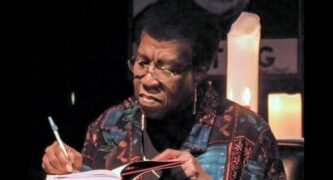

She also left behind a legacy that has only grown.
Butler’s archive is among the most actively researched collections at The Huntington, which currently features her notebooks and personal writings in the exhibition “Stories from the Library: From Brontë to Butler,” on view through June 15, according to the institution. The anniversary falls during Black History Month, and 2026 also marks 50 years since Butler published her first novel, Patternmaster, in 1976.
Butler was born on June 22, 1947, in Pasadena. Her father, Laurice, a shoeshiner, died when she was young. Her mother, Octavia Margaret Guy, worked as a housemaid to support the family. Butler’s mother had only three years of formal schooling, but she made sure her daughter had a library card.
“I didn’t like seeing her go through back doors,” Butler once said of accompanying her mother to clean houses in wealthier parts of Pasadena. The experience of entering through service entrances, of watching her mother endure disrespect, shaped Butler’s writing for the rest of her life. “I began writing about power because I had so little,” she said.
Butler was dyslexic. She was painfully shy. But she read constantly, spending hours at the Pasadena Central Library, and she began writing stories at age 10. By 12, she had turned to science fiction after watching a low-budget movie called Devil Girl from Mars on television. “I thought, I can write a better story than that,” she later recalled.
She graduated from John Muir High School in 1965 and earned an associate’s degree from Pasadena City College in 1968. She took writing classes at Cal State Los Angeles and UCLA, and in 1970 she attended the Clarion Science Fiction Writers Workshop, where she sold her first stories. For years afterward, she worked as a telemarketer, potato chip inspector, and dishwasher, waking at 2 a.m. each day to write.
Her first novel, Patternmaster, was published in 1976. Kindred, the 1979 novel about a Black woman transported to the antebellum South, became her best-known work and is now assigned reading in high school and college classrooms across the country. Her work is taught at more than 200 colleges and universities, according to her estate.
In 1984, her short story “Speech Sounds” won the Hugo Award. The following year, her novelette “Bloodchild” won both the Hugo and the Nebula, science fiction’s two highest honors. In 1995, Butler became the first science fiction writer to receive a MacArthur Foundation fellowship — the so-called “genius” grant — which came with a $295,000 prize. She received the PEN West Lifetime Achievement Award in 2000 and the Langston Hughes Medal from the City College of New York in 2005.
Butler died on February 24, 2006, in Lake Forest Park, Washington, after falling and striking her head on the walkway outside her home. Her memorial service was held at Lincoln Avenue Baptist Church in Pasadena. She was buried at Mountain View Cemetery in Altadena — where her grave survived the Eaton Fire that swept through the area in January 2025.
After Butler’s death, The Huntington became the repository of her papers. The archive arrived in 2008 in two file cabinets and 35 large cartons and eventually grew to encompass more than 8,000 individually cataloged items, according to the institution. “She kept nearly everything, from her very first short stories, written at the age of 12, to book contracts and programs from speaking engagements,” Natalie Russell, then assistant curator of literary manuscripts at The Huntington, has said.
Dr. Ayana Jamieson, assistant professor at Cal Poly Pomona and founder of the Octavia E. Butler Legacy Network, has called the collection “the most heavily used by researchers at The Huntington Library.”
The honors have continued to accumulate since Butler’s death. She was inducted into the Science Fiction Hall of Fame in 2010. In 2018, the International Astronomical Union named a mountain on Charon, a moon of Pluto, Butler Mons in her honor. Google featured her in a Doodle that same year.
In 2021, NASA named the Mars Perseverance rover’s touchdown site “Octavia E. Butler Landing.” The rover had landed on February 18, 2021, nearly 15 years to the day after Butler’s death. “I can think of no better person to mark this historic landing site than Octavia E. Butler, who not only grew up next door to JPL in Pasadena, but she also inspired millions with her visions of a science-based future,” Thomas Zurbuchen, then NASA’s associate administrator for science, said at the time.
In Pasadena, her presence is woven into the city. In 2022, Washington STEAM Multilingual Academy was renamed Octavia E. Butler Magnet — Butler’s former middle school and the first in the nation to carry her name. In February 2023, Octavia’s Bookshelf, an independent bookstore specializing in works by Black, Indigenous, and people of color authors, opened at 1361 North Hill Ave. in Pasadena, named in Butler’s honor. The City of Pasadena has proclaimed June 22 Octavia E. Butler Day.
The current Huntington exhibition, “From Brontë to Butler,” features manuscripts in which Butler wrote about wanting to “speak well and tell a good story,” according to the San Gabriel Valley Tribune. The exhibition, part of The Huntington’s ongoing “Stories from the Library” series, runs through June 15 at the institution’s San Marino campus.
Butler’s novel Parable of the Sower, published in 1993, is set in the years 2024 through 2027 — a timeline readers are now living through. The book imagines a near-future California ravaged by climate change, economic collapse, and social disorder. Its relevance has not gone unnoticed: sales of Butler’s books have increased significantly since her death, according to her estate’s website.
“Do the thing that you love and do it as well as you possibly can and be persistent about it,” Butler once told PBS. She practiced that persistence from a Pasadena childhood marked by poverty and segregation through decades of rejection and menial jobs to a career that changed American literature.
“Every story I create creates me,” Butler wrote. “I write to create myself.”
 Get our daily Pasadena newspaper in your email box. Free.
Get all the latest Pasadena news, more than 10 fresh stories daily, 7 days a week at 7 a.m.