









It is not.
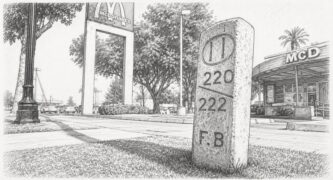
The carved “11” inside a circle, the block numbers “220” and “222,” and the initials “F.B.” identify it as the Foothill Boulevard Milestone — the Bancroft Marker — a relic of the road-numbering system Los Angeles County laid out in the early 1900s, more than two decades before the same pavement became Route 66.


It no longer sits exactly where it was set: in 1994, the marker was shifted about 25 feet east to make room for the McDonald’s driveway behind it.
It is the last of three such markers that once stood in Pasadena. The other two are gone. This one survives, listed on the National Register of Historic Places in April 1996, under a category that says almost everything about the story this street still has to tell: “Early Automobile-Related Properties in Pasadena.”
One modest stone, deliberately saved, standing in the very stretch of Colorado Boulevard that preservationists now consider the most at risk.
The marker is a fitting place to begin, because Colorado Boulevard is really akin to two different streets, carrying two different preservation stories — the one Pasadena saved — west of Lake Avenue — and the one it could still lose to the east.
The street Pasadena saved
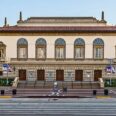
Travel west, and the success is unmistakable. Through Old Pasadena and the Civic Center, Colorado Boulevard bustled with activity, a living historic corridor — brick commercial blocks, hotels, theaters, banks, and government buildings that survived the twentieth century and are still in active use today (although some for decidedly different enterprises).

That survival was not an accident.
Pasadena Heritage Executive Director Dr. Bridget Lawlor points to the continued vitality of Colorado Boulevard as one of the city’s greatest preservation successes.
Unlike many communities where historic commercial corridors were bypassed, widened beyond recognition, or demolished outright, large portions of Pasadena’s Route 66 alignment remain recognizable and active.
According to Lawlor, the city protected much of its most architecturally significant fabric through landmark designation, historic districts, adaptive reuse, and sustained community advocacy.
The results are visible in the public record. The Old Pasadena Historic District, both sides of the street, was listed on the National Register in 1983. The Colorado Street Bridge, the War Memorial Flagstaff, City Hall, the Pasadena Playhouse — these are the landmarks an out-of-town visitor would name, and they are the ones the city moved to protect. West of Lake Avenue, preservation worked.
The pivot east
East of Lake, the story changes. This is the stretch most directly shaped by the automobile — by the Route 66 era and the postwar decades, when commerce catered to motorists rather than pedestrians. And it is here, Lawlor says, that Pasadena’s preservation record grows thin.
The resources most directly tied to automobile travel, she notes, have not received the same recognition or protection as the city’s celebrated civic architecture.
Midcentury motels and motor courts, service stations, roadside restaurants, and neon signs once lined East Colorado Boulevard. Many have already been demolished, significantly altered, or replaced.
As freeways diverted through-traffic away from the older corridor and tourism patterns shifted, the businesses that depended on that traffic declined — leaving the buildings, in Lawlor’s words, particularly vulnerable to redevelopment.
The vulnerability is partly economic. The midcentury motels were one or two story buildings on generous lots in a real estate market that now prizes exactly that kind of parcel for demolition and new construction.
Their “relatively low-rise development patterns make them attractive redevelopment sites in today’s real estate market,” Lawlor says.
Pasadena Heritage’s concern is for these categories of building as a whole — the motels, the showrooms, the auto sales lots, the garages, the neon — not for any single property.
It is also a problem of purpose. The buildings that defined the Route 66 experience were never meant to be monumental. They were built to be seen from a moving car: low, bright, vernacular, sometimes in the Googie and Mid-Century Modern styles that announced themselves with a sign rather than a façade.
Because they read as ordinary commercial buildings rather than heritage resources, Lawlor says, they are frequently overlooked when planning and preservation decisions are made.
Early auto showrooms, repair garages, and the surviving fragments of historic roadside signage often lack any formal recognition at all.
Even so, the city has shown it can recognize this layer. The same 1996 National Register effort that saved the Bancroft Marker also listed two early automobile showrooms on East Colorado Boulevard — the Howard Motor Company Building at 1285 East Colorado Boulevard and the Kindel Building at 1095 East Colorado Boulevard, both built in 1927 under that same “Early Automobile-Related Properties” banner.
Lawlor’s point is broader than any single listing: that historic significance is not limited to architectural grandeur, and that the modest roadside buildings, neon, and motor courts along Colorado Boulevard are tangible reminders of Pasadena’s role on Route 66.
“Preservation is not the opposite of progress”
Lawlor is careful not to frame this as nostalgia against growth.
Preservation, she argues, should not be viewed as the opposite of progress — and the case for protecting East Colorado Boulevard’s modest buildings is, in her telling, as much about the city’s future as its past.
Reusing existing buildings, she points out, conserves materials and reduces demolition waste; it preserves the embodied carbon already locked into older structures and extends their useful life, which makes adaptive reuse a climate strategy as well as a cultural one.
Historic commercial buildings also tend to house the locally owned businesses that give a corridor its character, and retaining that fabric supports the kind of walkable, distinctive street that draws residents and visitors alike. The goal, she says, is not to freeze Colorado Boulevard in time but to guide change in a way that respects and builds upon what makes the street meaningful.
That argument arrives with temporal force.
This year’s overlapping anniversaries — the centennial of Route 66 and the 150th of Colorado Boulevard — have put the corridor’s history back in public view, and Lawlor sees the coming wave of commemorations and planning efforts as a chance to connect preservation with broader civic goals: economic vitality, small-business stability, housing, mobility, climate resilience, and public space improvements.
This weekend
The conversation gets a public stage this weekend.
The Pasadena Museum of History opens Where History Meets the Road: Celebrating Route 66 & Colorado Boulevard on Saturday, June 13, on view through January 24, 2027. The exhibition traces the boulevard as both a transportation corridor and a cultural symbol, examining the Route 66 themes of mobility, commerce, nostalgia, and reinvention through interpretive text, memorabilia, and historic photographs of mid-twentieth-century Colorado Boulevard.
Pasadena Heritage has announced its own upcoming exhibit in partnership with the museum.
For Lawlor, the takeaway is that the two Colorado Boulevards are finally one street. The grand civic landmarks west of Lake and the motels, signs, and showrooms to the east are not competing histories but consecutive chapters of the same 150-year story — the agricultural settlement, the railroad resort, the streetcar suburb, the automobile city.
Few streets in America, she notes, embody so many nationally significant stories at once: the route of the Rose Parade, a celebrated segment of Route 66, and Pasadena’s historic commercial main street, all on the same pavement.
Which is why the little stone in front of the McDonald’s matters out of all proportion to its size. Pasadena saved it once, in 1996, when almost no one else thought a roadside marker was worth saving.
The question Lawlor leaves for the city is whether it will extend that same instinct to everything still standing around it — before the rest of East Colorado Boulevard becomes another set of markers for things that used to be there.
Colorado Boulevard, in Lawlor’s words, should be understood as a living historic corridor — one whose significance comes not only from individual buildings, but from the continuity of the street itself and the many stories it embraces.
For more visit https://www.pasadenaheritage.org/
 Get our daily Pasadena newspaper in your email box. Free.
Get all the latest Pasadena news, more than 10 fresh stories daily, 7 days a week at 7 a.m.


