









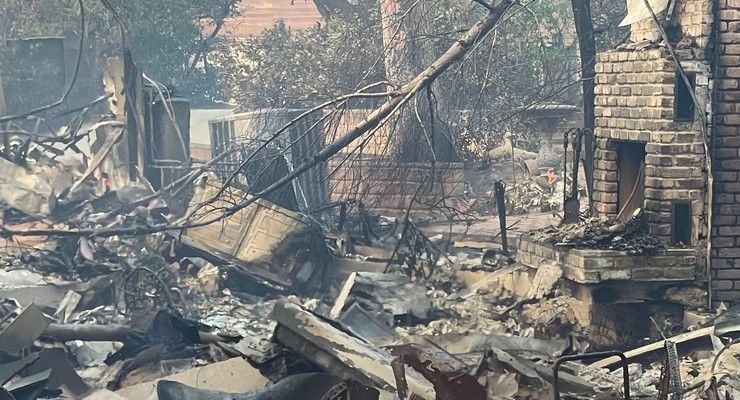
The policy brief, released Thursday by the UCLA Latino Policy and Politics Institute, examined the experiences of outdoor workers employed or seeking work during cleanup and rebuilding following the January 2025 wildfire.
Researchers conducted in-depth interviews with 11 workers nine months after the fire. Eighty-two percent had worked directly in fire-affected areas, while 64% said they had witnessed or experienced immigration enforcement during the recovery period.
The researchers cautioned that the study’s small qualitative sample was intended to document workers’ experiences and is not representative of all workers involved in the Eaton Fire recovery.
Among workers who provided a dollar estimate, average self-reported income losses exceeded $4,300 since the fire began, according to the report. Nearly half of those interviewed also lived in or near fire-affected neighborhoods, potentially exposing them to environmental hazards both at work and at home.
Researchers found safety training and protective equipment varied depending on how workers obtained jobs. Workers connected with community organizations were more likely to report receiving safety training, while those working through informal or subcontracted arrangements more frequently reported limited training and inconsistent access to adequate protective equipment.
Mental health emerged as another concern. All 11 workers interviewed rated their mental health as fair, poor or very poor. Workers attributed stress to the fire as well as unstable employment, hazardous conditions and immigration enforcement, according to the report.
“Day laborers are rebuilding our communities after wildfires, but too often the systems responsible for disaster recovery do not account for the conditions under which this work is actually happening,” said Michael Méndez, an associate professor at University of California, Irvine and co-author of the brief.
The study also found that community organizations, including the National Day Laborer Organizing Network, Central American Resource Center and Instituto de Educación Popular del Sur de California, helped fill gaps by providing workers with safety equipment, recovery assistance and immigration alerts.
Researchers said government inspectors were largely absent from the workers’ experiences described in the interviews.
The authors recommended increasing proactive labor inspections in disaster recovery zones and requiring site-specific worker protection plans for wildfire debris removal. They also called for a disaster income stabilization program for informal workers, behavioral health services for recovery workers and stronger partnerships between government agencies and community organizations.
“Almost every worker we talked to told us the same thing — when something went wrong, they didn’t think to call a government agency,” said Carlo A. Chunga Pizarro, a UC Irvine doctoral candidate and co-author of the study. “They called the community organizations that are holding up the system of worker protection.”
The researchers said formally incorporating those organizations into disaster planning could help ensure workers receive safety information, financial assistance and other resources more quickly during future disasters.
 Get our daily Pasadena newspaper in your email box. Free.
Get all the latest Pasadena news, more than 10 fresh stories daily, 7 days a week at 7 a.m.