








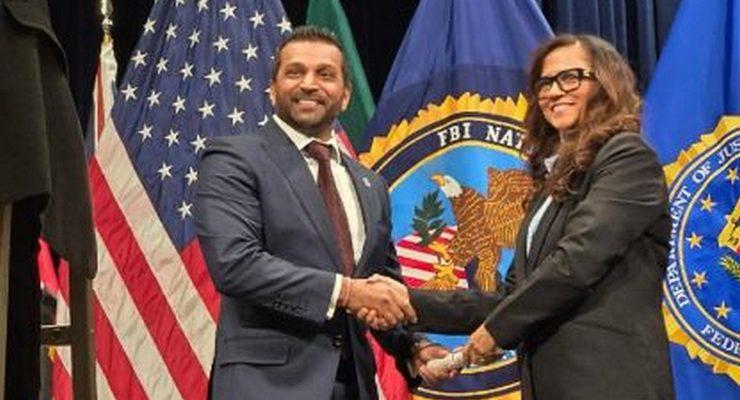
Pasadena Police Chief Eugene Harris and members of the department’s command staff congratulated Cuellar on completing the FBI National Academy’s 296th session, according to a city statement. Cuellar graduated Dec. 11 in Quantico, Virginia.
Cuellar joined the Pasadena Police Department in 1992 and has served in a series of assignments over more than three decades. She was promoted to corporal in 1999 and later served as a sergeant before becoming a lieutenant by 2023.
The lieutenant has served the city and department in a number of roles over the years, spanning the department’s Event Planning Unit, Youth and Family Services, detective work focused on adult and child sexual assaults, and enforcement assignments targeting gangs and street narcotics.
She also served on the Internet Crimes Against Children task force.
Cuellar has supervised the department’s H.O.P.E. Team — the Homeless Outreach Psychiatric Evaluation unit — and has worked with Los Angeles County mental health clinicians on field responses related to homelessness and mental illness.
In 2015, Cuellar was honored with a “Beyond the Call of Duty” award from Pasadena Masonic Wisdom Lodge No. 202 for work the report describes as involving investigations of sexual predators.
The FBI National Academy is a 10-week residential program at the FBI Training Academy in Quantico that the bureau describes as accredited instruction for law enforcement leaders from around the world.
The academy was established in 1935, according to the official FBI brochure, and its mission is to support and enhance the professional development of law enforcement leaders.
According to the FBI’s National Academy brochure, participants are nominated by their agency heads based on demonstrated leadership qualities. Eligibility requirements listed in the brochure include at least five years of full-time law enforcement experience, a rank of lieutenant or higher, and a college degree or at least 60 college credit hours, among other criteria.
The program’s three core components are academics, physical fitness and wellness, and networking and knowledge sharing.
Session 296 included 254 graduates representing 47 states and the District of Columbia, as well as officers from 24 countries, four military organizations, and two federal civilian agencies.
 Get our daily Pasadena newspaper in your email box. Free.
Get all the latest Pasadena news, more than 10 fresh stories daily, 7 days a week at 7 a.m.