









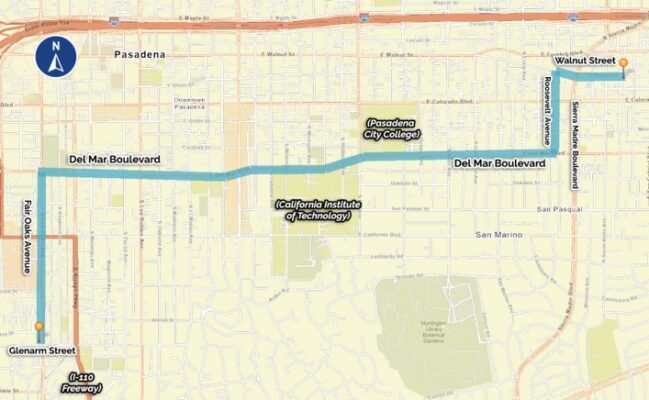
Pasadena Water and Power will begin replacing high-voltage underground subtransmission cables along an approximately five-mile route Monday, Oct. 19, General Manager David M. Reyes announced.
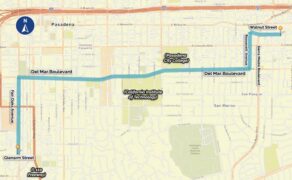
The corridor connects the utility’s Santa Anita and Glenarm receiving stations and supplies electricity to more than half of its customers. The city says the Path 2 Transmission Cable Upgrade Project, identified as a priority in the utility’s Power Delivery Master Plan, will modernize aging infrastructure and expand the capacity needed to bring more renewable energy into Pasadena, supporting its goal of 100% carbon-free electricity by the end of 2030. State law requires renewable and zero-carbon resources to supply all retail electricity sales by 2045.
The route includes portions of South Fair Oaks Avenue, East Del Mar Boulevard, Roosevelt Avenue and East Walnut Street, with work weekdays from 7 a.m. to 5 p.m. and Saturdays from 8 a.m. to 5 p.m. Work will pause during the city’s December and January construction moratorium and finish before summer 2027, according to the city. Crews working with contractor Outsource Utility Contractor, LLC will remove cables nearing the end of their service life and install new, higher-capacity cables within the existing underground infrastructure. Traffic controls and temporary No Parking signs will move with the work, generally affecting each location for one to two days, according to the city.
The affected lines will be de-energized for about six months, according to the City of Pasadena, down from the six to eight months the utility estimated in March. The utility will rely on internal generation during that period to ensure grid stability; no customer outages are anticipated, according to the city. The city’s Glenarm site includes GT-5, a 71-megawatt unit that entered commercial operation in December 2016, POWER magazine reported. An August 2025 staff report said local generation from the Glenarm Power Plant “must be at peak reliability to prevent rolling blackouts” during the Path 2 work.
The city’s capital budget lists the project at $73,180,000, including $31,560,000 in Fiscal Year 2027 funded by power bonds. In July 2025 the City Council approved a $43,952,000 Anixter Inc. cable purchase; copper drives about 75% of the cable’s cost, according to the staff report. A 50% federal tariff on copper wire and copper-intensive products such as cables took effect Aug. 1, 2025.
In March the council found the contract with Outsource exempt from state environmental review under categories covering existing utility facilities and replacement of utility systems with “negligible or no expansion of capacity.” The March staff report stated that the project proposed no expansion of use or capacity.
Underground cable systems in the United States were expected to last 30 to 40 years, a large portion of that infrastructure, much of it installed in the 1970s and 1980s, was reaching the end of its expected life, and rising failure rates on older systems were hurting reliability, Georgia Tech’s National Electric Energy Testing, Research and Applications Center reported in 2016. The American Public Power Association designated Pasadena Water and Power a Diamond-level Reliable Public Power Provider in 2024.
Project information is at https://pwp.cityofpasadena.
 Get our daily Pasadena newspaper in your email box. Free.
Get all the latest Pasadena news, more than 10 fresh stories daily, 7 days a week at 7 a.m.