






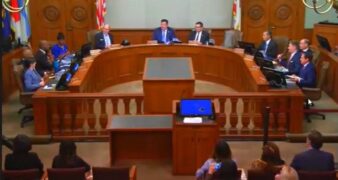


The Pasadena City Council held over an item from Monday’s City Council agenda that would authorize the use of the Construction Manager at-Risk (CMAR) delivery method for two major infrastructure projects: the Central Library Seismic Retrofit and Renovations and the Transit Operations Maintenance Facility (TOMF).
The item is now scheduled to be heard on Monday, Feb. 3. The library has been closed since 2021 pending the completion of a seismic retrofit on the nearly 100 year-old building.
In November, voters approved a $195 million bond to fund the the Central Library Seismic Retrofit and Renovations project.
Originally designed by Myron Hunt, and opened in 1927, the retrofit will involve reinforcing the structure to withstand future seismic activity while preserving its historic integrity. The project is expected to be completed by 2028, with the goal of reopening the library as a vital community hub for education, cultural events, and public services.
The CMAR method allows for a construction manager during the design phase, facilitating better coordination, risk management, and cost control through a Guaranteed Maximum Price (GMP).
The project focuses on seismic upgrades and renovations to the historic building.
In addition to seismic upgrades, the library renovation will address outdated systems and create more flexible spaces to accommodate evolving community needs. The CMAR delivery method is seen as crucial for managing the project’s technical complexities, particularly in integrating historic preservation with modern engineering solutions.
The TOMF project will replace the city’s current transit operations and maintenance facility, which is set to expire in 2027. Located at 2180 E. Foothill Blvd. and 2211 E. Walnut St., the new facility will support Pasadena Transit’s growing fleet, including the transition to zero-emission vehicles (ZEVs). The project also aims to accommodate the city’s rising ridership and ensure uninterrupted operations.
The TOMF will include specialized infrastructure for battery-electric buses and hydrogen fuel-cell electric buses, in line with California’s mandate for public transit agencies to transition to a 100% zero-emission fleet by 2040. The CMAR approach is critical for addressing the project’s high technical complexity and ensuring the new facility is completed before the current lease expires.
By using the CMAR delivery method, both projects benefit from early contractor involvement, which helps identify potential challenges, manage risks, and accelerate timelines.
 Get our daily Pasadena newspaper in your email box. Free.
Get all the latest Pasadena news, more than 10 fresh stories daily, 7 days a week at 7 a.m.