







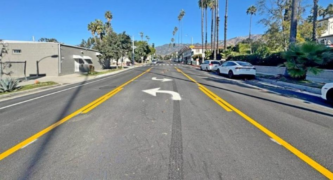


The lane reconfiguration delivers a traffic-calming measure that community organizations had advocated for since 2015, citing a stretch of road where city data showed 60 percent of motorists exceeded the 35 mph speed limit and 70 crashes occurred between 2020 and 2024, including five severe injuries. Two of those injuries involved pedestrians.
The $1.9 million project on Fair Oaks Avenue and Madison Avenue finished major paving operations by December 15, 2025, well before the February 2026 target date posted on the city’s website. Director of Public Works Greg de Vinck announced that all remaining work, including final striping and utility adjustments, was completed before the new year.
“We recognize that street construction disruptions are inconvenient, and we appreciate the community patience and cooperation as these much-needed infrastructure improvements were completed,” de Vinck said in a statement.
The work extended along Fair Oaks Avenue from 300 feet south of Washington Boulevard to the city’s northern boundary and along Madison Avenue from Villa Street to Orange Grove Boulevard. Crews resurfaced both corridors with fiber-reinforced rubberized asphalt designed for a smoother, quieter ride. The city expects the pavement’s condition rating to improve from 57 to 100 on a standard index.
On-street parking remains on both sides of Fair Oaks Avenue. A city traffic analysis found the three-lane configuration would provide safety benefits for drivers and pedestrians while having some impact on vehicle travel times.
The resurfacing followed Pasadena Water and Power’s replacement of two 90-year-old water mains along Fair Oaks, completed in March 2025. Rather than simply patching the trenches left by that work, the city chose full-width resurfacing and incorporated the lane reconfiguration — an approach that saved approximately $600,000 compared to earlier estimates for concrete-only repairs, according to city officials.
The North Fair Oaks Empowerment Initiative, led by Making Housing and Community Happen, began advocating for safety improvements in 2015 through surveys and community meetings. The City Council recognized the effort in 2022 by including the lane reconfiguration in Pasadena’s Capital Improvement Program. A city-led traffic study in 2019 analyzed the three-lane option that was ultimately implemented.
The Fair Oaks corridor has historical significance as the center of Pasadena’s African American community since the 1930s, with churches and businesses still concentrated between Washington Boulevard and Woodbury Avenue.
Toro Enterprises, Inc., an Oxnard-based contractor, performed the work under a contract approved by the City Council in September 2025. The company’s bid of $1.72 million came in 12 percent below the city engineer’s estimate.
The Departments of Public Works, Water and Power, and Transportation coordinated on the project. Funding came from Pasadena Water and Power’s trench restoration budget and the Public Works annual street resurfacing program.
Construction began October 20, 2025, with trench restoration starting November 12. Work was phased to keep at least one lane open in each direction throughout the project.
Whether the lane reduction achieves its safety goals will become clearer over time. The change affects a corridor that saw nearly 40 percent of its severe injuries involve pedestrians during the five-year period analyzed by city staff.
 Get our daily Pasadena newspaper in your email box. Free.
Get all the latest Pasadena news, more than 10 fresh stories daily, 7 days a week at 7 a.m.