








Every year, the Pasadena City Council votes to approve a pair of documents that few residents have reason to notice. The Federal and State Legislative Platforms — annual policy blueprints that authorize the city’s lobbyists to support, oppose or take no position on legislation in Sacramento and Washington — are ordinarily updated with modest, incremental revisions and adopted without controversy.
This year is different.
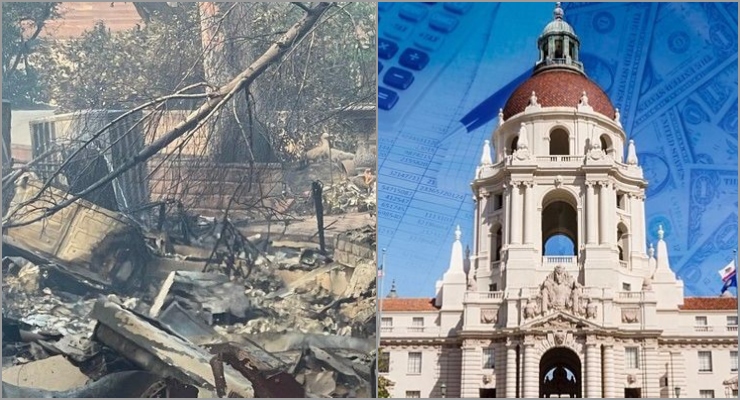
When the Council takes up the 2026 platforms at its Monday night meeting, it will be voting on a document that has been substantially rewritten to address a set of converging pressures unlike anything the city has faced in recent memory: the aftermath of the deadliest wildfire in the immediate region’s modern history, an escalating conflict between federal authorities and local governments over immigration enforcement and grant funding, and new state fire-hardening regulations that have provoked fierce opposition from homeowners across Southern California.
Taken together, the changes transform what is normally a procedural exercise into a consequential statement of how Pasadena intends to protect its residents, defend its finances and navigate an increasingly contentious political landscape at both the state and federal levels.
“These are the documents that authorize staff to act,” is how the city frames their function.
Once the platforms are approved, city staff can draft position letters for the mayor’s signature on any bill that aligns with the stated priorities — without returning to the Council for a separate vote. In a fast-moving legislative session, that delegation of authority matters. The broader and more specific the platform, the more latitude staff and lobbyists have to engage on the city’s behalf. This year, the platforms are both broader and more specific than they have been in years.
A City Reshaped by Fire
The most significant revision to the federal platform reflects the most significant event in the region’s recent history. The Eaton Fire has fundamentally altered Pasadena’s relationship with federal disaster policy. The city has expanded what was previously a “Pandemic Response” section into a broader framework encompassing federal aid for wildfire and natural disaster response — a change that signals Pasadena is no longer positioning itself as a city that may someday need disaster assistance, but as one that needs it now and will need it for years to come.
The practical implications are significant. The city’s ability to secure FEMA funding, Department of Homeland Security resilience grants and long-term rebuilding support will depend in part on how clearly and aggressively these priorities are articulated in its federal advocacy. The platform now also calls for extending FEMA and DHS resilience funding eligibility to libraries that serve as community hubs during emergencies — a provision that reflects the role Pasadena’s libraries played during the fire and its aftermath.
Federal Funding and Immigration: A Direct Fiscal Threat
The second major addition to the federal platform is bluntly stated: the city formally opposes efforts to condition federal funding on local cooperation and assistance with federal immigration law enforcement. The provision is listed under the public safety category.
This is not an abstract policy statement. Cities across the country that have declined to assist with immigration enforcement have faced threats to their federal grant funding — money that supports housing, homeless services, public safety and, now, disaster recovery.
For Pasadena, which relies on federal dollars across multiple departments, the provision amounts to an official declaration of where the city stands and what it is prepared to defend. The fiscal stakes are real: conditioning federal funds on immigration cooperation could jeopardize grants that flow to some of the city’s most essential services at a moment when the need for those services has never been greater.
Election Integrity: A New Federal Priority
The Legislative Policy Committee, chaired by Councilmember Steve Madison and including Councilmembers Gene Masuda and Vice Mayor Jess Rivas, added a new section to the federal platform supporting election integrity at its February 3 meeting. The addition reflects a growing national conversation about election security and represents the first time the city’s federal legislative platform has included a standalone section on the topic. The committee also added language supporting collaborative policy development with the state.
Zone Zero: The Fire Regulations That Could Change Every Yard in Pasadena
On the state side, the single most significant addition is a new section addressing Zone Zero legislation — state-proposed fire regulations that would require vegetation removal within five feet of homes. The platform calls for “measured considerations” in the development of those rules, language that places the city squarely between two powerful forces: the urgent need for stronger fire protection in a region devastated by wildfire, and the intense opposition of homeowners who view the regulations as an overreach that could fundamentally alter the character of their properties.
The issue has already drawn substantial public engagement. The California Board of Forestry and Fire Protection held a public hearing on the proposed rules at the Pasadena Convention Center in September 2025, attended by approximately 150 people. The platform’s language is carefully calibrated — it does not oppose the regulations outright, but it establishes a framework for the city’s lobbyists to advocate for modifications. For residents, the outcome of this advocacy could determine what their yards, gardens and the streetscape of their neighborhoods look like for years to come.
Tort Reform and the Cost of Doing Business
The state platform also adds a new section on tort reform, supporting state legislation that reduces excessive tort liabilities. The Legislative Policy Committee revised the section at its February 3 meeting to make the language more generalized. While the provision does not target a specific bill, its inclusion signals the city’s awareness that litigation costs affect municipal budgets and, by extension, the services those budgets fund.
An Unusually Broad Agenda
Beyond the headline items, the sheer volume of new material in both platforms is notable. In a typical year, updates are incremental — a tweak here, a new provision there.
This year, the list of additions spans automated speed enforcement, e-bike regulation, copper wire theft prevention, hydrogen fueling infrastructure, cannabis education, access to women’s reproductive health services and LGBTQ+ health services, greenhouse gas emission reductions from buildings, funding for community hardening from climate pollution penalties, and expanded economic development provisions supporting the California Competes Tax Credit, Community Economic Resilience Fund, Workforce Development Boards and Enhanced Infrastructure Financing Districts.
On the federal side, new provisions include support for expanding SNAP benefits toward residential tap water charges, dedicated funding for local streets preservation, maintaining funding criteria for the Continuum of Care homeless program, and continued funding of the Economic Development Administration, Small Business Administration and Community Development Block Grant program.
That breadth suggests the city is attempting to get ahead of a rapidly shifting legislative landscape at both the state and federal levels, rather than simply reacting to bills as they appear.
How the Platforms Work
The City Manager’s Office oversees Pasadena’s legislative activities and works with departments, city lobbyists and elected officials at the state and federal levels. Each year, city lobbyists meet one-on-one with department directors and staff members to discuss platform updates, review previous legislative activities, discuss potential bills and identify funding priorities. The 2026 report was prepared by Kathleen Chen, Management Analyst IV in the Water and Power Department, submitted by Assistant City Manager Brenda E. Harvey-Williams, and approved by City Manager Miguel Márquez.
The platforms can be amended at any time during the year if unanticipated legislative issues arise. The recommendation to approve them carries no direct fiscal impact, according to the agenda report, but may result in future grant opportunities and funding. Funds for the city’s legislative advocates and lobbyists are included in the City Council’s annual operating budget. The staff report recommends the Council find that the action is covered by the “Common Sense” exemption under State CEQA Guidelines Section 15061(b)(3), which applies to actions that cannot have a significant effect on the environment.
If You Want to Attend
The City Council meets at 6 p.m. Monday, February 9, in the Council Chamber at Pasadena City Hall, 100 N. Garfield Ave., Room S249. The meeting is accessible virtually via Zoom at cityofpasadena.net/cczoom or by telephone at 1-669-900-6833, Meeting ID: 161 482 446. Public comment speaker cards can be submitted online through the City Clerk’s website. The platforms are Agenda Item No. 7.
 Get our daily Pasadena newspaper in your email box. Free.
Get all the latest Pasadena news, more than 10 fresh stories daily, 7 days a week at 7 a.m.