




Owen Brown — third son of abolitionist John Brown, one of the five raiders who escaped the October 1859 attack on the federal arsenal at Harpers Ferry, Virginia, and the last of those survivors to die — spent his final years in the foothills above Altadena, where he died in 1889 and was buried on a hilltop the community named Little Round Top. A 20-minute documentary, “Owen Brown’s Body,” was commissioned by the Owen Brown Gravesite Committee specifically to bring that story into classrooms. On Tuesday evening, filmmaker Pablo D. Miralles and historian Michele Zack will discuss how the film came to be at the Pasadena Civil War Round Table’s monthly meeting at the historic Blinn House in Pasadena.
The committee says the film is designed to anchor a teacher professional development program for students in grades 6 through 12 in PUSD and other San Gabriel Valley schools — students who, in the committee’s own words, “know little of our local history.”
There is something personal about Miralles telling this particular story. An Altadena-based filmmaker and graduate of John Muir High School, class of 1982, he founded Arroyo Seco Films in 2008. His Altadena home was destroyed in the January 2025 Eaton Fire. Weeks later, on March 7, 2025, he stood at John Muir High School to introduce the world premiere of “Owen Brown’s Body.” The fire had taken his house. It had not taken the film.
Joining Miralles on Tuesday will be Michele Zack, chair of the LA County Owen Brown Gravesite Committee and a representative of Altadena Heritage. Zack is an author and historian who conducted two months of research on Los Angeles during the Civil War era as a Huntington Library Alan Jutzi Fellow in 2022 and 2023. Her book “Altadena: Between Wilderness and City,” originally published around 2004 and re-issued this year, traces the community’s layered past.
On the night of October 16, 1859, Owen Brown was among the 22 men in his father’s raiding party at Harpers Ferry — though posted as a rear guard at their base camp across the river, he never entered the arsenal itself. Of those 22, 10 were killed and seven were tried and executed. Five escaped. Owen was one of the five, and he eventually made his way west. In 1884, Owen, along with his brother Jason and sister Ruth, settled in Altadena, where they became local figures. Owen and Jason completed their cabin in El Prieto Canyon in 1886. Owen Brown died of pneumonia on January 8, 1889, at the Pasadena home of his brother-in-law, and was buried on the summit of a hill at the north end of El Prieto Road — a hill the community named Little Round Top, after the Union stand at Gettysburg.
The gravesite had a turbulent century. The headstone was vandalized and rolled down the hillside on more than one occasion. A local organization, Save the Altadena Trails, filed and won a lawsuit in 2003–2004 to protect public access to the site. The original gravestone, which disappeared in 2002, was recovered in 2012 and restored to its original position in 2021 using archival photographs to determine placement. On December 10, 2024, the Los Angeles County Board of Supervisors voted unanimously to designate the gravesite as an official LA County Historical Landmark. On January 20, 2026, the site was added to the National Park Service’s Network to Freedom program, which recognizes sites connected to the Underground Railroad and the fight against slavery. The documentary, according to Altadena Heritage, includes footage of the gravestone’s 2021 return to Little Round Top and features an interview with a descendant of Harriet Tubman.
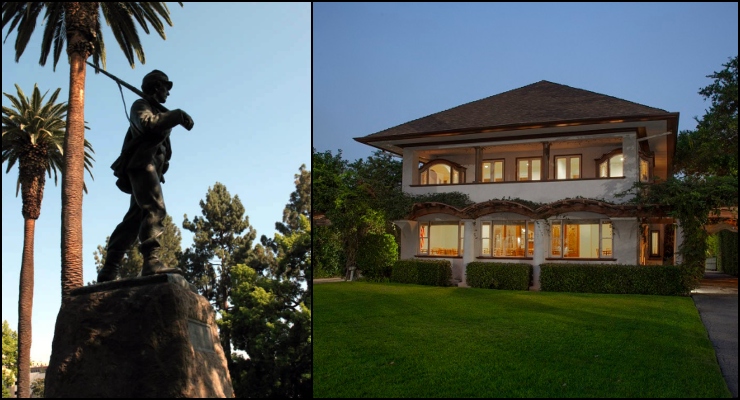
Tuesday’s presentation is described in CWRT materials as a program on “The Making of the Film: Owen Brown’s Body.” The Pasadena Civil War Round Table meets every fourth Tuesday at 7:15 p.m. at the Blinn House — 160 N. Oakland Avenue, Pasadena — a George Washington Maher-designed landmark completed in 1906 that now serves as Pasadena Heritage’s headquarters and is listed on the National Register of Historic Places. The event is free and open to the public; students are specifically welcomed. Parking is available at no cost in the rear lot, accessed via 165 N. Madison Avenue, second driveway south of Walnut Street; entrance is through the rear door. For information, contact CWRT Program Chair Janet Whaley at PasadenaCWRT@gmail.com or (626) 664-6627.
 Get our daily Pasadena newspaper in your email box. Free.
Get all the latest Pasadena news, more than 10 fresh stories daily, 7 days a week at 7 a.m.