






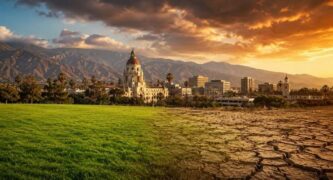

The city is continuing work on its first environmental justice element, a new section of the city’s General Plan intended to address pollution, health, housing and economic disparities affecting communities that have carried disproportionate environmental burdens.
Planning officials will present the effort Tuesday to the Northwest Commission, outlining how the city plans to identify environmental justice communities and develop policies designed to improve conditions in those areas. The commission meets at 6:30 p.m. at the Jackie Robinson Community Center, 1020 N. Fair Oaks Ave.
“Everyone has the right to live, work, and play in healthy places free of pollution in the air, water, and land,” according to a city staff report. “Also, the environmental impacts that disproportionately burden low-income communities and people of color need to be recognized and addressed to achieve equitable health outcomes.”
The city’s General Plan is its long-term blueprint for growth and development. It guides decisions about land use, housing, transportation, parks, public safety, environmental protection and infrastructure. City ordinances, zoning regulations and major development decisions are generally expected to be consistent with it.
Elements in the existing General Plan include the Land Use, Mobility, Housing, Green Space, Recreation and Parks, Open Space and Conservation, Noise and Safety elements.
The new element is expected to address six broad areas: pollution exposure; safe, sanitary and affordable housing; access to healthy and affordable food; public facilities and programs; active living and physical activity; and inclusive community engagement.
The initiative is intended to bring the city into compliance with Senate Bill (SB) 1000, a 2016 California law requiring cities and counties with disadvantaged communities to incorporate environmental justice policies into their general plans.
Under the state’s definition, environmental justice means the fair treatment and meaningful involvement of people of all races, cultures, incomes and national origins in the development and enforcement of environmental laws and policies.
According to a city staff report, the issue extends beyond exposure to pollution. It also encompasses economic opportunity, quality of life and residents’ ability to participate in decisions affecting their neighborhoods.
Pasadena’s presentation traces present-day disparities to a history that includes racially restrictive housing covenants, redlining and displacement due to freeway construction.
Most Northwest Pasadena neighborhoods fall within areas historically redlined, a practice that denied residents access to mortgages and home improvement loans and limited opportunities to build generational wealth.
Construction of the Foothill Freeway and the never-finished State Route 710 extension also displaced residents and businesses in northwest and central Pasadena, according to the city.
The city is using CalEnviroScreen and the Healthy Places Index to evaluate census tracts. The screening tools combine environmental, socioeconomic and health indicators, including air quality, drinking-water contamination, traffic, hazardous-waste sites, asthma, poverty, housing costs, education, insurance coverage, park access and tree canopy.
California considers census tracts scoring 75 or higher on CalEnviroScreen to be environmental justice communities because of their comparatively high environmental burdens. Pasadena has prepared a preliminary boundary showing communities that could receive focused policies, but officials say it may be revised based on residents’ experiences and evidence gathered during public outreach.
The element also will include citywide policies.
The city launched the project in May after providing preliminary updates to the City Council and several commissions during 2024 and 2025. An English- and Spanish-language community survey has drawn approximately 355 responses. Officials are analyzing the results and plan to use them to help shape policy priorities.
Additional outreach this fall will include commission presentations, discussions with community organizations, community meetings and two walking or rolling tours of Northwest Pasadena.
Drafting of policies is scheduled for this winter and is expected to conclude next spring, followed by discussions of proposed solutions and priorities.
A draft environmental justice element is expected to go before the Planning Commission and City Council for public hearings.
The Northwest Commission’s discussion is listed as an information item, and no formal action is requested by commissioners during the scheduled presentation.
“Survey results and continued engagement discussions will help to shape draft policies and priorities,” according to the staff presentation.
 Get our daily Pasadena newspaper in your email box. Free.
Get all the latest Pasadena news, more than 10 fresh stories daily, 7 days a week at 7 a.m.