








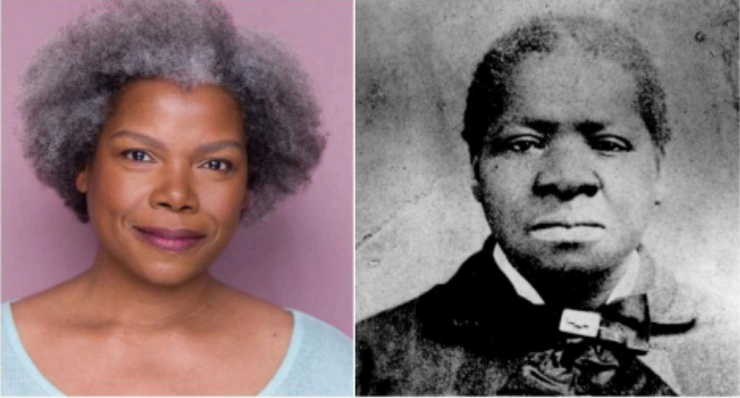
Hawkins, a domestic violence survivor who found herself that day homeless on Skid Row, discovered a memorial to Bridget “Biddy” Mason, a formerly enslaved woman who became one of 19th-century Los Angeles’s most prominent citizens. That inspiring discovery has culminated in a presentation that Hawkins will perform on Friday at a Pasadena library, aiming to bring Mason’s incredible story of resilience to a new generation.
This is a story about how the past can provide a powerful blueprint for the future. For Hawkins, an artist and activist who calls herself an “artivist,” Mason’s journey from bondage to becoming a pioneering landowner and philanthropist offered a powerful rebuke to her own despair.
Today, Hawkins uses her art to share the core truth of Mason’s improbable rise.
“When I learned about her and what she had been through and overcome, it just helped me understand, ‘Well, what’s my excuse if I have more tools at my disposal?’” Hawkins said in a recent interview. “It really is what I needed at that time to keep encouraging me as a survivor.”
Hawkins’s presentation, “Biddy Mason: Her Open Hand,” which uses spoken word storytelling and mixed media projections, will take place at the La Pintoresca Branch Library as part of the city’s Black History Month events.
The library holds a special significance for Hawkins, an Altadena native, because it was the first to carry her book series, “Justice?… or Just Me?” based on her life.
The historical Biddy Mason, born in 1818, endured a life of hardship that is difficult to comprehend today.
When Mason’s enslaver moved his household from the American South, she walked approximately 1,700 miles to Utah in 1848, and then another 700 to 800 miles to San Bernardino, Calif., in 1851, all while caring for her own children and her enslaver’s household.
The grueling overland journey totaled nearly 2,500 miles.
In 1856, in a landmark case in a Los Angeles courtroom, Mason won her freedom and that of 13 members of her extended family through a habeas corpus petition filed on her behalf, arguing that she was being illegally held in bondage in California, a free state.
The ruling, by Judge Benjamin Hayes, set her life on a new path.
Hawkins said it is Mason’s life after freedom that inspires her most.
Historical records confirm that Mason’s success was extraordinary. She worked as a nurse and midwife, and her business acumen was remarkable.
In 1866, just ten years after winning her freedom, she purchased a plot of land at 331 Spring Street for $250, making her one of the first Black women to own land in Los Angeles, according to historical accounts.
By the time of her death in 1891, her fortune was estimated at nearly $300,000, the equivalent of several million dollars today.
Mason’s philanthropy became legendary. She was a founding member of the First African Methodist Episcopal Church, the city’s first Black church, which she helped establish in 1872. Historical accounts confirm she opened a nursery for orphans, used her home to shelter the needy, and visited prisoners in the city jail.
This legacy of giving resonates with Hawkins.
“Her mission was even what she was blessed with, she was still giving it back,” she said, referencing Mason’s famous creed: “If you hold your hand closed, nothing good can come in. The open hand is blessed, for it gives in abundance, even as it receives.” While a memorial park in downtown Los Angeles has borne her name since 1989, broader official recognition has been slow. In 2024, the Los Angeles City Council approved the installation of ceremonial street signs in her honor along Spring Street, a move to make her legacy more visible.
For Hawkins, bringing this story to the forefront is a way to offer a new generation the same sense of the possibility she has found.
“I feel like when we give up on hope, that it just doesn’t leave a lot of options,” she said. “I feel like if we hold on to hope, hope gives us the ability to see situations a little differently and maybe think outside of the box for solutions.”
“Biddy Mason: Her Open Hand,” a presentation by Lorinda Hawkins, is scheduled for 4 p.m. on Friday, Feb. 20, 2026 at La Pintoresca Branch Library, 1355 N. Raymond Ave., Pasadena. For ages 5 and up.
 Get our daily Pasadena newspaper in your email box. Free.
Get all the latest Pasadena news, more than 10 fresh stories daily, 7 days a week at 7 a.m.