









The City of Pasadena would like them to notice. As part of its “Historic Places Pasadena: Completing Our Story” survey, the City has been spotlighting under-recognized local landmarks and asking residents to nominate the places that matter to them — and the garden at Plaza Las Fuentes, just east of City Hall, is one of them.
The landscape opened in 1989, the green heart of a six-acre mixed-use block that the City set out to redevelop in 1984 to improve its historic Civic Center, according to The Cultural Landscape Foundation. The block, the City says, had long been envisioned in its 1923 Civic Master Plan as a grand public garden framing City Hall. The parcel was developed by Maguire Thomas Partners and built out with an office tower, a hotel and retail designed by the architecture firm Moore Ruble Yudell, whose principal Charles Moore helped shape the project’s postmodern character.
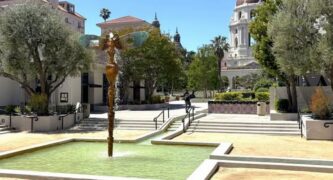
The garden itself was designed by Lawrence Halprin, the landscape architect behind Seattle’s Freeway Park and the Franklin Delano Roosevelt Memorial in Washington. His Moorish-influenced design threads pedestrian arcades, terraced gardens and a sequence of pools, channels and waterfalls through the block — a nod, the Cultural Landscape Foundation notes, to the heritage of nearby Old Town Pasadena.
Two artists gave the garden its color. A long wall of hand-painted ceramic tile was designed by Joyce Kozloff, whose 1990 installation, “Pasadena, The City of Roses,” draws on Egyptian, Greek and Islamic patterns alongside local influences. Sculptures by Michael Lucero and other artists are set throughout the gardens, and the courtyard’s fountains are finished in hand-painted tile. Both artists’ works are documented in the City’s own public-art records.
The garden’s survival in good condition, the Cultural Landscape Foundation has observed, contrasts with the erosion seen at some of Halprin’s other public works.
That is the kind of history the City’s survey is meant to capture. “Historic Places Pasadena: Completing Our Story” is a City Council-directed effort, led by the Planning and Community Development Department’s Design and Historic Preservation division with the consulting firm Historic Resources Group, to build a citywide historic context statement and identify resources that have never been formally designated. The City says it has already designated more than 200 individual historic sites and 26 historic neighborhoods, a preservation program that dates to Pasadena becoming one of California’s first Certified Local Governments in 1986.
Principal Planner Kevin Johnson has described the project, in a report to the city’s Historic Preservation Commission, as a comprehensive source on the resources significant to Pasadena’s history. Residents can submit places to the project through the City’s crowdsourced story map; the City has said it posts about the effort on social media on a weekly basis.
For now, the fountains still run each day beside City Hall, their tiled walls catching the afternoon light — a garden the city helped build, and is now asking its residents to help remember.
 Get our daily Pasadena newspaper in your email box. Free.
Get all the latest Pasadena news, more than 10 fresh stories daily, 7 days a week at 7 a.m.