









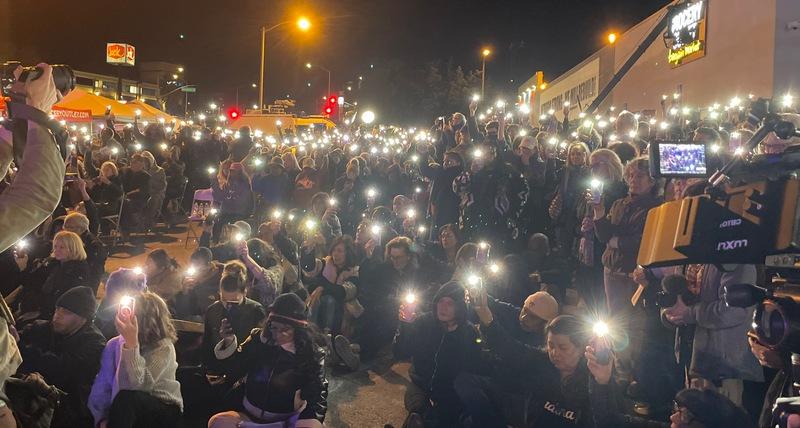
The confirmation matters in a community where the store has functioned as far more than a place to buy groceries. Since the Jan. 7 wildfire, the Grocery Outlet and its parking lot have served as a relief distribution site, a gathering place, and the location where roughly 1,000 people held a candlelight vigil on the one-year anniversary of the disaster.
Owners Sandra and Jose Valenzuela, who have operated the store since July 2021, are members of the Altadena Rotary Club and have made the parking lot available to nonprofits and community organizations at no charge since. The store is one of only two groceries in town, Victoria Knapp, then chair of the Altadena Town Council, said in February 2025.
The Grocery Outlet survived the Eaton Fire while much of the Lake Avenue retail district burned around it, thanks in large part to its surrounding parking lot.
Its “Greetings from Altadena” mural emerged with only some bubbling of the paint from the heat. A banner reading “Altadena Strong — We Will Rebuild!” went up on the building shortly after the fire.
While the store was closed for cleaning and restocking, the Valenzuelas opened their lot to disaster-response organizations.
The American Red Cross, ShelterBox USA, the Los Angeles County Department of Public Health, and the U.S. Army Corps of Engineers set up operations there. The Altadena Rotary Club organized an aid-distribution event that handed out more than three and a half semi-trailer loads of food and supplies to thousands of residents.
The store reopened on Feb. 19 after six weeks of intensive cleaning to HEPA standards and a complete restocking. The Valenzuelas said the smoke damage destroyed approximately 30 tons of inventory valued at about $850,000, which was covered by insurance. Five of the store’s employees lost their homes in the fire.
“We also know that our store is an anchor point for the community, so getting back to normal as quickly as possible is important for everyone,” Sandra Valenzuela said at the time of the reopening.
Los Angeles County Supervisor Kathryn Barger called the reopening “a big deal,” saying in a February 2025 statement that the store “is a family-run business owned by members of this very community — making it even more meaningful.”
On Jan. 7, 2026, approximately 1,000 people gathered in the Grocery Outlet parking lot for the one-year anniversary commemoration, with clergy holding photographs of the 19 victims and elected officials offering remarks.
The national closures that prompted concern about the Altadena location were announced March 4 by Grocery Outlet Holding Corp. during a fourth-quarter earnings call. The Emeryville, California-based company said it would shut 36 financially underperforming stores as part of what it called an Optimization Plan, approved by the board on March 2.
Nine of the closures are in California — in Azusa, Brawley, El Cajon, Kerman, La Habra, Ontario, Patterson, Poway, and Ridgecrest — according to a brochure published Friday by Gordon Brothers, the liquidation firm retained to market the closing stores’ leases. Twenty-four of the 36 are on the East Coast. None are in the San Gabriel Valley. The nearest closing California store to Altadena is in Azusa, roughly 15 miles to the east.
The closures represent about 6% of Grocery Outlet’s 570 stores in 16 states. CEO Jason Potter said the company had overextended itself.
“It’s clear now that we expanded too quickly, and these closures are a direct correction,” Potter said. The 36 locations, he said, did not have “a viable path to sustained profitability.”
Grocery Outlet reported fourth-quarter net sales of $1.22 billion, up 10.7% from a year earlier, but comparable-store sales declined 0.8% and the company posted a net loss of $218.2 million for the quarter. For the full fiscal year, Grocery Outlet reported a net loss of approximately $224.9 million on $4.69 billion in net sales. The company’s stock hit an all-time low of $8.79 on March 4 and fell roughly 24% in after-hours trading.
Potter attributed the losses in part to disruptions in SNAP benefits during last year’s government shutdown, which he said caused a “double-digit decrease in EBT sales” in November. He also said the company’s “value perception had eroded” even as base pricing remained competitive.
The company estimated restructuring charges of $14 million to $25 million and said the closures are expected to be completed during fiscal 2026. Potter said the company still plans to open 30 to 33 new stores this year.
 Get our daily Pasadena newspaper in your email box. Free.
Get all the latest Pasadena news, more than 10 fresh stories daily, 7 days a week at 7 a.m.