

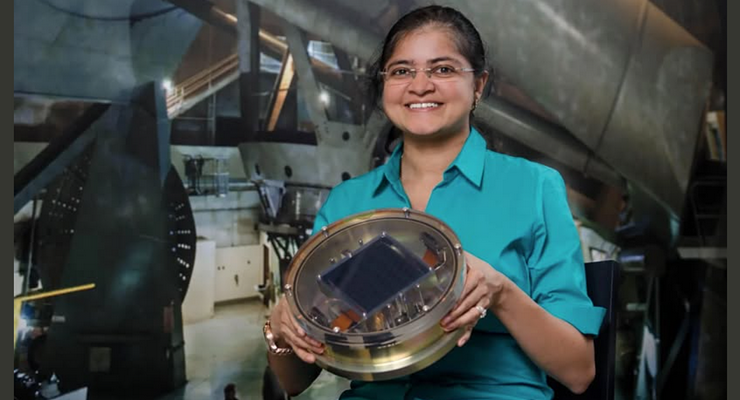
Kasliwal, a professor of astronomy at Caltech, brings extensive experience in time-domain and multi-messenger astrophysics to the role. Her research focuses on stellar explosions and cosmic transients that reveal how stars live, die and create the elements found throughout the universe.
The appointment represents a milestone for the renowned observatory, which has been home to groundbreaking astronomical discoveries.
Kasliwal has been instrumental in developing multiple research initiatives at Palomar, including the Zwicky Transient Facility, infrared surveys Palomar Gattini-IR and WINTER, and the recently commissioned Next Generation Palomar Spectrograph.
She also leads GROWTH (Global Relay of Observatories Watching Transients Happen), an international network that enables continuous observation of fast-changing cosmic events by coordinating telescopes worldwide to track phenomena before they disappear. The project’s goal is to detect transients and then “stay unbeaten by sunrise” by passing observations around the globe to keep the sky dark.
The astrophysicist’s achievements include receiving the 2022 Breakthrough Prize in Physics, one of the field’s most prestigious honors. She has published over 440 refereed publications and achieved an h-index of 100, indicating exceptional research impact.
Kasliwal earned her doctorate from Caltech in 2011, where she helped design and build the Palomar Transient Factory, an automated survey system that searches for powerful cosmic events like supernovae. Her work has already made it into textbooks — she discovered a supernova that was featured in a freshman astronomy textbook. “It was one of the most awesome moments for me,” she said.
Her leadership extends beyond Palomar through gravitational wave follow-up campaigns and international collaborations. The GROWTH project, funded with $4.5 million from the National Science Foundation’s Partnerships in International Research and Education program, coordinates observatories globally to maintain continuous observation of transient events.
“These are extreme events where a lot of elements that we see around us are actually synthesized,” Kasliwal said about her research focus on cosmic transients.
“We just go around the globe and keep passing the baton so that the sky remains dark,” Kasliwal explained about the GROWTH network.
Before joining the faculty, Kasliwal came to the United States from Indore, India, at age 15 to attend boarding school in Connecticut after a teacher advised her to apply to American schools. She spent her senior year taking classes and working with a professor at Bryn Mawr College.
She studied applied and engineering physics at Cornell University, with astrophysics as her concentration. At Cornell, she worked with the late Jim Houck, the principal investigator for the infrared spectrograph on NASA’s Spitzer Space Telescope. “Spitzer was being launched, and I got to see the data start flowing in,” Kasliwal said. “From then on, I was just completely hooked.”
 Get our daily Pasadena newspaper in your email box. Free.
Get all the latest Pasadena news, more than 10 fresh stories daily, 7 days a week at 7 a.m.