







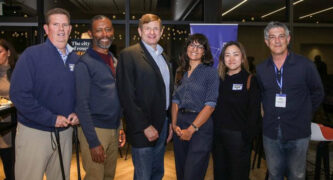

A Caltech team working on brain-targeted cancer drug delivery. An ArtCenter student who designed a collapsible commuter helmet. A pair of USC entrepreneurs behind a high-performance electric bike. All of them stood in the same room on a Monday evening in April, competing for $1,000 prizes in front of a panel of judges — and all of them were doing it in Pasadena.
The Pasadena Innovation Showcase, held April 13 at the Pasarroyo Gathering Event Center on South Lake Avenue, was one of six events during Connect Week 2026, a five-day series co-hosted by the volunteer-run nonprofit Innovate Pasadena and the City of Pasadena Economic Development Division.
From April 12 through 16, the week brought together founders, investors, researchers, and students across sessions focused on quantum computing, life sciences, climate innovation, and deep tech.
“We’re excited to bring together innovators from across Pasadena and the region during Connect Week,” Economic Development Director David Klug said in a city press release announcing the series. “These events highlight the collaboration and talent that make Pasadena a hub for meaningful innovation.”
The showcase’s student pitch competition, presented in partnership with the Alliance for SoCal Innovation and sponsored by Sunstone Management, awarded three $1,000 prizes. Andrew Lu and Lukas Moeller of Caltech won Best Research for Reroute Medicines, their work on brain-targeted RNA delivery. Ge Wu of ArtCenter College of Design won Best Presentation for Halos O2Fold, a foldable commuter helmet. Cooper Schoshinski and Caden Langer of USC took the Most Fundable prize for Vexcite, according to the Pasadena Outlook, which covered the event. Students from Pasadena City College were also listed as participants in the city’s pre-event announcement.
Student presentations spanned cancer therapeutics, rapid infectious disease diagnostics, a high-performance electric bike, and a low-violence mobile game designed to teach empathy and environmental stewardship. Following the student competition, early-stage and scaling founders — Ehsan Sani, Casper Hanney, Gunho Kim, and Anna Shaposhnik — presented ventures in healthcare, media technology, biotech, and aerospace, with innovations including rapid antibiotic diagnostics, camera-to-cloud connectivity tools, ultrasound-activated biodegradable implants for surgical adjustments, and space drones designed to inspect and maintain satellites, according to the Outlook. More than 100 people attended the showcase.
“The diversity of ideas reflected both deep technical research and user-centered design approaches, highlighting the breadth of talent emerging from the region,” an Innovate Pasadena spokesperson said.
The week had opened Sunday with a VIP kickoff reception at The Langham Huntington. Mayor Victor Gordo, Klug, Georgina Goode of JPL, and Frederic Farina, Caltech’s chief innovation and corporate partnerships officer, were among the confirmed attendees.
Other events included Quantum Day Pasadena, organized by the Pasadena-based venture capital firm Qubits Ventures and held at Caltech’s Hameetman Auditorium on April 14; a panel on “The Climate Cost of AI” that same evening; a BioTech Crawl on April 15; and the Pasadena Tech Happy Hour, which closed the week on April 16 at Hawg Heaven BBQ. The monthly happy hour, co-organized with AI LA, has been running since 2016.
Connect Week also coincided with a separate milestone for Pasadena’s life sciences sector. The Pasadena BioCollaborative Incubator, a nonprofit that has provided affordable laboratory space, shared equipment, and training to early-stage biotech companies since opening at 2265 E. Foothill Blvd. more than two decades ago, celebrated its 22nd year and welcomed its 100th company. That company, VelvEtch, is developing bio-compatible polymers for applications including drug delivery, implantable sensors, and neural interface technologies, according to a city press release dated April 9.
“Pasadena’s life sciences sector continues to be a cornerstone of the city’s innovation economy,” Klug said. “The Pasadena BioCollaborative Incubator plays a critical role in supporting early-stage companies and advancing breakthrough technologies.”
The incubator had expanded from its original 500 square feet to more than 12,600 square feet by 2020, according to Pasadena Now.
Innovate Pasadena, which operates entirely with volunteers and no paid staff, was co-founded in 2013 by Mike Giardello and Andy Wilson. Giardello returned as chairman in January after the city and others asked him to resume leadership of the organization, according to Pasadena Now.
“We’ve always had an embarrassment of riches, but we want to put the spotlight on that and make the awareness of what our community is capable of doing,” Giardello said.
Farina, whose Caltech office runs a proof-of-concept fund, an Entrepreneur in Residence program, an internal venture fund, and incubator space on campus, said the week underscored a practical goal: keeping scientific talent in the city.
“Companies can stay here and don’t have to move to the Bay Area,” Farina said. “It’s important to be connected to the community, understand who the people are, the network of people who can help our scientists.”
The student teams that pitched on that Monday evening in April were, for one night at least, exactly that network — researchers and designers and engineers, standing in a room on South Lake Avenue, trying to solve problems that ranged from brain cancer to bicycle helmets. They were doing it a few miles from the lab where the Mars rovers were built.
 Get our daily Pasadena newspaper in your email box. Free.
Get all the latest Pasadena news, more than 10 fresh stories daily, 7 days a week at 7 a.m.