




The City Council received an update Monday on construction, finances and local economic participation in the project, which is now in its major construction phase.
City Manager Matthew Hawkesworth said progress has been made, but acknowledged the city still has “a long ways to go” on local hiring, recruitment and sourcing.
Seven Pasadena craftworkers have worked 2,250 hours on the project and earned $186,235 in wages and benefits through June 30, accounting for 4.28% of the 52,555 craft hours worked to date. Overall, the project has generated about $1.02 million in qualifying local economic activity, representing 10.1% of approximately $10.09 million in eligible direct construction costs.
“We are encouraged by the progress in local hiring, but the work continues,” said Ronald K. Matthews, local workforce development consultant.
Matthews monitors local workforce participation and support efforts to help identify Pasadena residents for opportunities, including existing local union members being dispatched and local residents being sponsored into unions as apprentices, creating pathways to long-term construction careers.
“The goal is to identify these opportunities early so they are not missed on this project or future Pasadena projects.”
Councilmember Tyron Hampton questioned how many Pasadena residents are actually working on the project and pushed for more local hiring as the project goes forward.
The project defines Tier 1 workers as Pasadena residents. Tier 2 expands the area to communities covered by the Foothill Workforce Development Board, including Altadena, South Pasadena, Arcadia, Sierra Madre and Duarte. Tier 3 includes workers within a 10-mile radius of Pasadena City Hall.
The project calls for at least 10% of direct construction costs to go toward qualifying local workers, trade partners, subcontractors and suppliers. An additional aspirational goal seeks to have at least 10% of total craft hours performed by Tier 3 workers.
Through June 30, about $186,000 had been spent on wages for Pasadena workers, $220,000 on Pasadena trade partners and subcontractors and $147,000 on local supplies and materials. Together, those expenditures totaled about $554,000, or roughly 5.5% of direct construction costs to date.
Principal Engineer Hayden Melbourne said he could not provide a specific projection because relatively few trades are currently working at the site. More workers are expected when interior work begins and additional trades arrive.
“We’re still going to meet that goal of at least the 10% of the local hire,” Melbourne said.
One Pasadena-based heating, ventilation and air conditioning (HVAC) company expected to receive a contract worth more than $14 million and asked whether the city would track how many local residents that company employs when its work begins.
A June 25 Central Library job fair attracted more than 100 job seekers and 12 trade partners. Eleven workers were identified for potential hiring or apprenticeship sponsorship. Six have since been hired, two remained in the process and three did not complete a required boot camp.
Pasadena resident Alfredo Hernandez said he was hired after attending the event.
Hernandez said he had no construction experience when he was connected with PCL Construction and the Flintridge Center. He enrolled in a construction program in May, graduated in July, completed a carpenters boot camp and was subsequently hired to work on the library.
“For me and my family, this is more than a job. It’s a career,” Hernandez told the council. “It’s an opportunity to build generational wealth.”
Hernandez said working on the project also gives him an opportunity to help rebuild a landmark in the city where he has lived his entire life.
Representatives from the Flintridge Center and the Western States Regional Council of Carpenters also praised PCL’s efforts to connect local residents with construction careers.
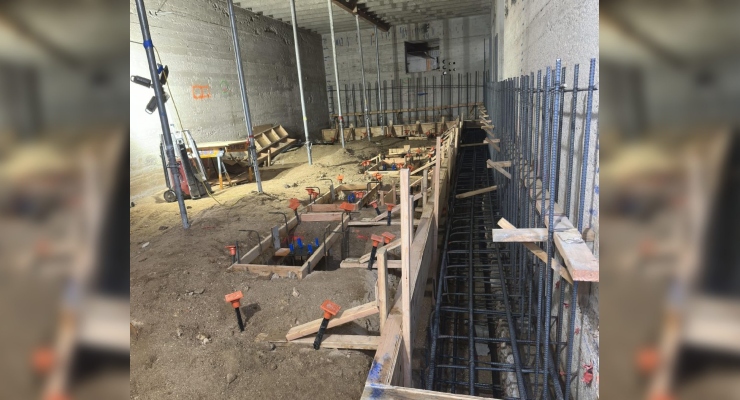
Public Works Director Greg de Vinck said the overall project remains on schedule. Phase 2, the major construction portion of the renovation, began in March after the council amended PCL’s contract to a total of $186 million. Current work includes structural demolition, foundation preparation, temporary shoring and seismic strengthening.
Crews are also removing and preserving much of the historic roof tile for reuse. The manufacturer that originally supplied the tiles approximately a century ago remains in business and will provide replacement tiles where needed.
The project’s base construction contract stands at $164.9 million, with about $714,000 in additions to date. Approximately $16.1 million remains in the city’s owner contingency, while the construction manager’s contingency has not been used.
The city plans to continue monthly project reviews, quarterly updates to the Economic Development and Technology Committee and semiannual reports to the City Council.
 Get our daily Pasadena newspaper in your email box. Free.
Get all the latest Pasadena news, more than 10 fresh stories daily, 7 days a week at 7 a.m.