



“Mental health touches every aspect of our community,” Councilmember Rick Cole says — even though, he acknowledges, the city has no direct responsibility for it. “These are challenging times.”
That premise — that mental health belongs to a community itself, not only to a county agency or a health plan — anchors “Talking Mental Health in Traumatic Times,” the District 2 issue forum Cole convenes at 7 p.m. Tuesday at the Santa Catalina Library.
It is the in-person half of a two-part July series that began July 7 with an online City Talk, and it lands 18 months after the Eaton Fire, the event Cole and his panelists return to as the backdrop for the stress and strain they are witnessing in Pasadena and Altadena.
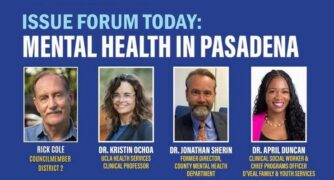
Cole has assembled three panelists who come at mental health from different directions.
Dr. Jonathan Sherin led the Los Angeles County Department of Mental Health, the largest public mental health system in the country, from 2016 until he stepped down in 2022; Cole describes him as an innovator with “a particular heart for the mental health challenges around homelessness.”
Dr. April Duncan is on the front lines of this challenge as chief programs officer at D’Veal Family & Youth Services, a Pasadena nonprofit founded in 1993 that provides behavioral health services to children and families in their homes and schools.
Dr. Kristen Ochoa, a forensic psychiatrist and clinical professor at UCLA’s David Geffen School of Medicine, founded the Chaney Trail Corridor Project, which has documented wildlife recovery in the Altadena foothills since before the fire.
Cole has framed the evening around what more can be done to support mental wellness, expand access to care and strengthen community resilience, and how schools, families, neighborhoods and local organizations might work together so that, as his announcement put it, no one faces these challenges alone.
For Duncan, the answer starts with going to where people already are.
“Providing services in the home, school or community allows flexibility for our clients to get services wherever they can,” she wrote in response to questions from Pasadena Now, describing an approach meant to remove barriers such as transportation.
Duncan tied the demand she sees to overlapping pressures — the pandemic, immigration enforcement, the fire and a rising cost of living — that she said have driven up stress, housing instability and an increase in suicidal thoughts, self-harming behaviors and substance use.
Most caregivers she has met want their child to get better, she said, but “don’t know where to start,” and she said she tells parents that “asking for help doesn’t mean you’ve failed as a caregiver.”
Ochoa pushes toward a broader definition of care.
Mental health, she wrote, “is influenced not only by access to treatment, but also by the strength of community and the environments we create and steward,” and she argued that parks, trees, schools, wildland and community organizations should be counted “as part of our public health infrastructure.”
Her reframing seems to exemplify what Cole said he wanted to hear — a shift, in his words, away from a “sickness model” toward a “health model.”
Cole returns in conversation to the people he says fall through the cracks: isolated seniors living in homes they have lived in for decades, young people spending less time outdoors and more time on screens, and the roughly 300 people he says are on Pasadena’s streets each night.
“Mental health is everybody’s concern,” he said, “but what we’re seeing is at the fringes of our community, more and more people either actually left out or feeling left out.”
Cole called ending street homelessness a tangible next step, but said the more important shift is to treat mental health as something that runs through libraries, parks and emergency response rather than a service the county alone provides.
Cole’s earlier July 7 webinar drew on a voice from outside Pasadena — Kerry Morrison, founder of the Los Angeles nonprofit Heart Forward LA.
Tuesday’s forum, Cole said, is meant to bring the conversation home.
Cole set modest terms for what one evening can do, realistically.
“These are issues that we’re not going to solve in an hour,” he said.
So the forums, he added, are meant “to inform, engage and motivate people.”
(The forum was moved from the series’ usual Jefferson School Auditorium to the air-conditioned library.)
“Talking Mental Health in Traumatic Times,” a District 2 issue forum hosted by Councilmember Rick Cole, takes place Tuesday, July 21, at 7 p.m. at the Santa Catalina Library, 999 E. Washington Blvd., Pasadena. A livestream may be seen at: https://us02web.zoom.us/j/88215008909#success
 Get our daily Pasadena newspaper in your email box. Free.
Get all the latest Pasadena news, more than 10 fresh stories daily, 7 days a week at 7 a.m.