










“Surface street congestion exists because of housing congestion,” wrote Pasadena resident Roger Stutenroth, who linked traffic conditions to broader development pressures in the city.
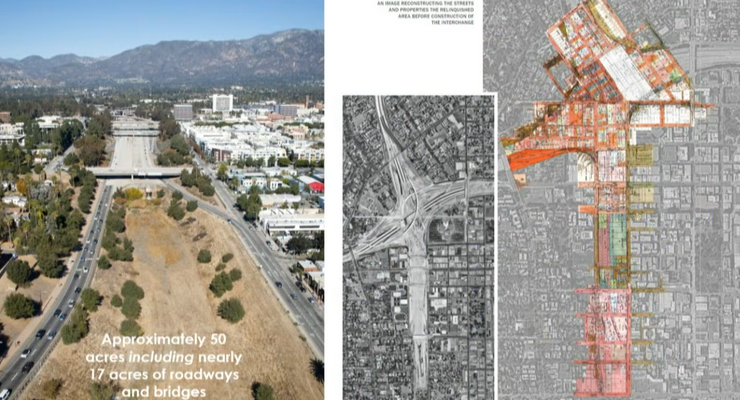
The Reconnecting Pasadena 710 Vision Plan provides a long-term, aspirational framework for redeveloping approximately 50 acres of former freeway land, focusing on reconnecting neighborhoods divided by the corridor, expanding housing, improving mobility, and advancing sustainability goals.
The plan calls for a minimum of 1,800 housing units, new street networks designed to prioritize local access over freeway traffic, and a mix of commercial uses, open space, and community-serving development. It also introduces a restorative justice framework aimed at acknowledging and addressing the displacement of primarily communities of color caused by the original freeway construction.
The City Council reviewed the plan Monday.
Concerns about traffic impacts were a recurring theme in the correspondence, with residents warning that changes to the 710 stub could worsen already strained local streets if not carefully managed.
At the same time, commenters indicated openness to multiple possibilities for the site, including parks, housing or transportation-focused solutions, as long as decisions are guided by data and public input.
The 710 stub is a partially built, never-completed section of freeway that left behind a trench-like corridor dividing neighborhoods after construction was halted decades ago. The project displaced communities and has remained a source of debate as the city considers how to reuse the land.
“The pending study and report are impressive and daunting,” wrote John Fauvre. “We must go forward on the program to stop the 710 Freeway undertaken some 60 years ago. Yet still we wonder, how long to an ending, and what price. Can you give best estimates? A long time at a high cost for construction to be recovered over decades. How should we prepare and sustain our expectations?”
The history of the corridor reflects a broader national pattern. During the mid-20th century, freeway construction across the United States often cut through Black and Latino neighborhoods, displacing families, businesses and cultural institutions in the name of urban renewal and regional mobility.
Others called for a more deliberate approach to evaluating the project’s impacts.
“All efforts must be made to determine appropriate action with regard to the issues involved with the 710 freeway stub,” wrote Thomas Dreher of Pasadena.
Dreher urged the city to fully study potential solutions before committing to a plan.
“Efforts should include all appropriate avenues of inquiry, including a publicly released traffic simulation survey, a complete CEQA environmental review … and perhaps even … improving public transportation,” he wrote.
 Get our daily Pasadena newspaper in your email box. Free.
Get all the latest Pasadena news, more than 10 fresh stories daily, 7 days a week at 7 a.m.