







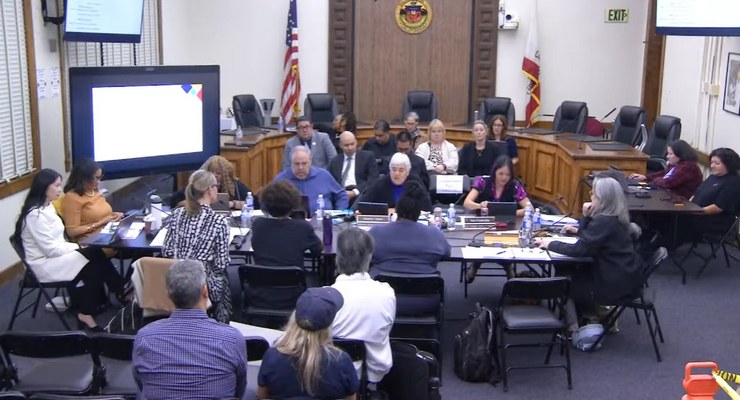
As Pasadena’s school board weighs an “existential” fiscal stabilization plan demanded by Los Angeles County education officials, a resolution before the board Thursday night lays out, in unusually blunt language, how years of declining enrollment, rising special education costs and dependence on one-time money have left the district at risk of losing control over its own budget.
Authored by Trustee Tina Fredericks, the “Review of Policy/Practices to Improve Long-Term Fiscal Solvency” resolution outlines a perspective on how Pasadena Unified has arrived at what county officials describe as a precarious financial position.
If adopted, it would commit the board to “Doing Business Differently” — capitalized and quoted throughout the document — beginning with the 2026–27 budget cycle, including pursuing new revenue and long-term planning aligned with projected enrollment losses.
The resolution documents a number of previous county warnings. It cites a Sept. 12 letter urging Pasadena to monitor enrollment and adjust staffing and facilities, and an Oct. 9 presentation where county advisers warned that “Pasadena has not yet reached a stabilization phase in its decline.” It says deficit spending since 2019 was masked by one-time COVID-19 relief and insurance funds.
The resolution invokes California Education Code section 42127.6, which allows the county to install a fiscal expert or replace the superintendent “with the goal of preventing insolvency and ensuring long-term fiscal stability.” It cites Inglewood Unified, under county control since 2012, as a cautionary example.
Enrollment has dropped from 16,000 in 2019–20 to 14,000 in 2025–26. A 2023 study by Davis Demographics & Planning, Inc., titled “Student Population Forecast for 2022/2023–2029/2030,” found Pasadena Unified is educating fewer than half the school-age children in its boundaries, with more than 50 private and charter schools competing for students.
Transitional kindergarten enrollment is projected to grow by 20 percent annually through 2026–27, then decline.
The resolution notes that “a majority of PUSD schools have either maintained or increased enrollment but a minority… are contributing to the district’s overall declining enrollment.”
Personnel costs make up 85 to 95 percent of the budget, and special education now exceeds $50 million. County “best practices” include reviewing academic programs, “excessive special education one-on-one assignments,” business operations, and leases. HR suggestions include “golden handshakes,” tighter attendance tracking and avoiding use of one-time funds for permanent hires.
The resolution does not endorse specific moves but identifies these as “focus areas.” It directs the superintendent to include a one-time review in the December plan, with findings due by May 2026 in a “confidential Friday communique.”
 Get our daily Pasadena newspaper in your email box. Free.
Get all the latest Pasadena news, more than 10 fresh stories daily, 7 days a week at 7 a.m.