








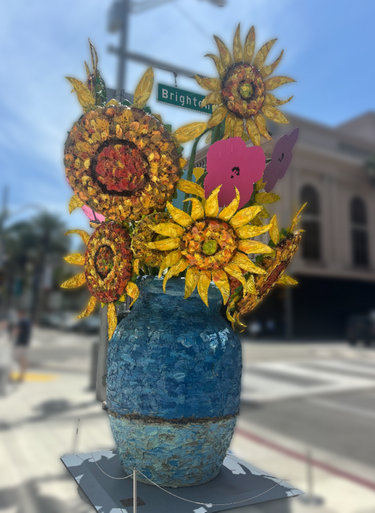
Last week, while walking through Beverly Hills, I came across a stunning oversized art installation positioned on a sidewalk corner—an enormous vase overflowing with vibrant flowers.
It was bold, joyful, and impossible to miss.
It did not sit behind gates or inside a museum. It stood directly in the path of everyday life, transforming an ordinary corner into something memorable.
I found myself smiling.
And almost immediately, I wondered:
Why couldn’t Pasadena do something like this?
I began thinking about places in Pasadena that could benefit from that same kind of imagination, and Fillmore Station came to mind.
Imagine a Metro train station that reflected the extraordinary area around it—a station that was beautiful, welcoming, and a joy to pass through. Sadly, that is not what Fillmore Station feels like today.
 The station and its surrounding public spaces are visibly in need of attention. Right beside it sits ArtCenter’s South Campus, one of the world’s leading institutions of art and design. The connection seemed obvious.
The answer is not to copy Beverly Hills. It is to ask how Pasadena might express its own identity just as boldly.
And ArtCenter is only one of the remarkable strengths surrounding Fillmore Station.
Huntington Hospital is essentially at the station. Caltech is a short bike ride away. New housing, established neighborhoods, local businesses, medicine, research, education, art, science, and regional transit all converge in this one part of Pasadena.
Yet we rarely talk about those strengths together.
What if we stopped seeing Fillmore simply as a station in need of repair and began imagining what it could become?
What if it were viewed not merely as a transit stop or a collection of development projects, but as a reflection of Pasadena’s creativity, innovation, healing, and intellectual life?
The artwork in Beverly Hills stayed with me not because Pasadena should imitate another city, but because it reminded me what beauty can do.
It can cause people to stop.
It can create memories.
It can give a place its own identity.
And it can make us imagine something better.
There was a time when Pasadena seemed to spend as much energy imagining its future as it did debating its challenges. Today, our public meetings often feel consumed by immediate conflicts and competing priorities. Those conversations are necessary, but I hope they do not crowd out the larger question of what inspires us—and what kind of city we are trying to create together.
A city does not function through isolated decisions.
Housing affects schools and the stability of neighborhoods. Schools influence where families choose to live. Beautiful public spaces support local businesses, and thriving businesses generate the sales tax that funds city services.
Public safety shapes whether people feel comfortable using parks, libraries, transit, and neighborhood commercial districts. Transportation influences housing and economic development. Historic preservation contributes to identity and tourism. Art and culture attract visitors, employers, students, and investment.
Even homelessness cannot be understood apart from mental health, addiction, housing costs, prevention, public safety, economic opportunity, and the capacity of surrounding neighborhoods and service systems.
It is all connected.
Yet too often, these subjects are discussed one agenda item at a time—one housing target, one bike lane, one budget request, one shelter proposal, one development project.
Each discussion may be necessary. But a city is not a collection of separate categories.
It is a living place, and every decision affects the whole.
Perhaps that is why the flowers affected me so deeply. They were not simply beautiful. They were a reminder that one thoughtful idea can change how people experience an entire place.
Somehow, Pasadena needs to return to that kind of thinking. The best ideas do not exist in isolation. They create ripple effects that strengthen neighborhoods, support local businesses, enrich public spaces, and inspire people to see their city differently.
Pasadena did not become extraordinary by accident.
Someone imagined the Tournament of Roses.
Someone imagined Caltech becoming one of the world’s great centers of scientific discovery.
Someone imagined The Huntington as a place where art, literature, history, and gardens could inspire generations they would never meet.
Someone imagined ArtCenter.
Someone imagined the Pasadena Playhouse.
Someone planted the trees that still define so many of Pasadena’s streets today.
Someone designed the homes and buildings that, more than a century later, still give Pasadena so much of its character.
They were not simply managing a city.
They were creating one.
I do not pretend to know exactly how Pasadena returns to that spirit of imagination. I do not have a blueprint or a master plan.
But I do know that great cities are not built by treating every issue as an isolated problem.
They are built when people understand the relationship between education and neighborhoods, art and business, public spaces and economic vitality, transit and opportunity, history and innovation.
The dots are already here—our institutions, our neighborhoods, our businesses, our parks, our artists, our scientists, our doctors and nurses, our educators, our volunteers, and our history.
What is missing is not potential.
It is the vision that connects it all.
Perhaps it is time for Pasadena to start connecting the dots again.
Erika Foy is an active Pasadena resident who lives in the Madison Heights neighborhood.
 Get our daily Pasadena newspaper in your email box. Free.
Get all the latest Pasadena news, more than 10 fresh stories daily, 7 days a week at 7 a.m.