

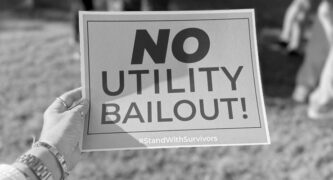

In the days since Governor Gavin Newsom and legislative leaders announced their wildfire reform rolled into 1700 pages of SB 492, a narrative has taken hold.
Fire survivors won.
I wish that were true.
There is absolutely something worth celebrating here. Fire survivors, consumer advocates, community organizations and legislators fought extraordinarily hard against a proposal that could have done profound damage to the rights of people who have already lost everything. Some of its worst provisions did not survive. But stopping something worse is not the same thing as winning.
Survivor organizations were asked Sunday to sign onto a letter taking a Neutral position on SB 492, in other words, not Oppostion, I think we need to be very clear about the distinction and why Beautiful Altadena will not be signing it.
First Things First. This Is Not An Indictator of Division in Altadena
I want to state this clearly from the outset because disagreement is too easily turned into a story about conflict. This is not a fracture among Altadena organizations or fire survivors.
For months, those of us working on these issues through an Altadena Working Group and together in Sacramento have talked constantly. We have shared information, debated strategy, challenged one another, reconsidered positions and worked through enormously complicated policy questions together. There has been tremendous transparency and more importantly, tremendous respect. Sometimes we arrive at different strategic decisions but we are not divided.
Some organizations, including our Altadena Town Council, concluded that signing the Neutral letter was the best position for them. I respect that decision, just as I know there is respect for ours. We are still working toward the same thing. Protecting fire survivors and finding pathways to rebuilding Altadena.
But Beautiful Altadena cannot be Neutral on this legislation. Explaining why requires looking past the victory narrative and asking a simple question. What did we actually win?
Altadena Was the Pawn, Hardly Even a Player, and Certainly Not the Winner
Altadena was everywhere in this fight. Our destroyed homes, our dead neighbors, our displacement and our financial devastation became part of the argument over California’s wildfire liability system. Eaton Fire survivors traveled to Sacramento. We testified. We stood at press conferences. We told our stories. We became the face of opposition to the Governor’s original proposal.
And our opposition worked. But when the deal was finished, what did Altadena actually receive?
Nothing in this bill creates accountability or even real gains. Nothing in the bill requires utilities to maintain their equipment or even remove decommissioned towers like those that ignited our fire. We still do not have the financial recovery tools we have repeatedly asked this administration to provide. We do not have transformative investment in rebuilding our town. We do not have a meaningful new recovery mechanism for our community. We’re still waiting for the Marshall Plan our Governor promised us in the days following the fire. Altadena was used to help defeat an extraordinarily bad proposal, but Altadena itself walked away essentially emptyhanded.
And perhaps nothing makes the imbalance clearer than the extraordinary financial creativity Sacramento demonstrated in this bill. California has shown that when the financial stability, nay, extraordinary profitability of an investor owned utility are at stake, it is perfectly capable of constructing complex financing mechanisms, moving billions of dollars, and rewriting the rules to make the numbers work. Yet nearly 20 months after the Eaton Fire, that same creativity and urgency have somehow not been applied to getting meaningful rebuilding dollars into Altadena. That is difficult to reconcile.
If California can engineer sophisticated financial structures to protect the viability of its investor owned utilities after catastrophic fires, surely it can exercise the same ingenuity to protect the viability of the communities those fires destroy. We have been asking for exactly that. The mechanisms exist. What has been missing is the political will to use them for us.
Stephen Sachs, Executive Director of Sustainable Community Development, an Eaton Fire survivor, government contractor, and longtime advocate for meaningful Altadena recovery funding, called the final outcome “legislative sleight of hand.”
“This bill represents a legislative sleight of hand where the utilities and insurance companies won, even though it looked like fire survivors were going to gain a victory,” Sachs said. “The reality is that fire survivors were positioned as the voice of the opposition, but in the end, we walked away with nothing.”
“The financial tools we need to rebuild our community are still not there,” he continued. “We continue to call on the Legislature and the Governor to give Altadena the tools we have been asking for to rebuild our community.”
That is the disconnect I believe is getting lost. Visibility is not victory. Altadena was paraded out as the reason something had to change, and then Altadena was sent home with nothing. That is not winning. There is a clear winner here. It’s the utilities and insurance companies that spent bullions to ensure this outcome. Again.
And Then There Is the Next Altadena
My biggest concern, however, isn’t only what this legislation failed to do for us. It is what we may have just created for everyone who comes after us.
The Fast Pay framework in the bill establishes a system for resolving claims after future utility caused wildfires outside traditional litigation. It bears troubling similarities to the direct offer process Southern California Edison is already using with Eaton Fire survivors. Faster access to money in exchange for resolving claims without pursuing them through litigation.
Anyone who has survived a catastrophic fire understands why speed is appealing. People need somewhere to live. They need to replace cars, clothing, furniture and everything else that disappeared overnight. They need to send kids to school. They need to pay rent. They need to eat. They need money.
But speed is not meaningful reform if survivors sacrifice full and fair recovery to get it. And limiting non economic damages in any way fundamentally misunderstands what catastrophic fire takes from people. The loss is not simply the replacement cost of a structure and its contents. It is trauma. Grief. Displacement. Community. History. Years of instability. In some cases, lives.
The survivors of California’s next catastrophic fire will not know the political history that produced this system. They won’t know what the Governor originally proposed. They won’t know what we fought off. They won’t know what was negotiated away. They won’t know why everyone celebrated when the agreement was announced. They will simply wake up after the worst day of their lives and discover that this is the system we left them. That weighs heavily on me.
The Devil’s Greatest Trick
There is an old line, made famous by The Usual Suspects. The devil’s greatest trick was convincing the world he didn’t exist. The devil’s greatest trick here may have been convincing everyone that fire survivors won. Start with something so extraordinarily harmful that when its worst provisions disappear, what remains suddenly feels like a victory.
Politically, it was masterful. But avoiding the worst possible outcome is not the same thing as getting a good one.
None of that diminishes the extraordinary work that stopped those provisions. Quite the opposite. We should thank the legislators who stood up and fought alongside fire survivors, including Senator Sasha Renée Pérez, who has been incredibly vocal in defending Eaton Fire survivors and Altadena throughout this fight. There are legislators who continue to fight for us behind the scenes, and their work deserves both our gratitude and our support. Thousands of survivors, advocates and community members also called, wrote, traveled, testified and refused to accept what was originally put in front of us. We fought like hell. But gratitude does not require us to frame the outcome a victory. And it certainly does not require us to be neutral about what remains.
Why Beautiful Altadena Didn’t Sign the Neutral Letter
Survivor and community organizations were asked on Sunday to sign a letter taking a Neutral (read: not Opposition) position on SB 492 while thanking legislators for their work and committing to continue the fight when Sacramento reconvenes in January. I understand the strategy. I respect the organizations—including organizations I work with here in Altadena—that believed signing was the best way to preserve relationships and position themselves for the next legislative fight.
Beautiful Altadena reached a different conclusion. There are moments when declining to take a position is itself a position. Elie Wiesel famously said, “Neutrality helps the oppressor, never the victim.” For us, this is one of those moments. We cannot spend months arguing that provisions affecting wildfire survivors are dangerous, watch a final package emerge that still gives us serious concerns about the rights and recovery of future survivors, and then attach Beautiful Altadena’s name to a document saying we are neutral.
That does not mean the organizations signing it are abandoning survivors. It means we have made different strategic judgments about what happens next.
Beautiful Altadena has also intentionally remained independent. We do not accept monetary support from a fund or operate under a fiscal sponsor. That isn’t a criticism of organizations that do. Many organizations doing extraordinarily important work depend on those structures. It is simply important to me that our ability to say something uncomfortable, unpopular or politically inconvenient never depends on who funds us, sponsors us or needs to be kept happy.
Our calculation remains simple. Is this good for survivors? By that measure, I cannot declare this a victory. And Beautiful Altadena cannot be neutral about that.
We Are Not Done
The important thing now is not to turn a strategic disagreement among organizations that have spent months fighting shoulder-to-shoulder into another distraction. We are not divided about what matters. Altadena needs to rebuild. Altadena needs money to rebuild. Eaton Fire survivors need meaningful financial recovery tools. Utilities need real accountability. And the next community devastated by a utility caused fire deserves stronger rights and better options than we had—not less.
We stopped something much worse from happening. That is an accomplishment and everyone who helped make it happen from survivors and advocates to the legislators who stood with us deserves enormous credit. But it cannot be the end of the work and it’s not the victory lap.
When the Legislature returns in January, we need to finish what this fight should have been about all along. Meaningful utility accountability, strong survivor protections, and real financial tools that allow devastated communities to rebuild.
We can disagree about the best strategy for getting there and still respect one another, work together, and fight for the same community. That is not division. That is an engaged community at work. And Altadena has already paid far too high a price for us to stop now.
Read more on the actual bill in my Beautiful Altadena Substack post on the subject here:https://beautifulaltadena.
Shawna Dawson Beer is an Eaton Fire total loss survivor and creator of Beautiful Altadena, a decade old community network connecting more than 20,000 Altadenans fire survivors and advocating on their behalf. Its platforms include the Beautiful Altadena private neighbors only group and subgroups on Facebook, a Substack publication, and After the Ashes, a podcast documenting Altadena’s recovery after the Eaton Fire from a policy perspective.
 Get our daily Pasadena newspaper in your email box. Free.
Get all the latest Pasadena news, more than 10 fresh stories daily, 7 days a week at 7 a.m.