










There is Proposition 40, the proposed one-time tax on billionaires. And then there are Propositions 41 and 42, two measures that, on the surface, sound like sensible proposals about government accountability, audits, taxes and protecting Californians’ retirement savings. But look beneath the ballot titles.
If you support Proposition 40, you need to understand that voting Yes on 41 or Yes on 42 could effectively cancel the very tax you just voted to approve.
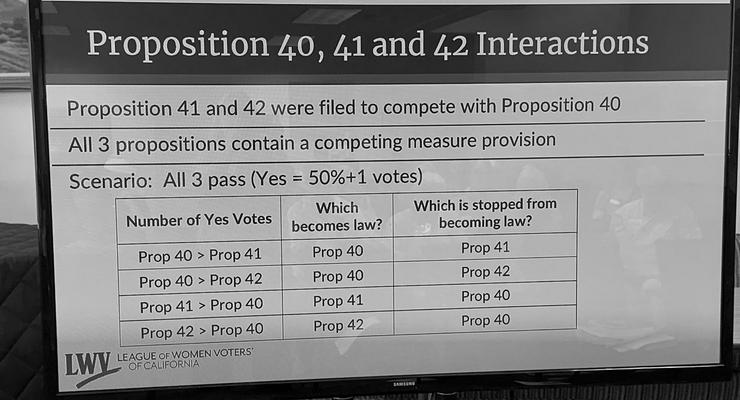
That is not speculation. The California Secretary of State’s official voter guide says that both 41 and 42 contain provisions making conflicting measures on the same ballot void if they receive more affirmative votes. The Legislative Analyst’s Office likewise says Proposition 41 could prevent Proposition 40 from becoming law, while Proposition 42 could nullify it because of the two measures’ conflicting provisions. So, California voters need to look beyond the reassuring names and ballot language. Here’s some of what I learned from a presentation by League of Women Voters, Marilynne Wilander, sponsored by the Social Justice Ministry of First United Methodist Church of Pasadena:
The three propositions, and how they collide
Proposition 40 would impose a one-time tax of up to 5% on certain taxpayers with more than $1 billion in covered assets. Ninety percent of the resulting revenue would go to health care and 10% to food assistance or education-related programs. The Legislative Analyst estimates that the measure could generate tens of billions of dollars in temporary revenue over several years. Proposition 40 specifically exempts its revenue from California’s constitutional spending limit.
That is important because Proposition 41 is designed to prohibit new state taxes from receiving that kind of exemption. Proposition 41 is marketed as a measure about transparency and accountability. It would require audits of programs funded by new special taxes and would change how new state taxes interact with California’s spending limit. Those provisions may sound reasonable. Who doesn’t want government programs audited and taxpayer dollars scrutinized? But Proposition 41 also says that taxes enacted after January 1, 2026 that exempt their revenue from the state’s spending limit would be nullified.
That directly conflicts with Proposition 40. The state’s official voter guide explicitly says Proposition 41 would nullify state taxes enacted after January 1, 2026 that exempt their revenues from the voter-approved spending limit. In other words, a voter could read Proposition 41, think, “Of course I want government programs audited,” vote Yes, and inadvertently cast a vote that helps kill the billionaire tax.
Then there is Proposition 42
Proposition 42 may be even easier to misunderstand. Its campaign presents it as a measure to protect retirement accounts, personal savings and property from new taxes. That sounds reassuring. But the actual language is much broader. Proposition 42 would prohibit new state taxes on personal property, including financial assets, business interests and intellectual property. It would also prohibit certain taxes based on activities or circumstances that occurred before a tax’s effective date. Those restrictions directly collide with Proposition 40, which taxes certain forms of wealth held by billionaires. California’s official voter guide makes the consequence clear: a Yes vote on 42 would prevent the state from establishing new taxes on financial assets or other personal property. That is why Proposition 42 matters so much to anyone voting on Proposition 40.
Who is behind 41 and 42?
This is where voters should pay particularly close attention. The principal financial force behind both measures is Building a Better California, a political organization funded largely by some of California’s wealthiest technology and investment figures. According to California’s Fair Political Practices Commission, Building a Better California, has contributed approximately $58.35 million to the campaign supporting Proposition 41 and approximately $89.8 million to the campaign supporting Proposition 42. Its major donors include Google co-founder Sergey Brin and venture capitalist John Doerr. Building a Better California itself openly says it supports No on Proposition 40, Yes on Proposition 41 and Yes on Proposition 42.
That doesn’t mean every organization or individual supporting 41 or 42 shares the same motivation. The official voter guide lists legitimate organizations supporting each measure. For Proposition 41, supporters include the California Society of Certified Public Accountants, CalAsian Chamber of Commerce and California Taxpayers Association. For Proposition 42, supporters include the California Professional Firefighters, State Building and Construction Trades Council of California and AMVETS Department of California. Those groups may have their own reasons for supporting the measures.
But voters should also know who is paying for the campaigns. And the financial connection is difficult to miss: the same billionaire-backed political organization opposing Proposition 40 is spending tens of millions of dollars to pass both measures that can nullify it.
Why the polling should concern anyone who supports Proposition 40
The latest Public Policy Institute of California poll illustrates exactly how effective the ballot language can be at creating confusion. Among likely voters surveyed September 4–10, 52% supported Proposition 40.
But at the same time, 51% supported Proposition 41 and 54% supported Proposition 42. That is an extraordinary disconnect.
How can voters simultaneously support a billionaire tax and measures that can prevent that billionaire tax from taking effect? Part of the answer may be that voters are not being asked a simple question. They are being asked three questions that sound very different:
- Do you support taxing billionaires?
- Do you support government accountability and audits?
- Do you support protecting retirement savings and personal property from new taxes?
Most Californians can see why someone might answer Yes to all three. But these are not three independent choices. They are legally connected. Voters may not realize that Propositions 41 and 42 are direct countermeasures to Proposition 40.
Look past the labels
This is why voters need to read what the propositions actually do rather than relying on their titles.
Proposition 41 is not simply an “audit” proposition.
Proposition 42 is not simply a “protect your retirement savings” proposition.
Both contain provisions that can prevent Proposition 40 from taking effect.
And Proposition 42’s campaign rhetoric about protecting ordinary Californians’ retirement accounts deserves particular scrutiny. Proposition 40 itself does not impose a tax on the retirement savings of ordinary Californians. Even for billionaires, pensions and many retirement accounts are excluded from Proposition 40’s covered assets, with specific exceptions.
That distinction matters. A proposition can have an appealing title and contain provisions that sound broadly protective while simultaneously accomplishing something very specific: blocking the billionaire tax.
One vote cannot be separated from the others
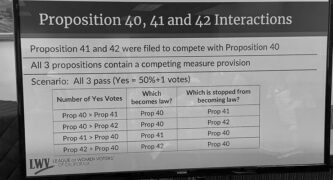
This is perhaps the most important thing for voters to understand: If Proposition 40 receives more Yes votes than both 41 and 42, the wealth tax can take effect. But if Proposition 41 receives more Yes votes than Proposition 40, 41 can nullify the wealth tax. And if Proposition 42 receives more Yes votes than Proposition 40, 42 can nullify it as well.
That means someone who genuinely wants Proposition 40 can vote Yes on 40 and unintentionally vote for its defeat by voting Yes on 41 or 42.
The ballot is giving voters an opportunity to make their wishes clear, but only if they understand the connection. And what about the concerns? Opponents argue that billionaires will flee California, investment will suffer, the tax is unconstitutional or retroactive, or that ordinary Californians could eventually be taxed. The evidence and the measure itself tell a more complicated story. Proposition 40 applies to people who were California residents on January 1, 2026, so moving afterward does not erase the tax obligation; California’s Legislative Analyst estimates the measure would generate tens of billions of dollars, while any resulting annual loss of billionaire income-tax revenue would likely be less than $1 billion. The tax is one-time and limited to billionaires, and the measure generally excludes real estate, pensions and retirement accounts. Billionaires with largely illiquid wealth can also spread payments over five years, with provisions allowing deferral in certain circumstances. And while critics warn of economic harm, the Institute on Taxation and Economic Policy and other economists argue that the evidence does not support the claim that a one-time tax on the nation’s wealthiest residents would cripple California’s investment economy. These are legitimate questions worth examining, but they should be weighed against what Proposition 40 actually says, rather than against worst-case scenarios presented by its opponents.
So, if your position is that California should impose the one-time billionaire tax in Proposition 40, don’t let a proposition about “government accountability” or “protecting retirement savings” obscure what Propositions 41 and 42 could actually do to your vote.
Read the fine print and follow the money.
And most importantly, understand that on this ballot, 40, 41 and 42 are not three separate stories. They are three parts of the same fight.
For more information:
Public Policy Institute of California:
Pasadena League of Women Voters:
https://www.lwv.org/local-
 Get our daily Pasadena newspaper in your email box. Free.
Get all the latest Pasadena news, more than 10 fresh stories daily, 7 days a week at 7 a.m.