







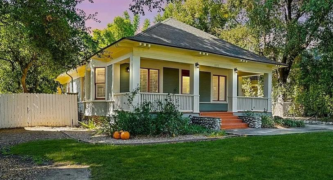

A Victorian-era bay window that has graced a North Marengo Avenue home since 1897 may soon disappear.
The Historic Preservation Commission will tour 1091 N. Marengo Ave. on Tuesday at 4:45 p.m. Following the tour, the seven commissioners will then decide the fate of the 128-year-old cottage’s original feature.
The property owners want to build a 245-square-foot addition on the home’s south side. Their plans call for removing the three-sided bay window to make room for new living space.
The Department of Planning and Community Development recommends rejecting that approach.
Planning officials want the addition pushed farther back from the house’s front. That would save the bay window, which they call a “character-defining original” feature of the vernacular hipped cottage.
The one-story home sits in the designated Garfield Heights Landmark District. It contributes to the historic neighborhood’s architectural significance.
The house displays a steeply-pitched bell-shaped roof with deep boxed eaves. Lap siding with rounded edges wraps the exterior. An Arroyo stone foundation anchors the structure.
Wood double-hung windows line all visible walls. A full-width recessed front porch spans the facade, supported by square wood posts.
The addition would use cedar bevel siding and wood windows. Stone veneer would cover the exposed foundation. Its roofline would sit lower than the existing roof but maintain a similar hipped shape.
Planning staff have proposed five conditions if commissioners approve the project. These include submitting stone veneer samples and simplifying decorative roof elements to better distinguish new from old.
The applicants explored other locations for the addition, according to documents submitted to the city. They provided a narrative explaining their design choices.
The public hearing begins at 6 p.m. in City Hall’s Grand Conference Room. The commission will hear from the applicants and any members of the public before voting.
The house received no protected trees designation under the city’s tree protection ordinance. No native, specimen or landmark trees would be removed.
City planners determined the project qualifies as categorically exempt from environmental review under state law. The exemption covers alterations to existing single-family dwellings.
The owners also plan an accessory dwelling unit behind the existing garage. State law exempts ADUs from discretionary review, so commissioners will not consider that element.
 Get our daily Pasadena newspaper in your email box. Free.
Get all the latest Pasadena news, more than 10 fresh stories daily, 7 days a week at 7 a.m.